
NSF NEON, Operated by Battelle

Main navigation

  • About
    • NEON Overview
      • Vision and Management
      • Spatial and Temporal Design
      • History
    • About the NEON Biorepository
      • ASU Biorepository Staff
      • Contact the NEON Biorepository
    • Observatory Blog
    • Newsletters
    • Staff
    • FAQ
    • Contact Us

    About

  • Data
    • Data Portal
      • Data Availability Charts
      • API & GraphQL
      • Prototype Data
      • Externally Hosted Data
    • Data Collection Methods
      • Airborne Observation Platform (AOP)
      • Instrument System (IS)
        • Instrumented Collection Types
        • Aquatic Instrument System (AIS)
        • Terrestrial Instrument System (TIS)
      • Observational System (OS)
        • Observation Types
        • Observational Sampling Design
        • Sampling Schedules
        • Taxonomic Lists Used by Field Staff
        • Optimizing the Observational Sampling Designs
      • Protocols & Standardized Methods
    • Getting Started with NEON Data
      • neonUtilities for R and Python
      • Learning Hub
      • Code Hub
    • Using Data
      • Data Formats and Conventions
      • Released, Provisional, and Revised Data
      • Data Product Bundles
      • Usage Policies
      • Acknowledging and Citing NEON
      • Publishing Research Outputs
    • Data Notifications
    • NEON Data Management
      • Data Availability
      • Data Processing
      • Data Quality

    Data

  • Samples & Specimens
    • Biorepository Sample Portal at ASU
    • About Samples
      • Sample Types
      • Sample Repositories
      • Megapit and Distributed Initial Characterization Soil Archives
    • Finding and Accessing Sample Data
      • Species Checklists
      • Sample Explorer - Relationships and Data
      • Biorepository API
    • Requesting and Using Samples
      • Loans & Archival Requests
      • Usage Policies

    Samples & Specimens

  • Field Sites
    • Field Site Map and Info
    • Spatial Layers & Printable Maps

    Field Sites

  • Resources
    • Getting Started with NEON Data
    • Research Support Services
      • Field Site Coordination
      • Letters of Support
      • Mobile Deployment Platforms
      • Permits and Permissions
      • AOP Flight Campaigns
      • Research Support FAQs
      • Research Support Projects
    • Code Hub
      • neonUtilities for R and Python
      • Code Resources Guidelines
      • Code Resources Submission
      • NEON's GitHub Organization Homepage
    • Learning Hub
      • Tutorials
      • Workshops & Courses
      • Science Videos
      • Teaching Modules
    • Science Seminars and Data Skills Webinars
    • Document Library
    • Funding Opportunities

    Resources

  • Impact
    • Research Highlights
    • Papers & Publications
    • NEON in the News

    Impact

  • Get Involved
    • Upcoming Events
    • Research and Collaborations
      • Environmental Data Science Innovation and Inclusion Lab
      • Collaboration with DOE BER User Facilities and Programs
      • EFI-NEON Ecological Forecasting Challenge
      • NEON Great Lakes User Group
      • NCAR-NEON-Community Collaborations
    • Advisory Groups
      • Science, Technology & Education Advisory Committee
      • Technical Working Groups
    • NEON Ambassador Program
      • Exploring NEON-Derived Data Products Workshop Series
    • Partnerships
    • Community Engagement
    • Work Opportunities

    Get Involved

  • My Account
  • Search

Search

About

  • NEON Overview
  • About the NEON Biorepository
  • Observatory Blog
  • Newsletters
  • Staff
  • FAQ
  • Contact Us

Breadcrumb

  1. About
  2. Observatory Blog
  3. Domain Digest No. 11: How NEON Beat the Summer Heat

Domain Digest No. 11: How NEON Beat the Summer Heat

October 14, 2024
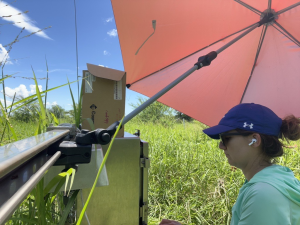
Maria Beltrocco troubleshoots comms at Lajas Experimental Station (LAJA) in Puerto Rico.

Summer 2024 was the fourth-hottest on record for the U.S. and hottest on record for the Northern Hemisphere as a whole. Across the Observatory, many NEON field sites experienced extended bouts of extreme heat and some record-breaking temperatures. When temperatures rise, field staff safety is a priority.

The summer was notable for persistently high temperatures in many regions. A heat dome over the Southwest kept the thermometer over 110°F (43°C) in some areas for several weeks in July and August. Texas saw one of its hottest summers on record, with some areas seeing temperatures well over 100°F. In the Mid-Atlantic, daily temperatures reached the high 90s to 100°F, coupled with high humidity. In the Great Lakes region, above-average temperatures were recorded alongside high humidity, which elevated heat index levels. Northern Alaska also experienced higher-than-normal temperatures. Across NEON, many Domains and individual field sites experienced one of their top five warmest summers to date. These extreme conditions create safety risks and operational challenges for NEON field staff working outdoors. Exposure to prolonged heat and high humidity makes regular hydration and shade breaks essential.

To address these challenges, NEON field staff adjusted schedules and took precautionary measures to keep cool. Along the way, they also managed to have some summer fun! Chau Tran, the Field Science Lead for the NEON program, says, "We take the safety of field staff very seriously across NEON Domains, and that includes dealing with the day-to-day natural elements. It was a brutally hot summer. I appreciate the safety measures our field teams take to remain safe: monitoring environmental conditions as well as their coworker status throughout the day, shifting work to the earliest part of the day, increasing hydration and rest periods in the shade, and stopping work if unsafe."

Domain 02 – Mid-Atlantic
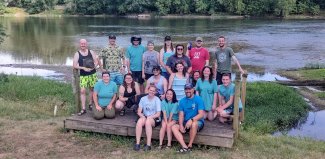
Domain 02 staff

Domain 02 found a way to beat the heat with swimming and a cookout at the Shenandoah River in Virginia.
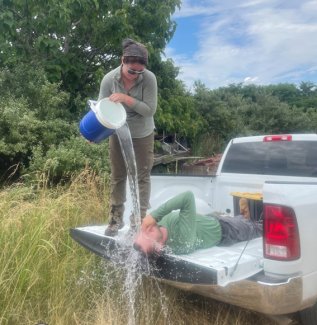
Mackenzie Dickson dumps a cooler of water on Carl Malinsky after a hot day of plant diversity at Smithsonian Conservation Biology Institute (SCBI) in Virginia.
Mackenzie Dickson dumps a cooler of water on Carl Malinsky after a hot day of plant diversity at Smithsonian Conservation Biology Institute (SCBI) in Virginia.

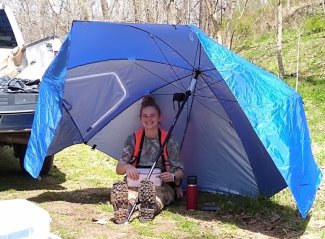
Becca Arnold takes a break for lunch under a large field umbrella at the Lewis Run (LEWI) aquatic site in Virginia.
Becca Arnold takes a break for lunch under a large field umbrella at the Lewis Run (LEWI) aquatic site in Virginia.

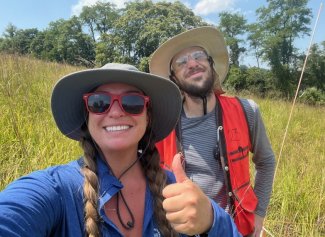
Ashley Landes and Benjamin Virnston trying to beat the heat with their field hats during plant diversity at SCBI.

Ashley Landes and Benjamin Virnston trying to beat the heat with their field hats during plant diversity at SCBI.

Domain 03 – Atlantic Southeast
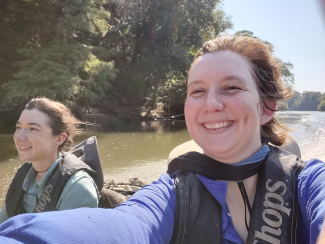
Victoria Frazier and Breeann Ortega-Roberts boating down the Flint River (FLNT) in Georgia

Victoria Frazier and Breeann Ortega-Roberts boating down the Flint River (FLNT) in Georgia. Ortega-Roberts says, “Things are so much cooler on the river. Especially when we ‘accidentally’ get water on ourselves during water sampling!”
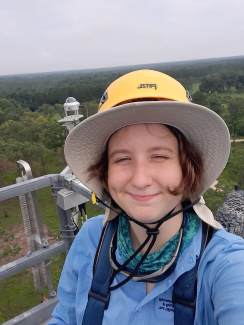
Ortega-Roberts at tower top at Jones Ecological Research Center (JERC) in Georgia

Ortega-Roberts at tower top at Jones Ecological Research Center (JERC) in Georgia. Sunhats are a crucial piece of headgear, even with climbing PPE.
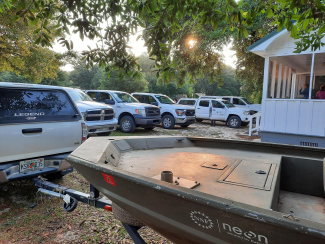
The Domain 03 trucks lined up in front of the staff house in Georgia

The Domain 03 trucks lined up in front of the staff house in Georgia, ready to roll out at sunrise so the teams can finish work before temperatures get too high.

Domain 15 – Great Basin
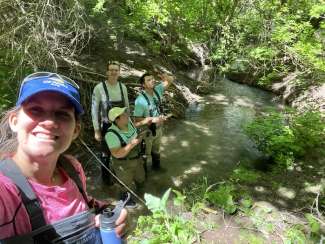
Field staff conduct a riparian assessment

Maria Viggiano Beltrocco and Ingrid Ortiz Gonzales of Domain 04 (Puerto Rico) travelled to Red Butte Creek (REDB) in Utah (Domain 15) to provide training in aquatic science protocols for new D15 staff. Here, they are conducting a riparian assessment. Shade and water helped to keep everyone cool!

D04 – Atlantic Neotropical
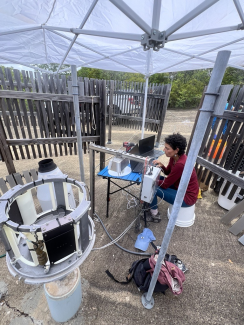
Staff calibrating an instrument

Under the shade of a tent, technician Suhey Ortiz-Rosa calibrates the Double Fence Intercomparison Reference (DFIR) at Guánica Forest (GUAN) in Puerto Rico. The DFIR is used to measure precipitation.
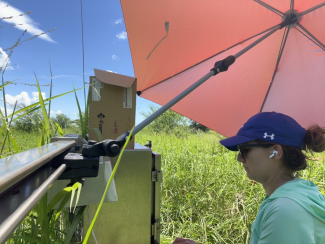
Maria Beltrocco troubleshoots comms at Lajas Experimental Station (LAJA) in Puerto Rico.

Maria Beltrocco troubleshoots comms at Lajas Experimental Station (LAJA) in Puerto Rico.

Domain 17 – Pacific Southwest
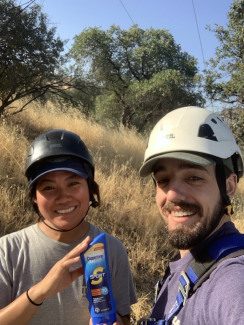
Evan Donoso and Eissas Ouk

Evan Donoso and Eissas Ouk, of Domain 20 (Hawaii), traveled to California to help with the Lower Teakettle (TEAK) sensor refresh. Ouk says, “It was a daily reminder to put on sunscreen!”
Share

Related Posts:

NEON operations coming to a close at Dead Lake, Alabama, field site

October 15, 2025

NEON Operations coming to a close at Dead Lake, Alabama, field site

October 15, 2025

Map with DELA field site marker
NSF NEON, Operated by Battelle

Follow Us:

Join Our Newsletter

Get updates on events, opportunities, and how NEON is being used today.

Subscribe Now

Footer

  • About Us
  • Contact Us
  • Terms & Conditions
  • Careers
  • Code of Conduct

Copyright © Battelle, 2026

The National Ecological Observatory Network is a major facility fully funded by the U.S. National Science Foundation.

Any opinions, findings and conclusions or recommendations expressed in this material do not necessarily reflect the views of the U.S. National Science Foundation.