
NSF NEON, Operated by Battelle

Main navigation

  • About
    • NEON Overview
      • Vision and Management
      • Spatial and Temporal Design
      • History
    • About the NEON Biorepository
      • ASU Biorepository Staff
      • Contact the NEON Biorepository
    • Observatory Blog
    • Newsletters
    • Staff
    • FAQ
    • Contact Us

    About

  • Data
    • Data Portal
      • Data Availability Charts
      • API & GraphQL
      • Prototype Data
      • Externally Hosted Data
    • Data Collection Methods
      • Airborne Observation Platform (AOP)
      • Instrument System (IS)
        • Instrumented Collection Types
        • Aquatic Instrument System (AIS)
        • Terrestrial Instrument System (TIS)
      • Observational System (OS)
        • Observation Types
        • Observational Sampling Design
        • Sampling Schedules
        • Taxonomic Lists Used by Field Staff
        • Optimizing the Observational Sampling Designs
      • Protocols & Standardized Methods
    • Getting Started with NEON Data
      • neonUtilities for R and Python
      • Learning Hub
      • Code Hub
    • Using Data
      • Data Formats and Conventions
      • Released, Provisional, and Revised Data
      • Data Product Bundles
      • Usage Policies
      • Acknowledging and Citing NEON
      • Publishing Research Outputs
    • Data Notifications
    • NEON Data Management
      • Data Availability
      • Data Processing
      • Data Quality

    Data

  • Samples & Specimens
    • Biorepository Sample Portal at ASU
    • About Samples
      • Sample Types
      • Sample Repositories
      • Megapit and Distributed Initial Characterization Soil Archives
    • Finding and Accessing Sample Data
      • Species Checklists
      • Sample Explorer - Relationships and Data
      • Biorepository API
    • Requesting and Using Samples
      • Loans & Archival Requests
      • Usage Policies

    Samples & Specimens

  • Field Sites
    • Field Site Map and Info
    • Spatial Layers & Printable Maps

    Field Sites

  • Resources
    • Getting Started with NEON Data
    • Research Support Services
      • Field Site Coordination
      • Letters of Support
      • Mobile Deployment Platforms
      • Permits and Permissions
      • AOP Flight Campaigns
      • Research Support FAQs
      • Research Support Projects
    • Code Hub
      • neonUtilities for R and Python
      • Code Resources Guidelines
      • Code Resources Submission
      • NEON's GitHub Organization Homepage
    • Learning Hub
      • Tutorials
      • Workshops & Courses
      • Science Videos
      • Teaching Modules
    • Science Seminars and Data Skills Webinars
    • Document Library
    • Funding Opportunities

    Resources

  • Impact
    • Research Highlights
    • Papers & Publications
    • NEON in the News

    Impact

  • Get Involved
    • Upcoming Events
    • Research and Collaborations
      • Environmental Data Science Innovation and Inclusion Lab
      • Collaboration with DOE BER User Facilities and Programs
      • EFI-NEON Ecological Forecasting Challenge
      • NEON Great Lakes User Group
      • NCAR-NEON-Community Collaborations
    • Advisory Groups
      • Science, Technology & Education Advisory Committee
      • Technical Working Groups
    • NEON Ambassador Program
      • Exploring NEON-Derived Data Products Workshop Series
    • Partnerships
    • Community Engagement
    • Work Opportunities

    Get Involved

  • My Account
  • Search

Search

Welcome to the updated NEON website! This site features more intuitive navigation and a seamlessly integrated Biorepository portal, making it easier to explore NEON data, samples and resources. For a brief summary of changes visit this page. Your feedback is welcome through our webform through February 20.

Breadcrumb

  1. Data Collection Methods
  2. Birds

Birds

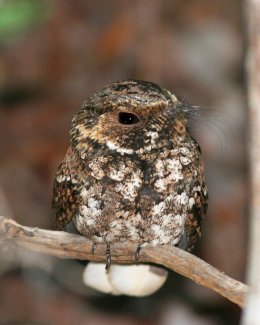
Three different birds seen at NEON sites
Photo of Puerto Rican Nightjar
An Endangered Puerto Rican Nightjar (Antrostomus noctitherus). Photo by Mike Morel of U.S. Fish and Wildlife Service Southeast Region.

Field studies of birds have played a key role throughout the history and development of both natural resource management and ecology. Breeding landbirds (i.e., birds that are diurnal and resident in or migrating through terrestrial habitats) were chosen to be a component of NEON’s suite of biodiversity measurements, because they:

  • Have proven useful in large-scale modeling of climate impacts (Stralberg et al. 2009, Tingley et al. 2012)
  • Are consumers of other NEON target taxa (i.e., insects, plants)
  • Serve as reservoirs for mosquito-borne diseases of interest to NEON (e.g., West Nile Virus; LaDeau et al. 2007, McKenzie and Goulet 2010)
  • Can be impacted by nest predation by small mammals (also a NEON target taxon; Schmidt et al. 2008)
  • Are vulnerable to changing climates (Gardali et al. 2012)
  • Respond strongly to land-use change (Luther et al. 2008, Newbold et al. 2012, Jongsomjit et al. 2012)

NEON collects observations of birds at terrestrial field sites to capture interannual variation in the abundance, diversity, and distribution of birds within each NEON domain and across the continent. The sampling protocol is focused on breeding landbirds, including songbirds and other birds that are diurnal and that reside in or migrate through terrestrial habitats during the breeding season, however, all bird species observed are recorded in the data. These open access bird data are available from the NEON data portal.
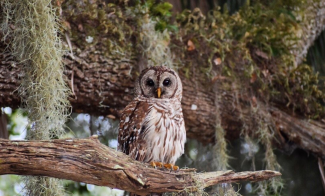
A Barred Owl (Strix varia) at the Disney Wilderness Preserve field site in Florida.

A Barred Owl (Strix varia) at the Disney Wilderness Preserve field site in Florida.

Sampling Design and Methods

Sampling locations are proportionally distributed in the dominant habitat classes of each field site to facilitate inference at the scale of the entire site. Bird Grids overlap distributed base plots to allow for comparisons between bird data and other NEON observations of plants, soils, mosquitoes, microbes, and beetles. Field scientists sample 5-15 grids at most NEON field sites depending on the geographic size of each site. Each Bird Grid is composed of nine observation points. Some smaller sites cannot accommodate a minimum of 5 grids with required spacing. At these sites, points are distributed throughout the site according to a stratified-random spatial design used for all Terrestrial Observation System sampling, maintaining a 250 m minimum separation and co-located with the NEON distributed base plots.

Collecting Bird Observations
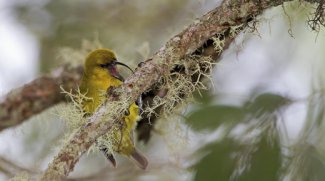
Male akiapolaau bird at PUUM

Male akiapolaau (Hemignathus munroi) bird seen at the PUUM field site in Hawaii

Point counts for birds take place during the peak of the breeding season for resident birds (exact months vary by field site). Observations occur at points near or co-located with distributed base plots, located in areas representative of vegetation cover at NEON sites.

  • Each point count lasts for six minutes following a two-minute settling-in period.
  • Sampling occurs in the early morning when birds are most active and ambient noise is at a minimum.
  • Field scientists record the species, sex, and distance from point for every bird seen or heard during the six minutes.
  • Sampling bouts occur once per season at larger field sites and twice per season at smaller sites.

Data Products

Breeding Landbird Point Counts (DP1.10003.001)

Related Content

Studying Relationships Between Forest Structure and Bird Biodiversity
NSF NEON, Operated by Battelle

Follow Us:

Join Our Newsletter

Get updates on events, opportunities, and how NEON is being used today.

Subscribe Now

Footer

  • About Us
  • Contact Us
  • Terms & Conditions
  • Careers
  • Code of Conduct

Copyright © Battelle, 2026

The National Ecological Observatory Network is a major facility fully funded by the U.S. National Science Foundation.

Any opinions, findings and conclusions or recommendations expressed in this material do not necessarily reflect the views of the U.S. National Science Foundation.