
NSF NEON, Operated by Battelle

Main navigation

  • About
    • NEON Overview
      • Vision and Management
      • Spatial and Temporal Design
      • History
    • About the NEON Biorepository
      • ASU Biorepository Staff
      • Contact the NEON Biorepository
    • Observatory Blog
    • Newsletters
    • Staff
    • FAQ
    • Contact Us

    About

  • Data
    • Data Portal
      • Data Availability Charts
      • API & GraphQL
      • Prototype Data
      • Externally Hosted Data
    • Data Collection Methods
      • Airborne Observation Platform (AOP)
      • Instrument System (IS)
        • Instrumented Collection Types
        • Aquatic Instrument System (AIS)
        • Terrestrial Instrument System (TIS)
      • Observational System (OS)
        • Observation Types
        • Observational Sampling Design
        • Sampling Schedules
        • Taxonomic Lists Used by Field Staff
        • Optimizing the Observational Sampling Designs
      • Protocols & Standardized Methods
    • Getting Started with NEON Data
      • neonUtilities for R and Python
      • Learning Hub
      • Code Hub
    • Using Data
      • Data Formats and Conventions
      • Released, Provisional, and Revised Data
      • Data Product Bundles
      • Usage Policies
      • Acknowledging and Citing NEON
      • Publishing Research Outputs
    • Data Notifications
    • NEON Data Management
      • Data Availability
      • Data Processing
      • Data Quality

    Data

  • Samples & Specimens
    • Biorepository Sample Portal at ASU
    • About Samples
      • Sample Types
      • Sample Repositories
      • Megapit and Distributed Initial Characterization Soil Archives
    • Finding and Accessing Sample Data
      • Species Checklists
      • Sample Explorer - Relationships and Data
      • Biorepository API
    • Requesting and Using Samples
      • Loans & Archival Requests
      • Usage Policies

    Samples & Specimens

  • Field Sites
    • Field Site Map and Info
    • Spatial Layers & Printable Maps

    Field Sites

  • Resources
    • Getting Started with NEON Data
    • Research Support Services
      • Field Site Coordination
      • Letters of Support
      • Mobile Deployment Platforms
      • Permits and Permissions
      • AOP Flight Campaigns
      • Research Support FAQs
      • Research Support Projects
    • Code Hub
      • neonUtilities for R and Python
      • Code Resources Guidelines
      • Code Resources Submission
      • NEON's GitHub Organization Homepage
    • Learning Hub
      • Tutorials
      • Workshops & Courses
      • Science Videos
      • Teaching Modules
    • Science Seminars and Data Skills Webinars
    • Document Library
    • Funding Opportunities

    Resources

  • Impact
    • Research Highlights
    • Papers & Publications
    • NEON in the News

    Impact

  • Get Involved
    • Upcoming Events
    • Research and Collaborations
      • Environmental Data Science Innovation and Inclusion Lab
      • Collaboration with DOE BER User Facilities and Programs
      • EFI-NEON Ecological Forecasting Challenge
      • NEON Great Lakes User Group
      • NCAR-NEON-Community Collaborations
    • Advisory Groups
      • Science, Technology & Education Advisory Committee
      • Technical Working Groups
    • NEON Ambassador Program
      • Exploring NEON-Derived Data Products Workshop Series
    • Partnerships
    • Community Engagement
    • Work Opportunities

    Get Involved

  • My Account
  • Search

Search

This website and the Biorepository Sample Portal will be updated on February 9 from approximately 8 AM - 12 PM EST. The website or some pages may be temporarily unavailable during this time. There may also be a few broken links. Thank you for your patience. We will remove this banner when the updates are complete.

Instrument System (IS)

  • Instrumented Collection Types
  • Aquatic Instrument System (AIS)
  • Terrestrial Instrument System (TIS)

Breadcrumb

  1. Data
  2. Data Collection Methods
  3. Instrument System (IS)
  4. Terrestrial Instrument System (TIS)

Terrestrial Instrument System (TIS)
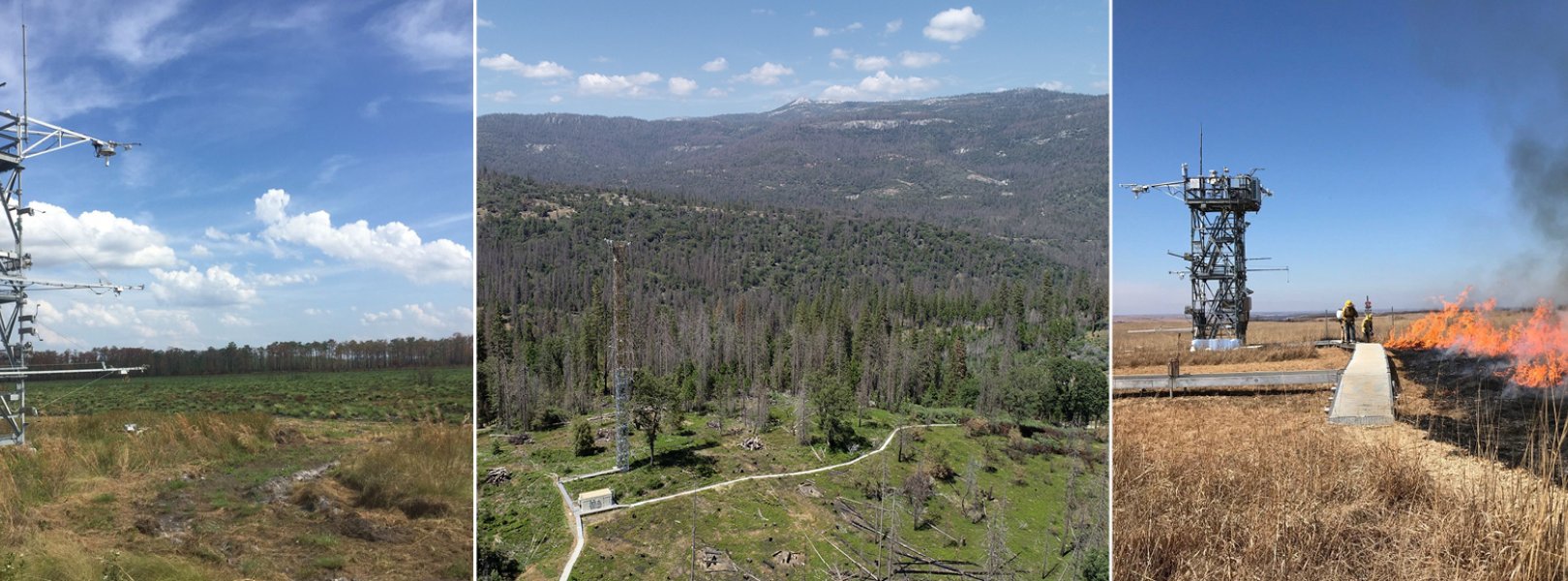
Towers at DSNY, KONZ, and SOAP

The NEON Terrestrial Instrument System (TIS) collects meteorological, soil, and phenology data at terrestrial field sites. TIS measurements are colocated and coordinated with NEON’s terrestrial observation system and airborne observation platform.

Sampling Design

At each field site, NEON collects automated instrument measurements, remote sensing data, field observations and samples in close proximity to each other and at different temporal scales. Locations of instruments and observational sampling plots are strategically placed to maximize data capture to measure the representative ecosystem of each field site. These activities allow for the quantification of ecological parameters and the detection of multi-faceted ecosystem responses to drivers of change.

Sensors & Infrastructure

Micrometeorological towers

Micrometeorological towers collect weather and climate data, including fluxes of carbon, water, and energy between terrestrial ecosystems and the atmosphere using a series of automated sensors. Towers are positioned to maximize data capture along the predominant wind direction and to measure the representative ecosystem at the site. Tower height is determined based on ecosystem characteristics, with the goal of capturing a full vertical profile of atmospheric conditions from the top of the vegetation canopy to the ground. Profile measurement levels are distributed based on the canopy structure of the site.
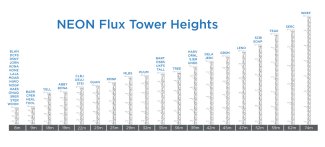
NEON Flux Tower Heights

Flux tower heights across NEON field sites

Soil sensor arrays
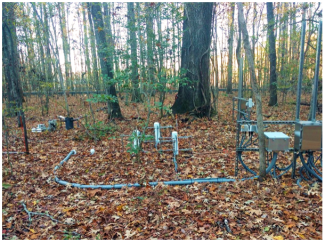
Soil sensors at the LENO field site

Layout of a sensor-based soil plot at the LENO field site (not all sensors are installed in every plot).

Each terrestrial site includes five sensor-based soil plots near the tower where a variety of soil and aboveground measurements are made. The exact layout varies from site to site, but the soil plots are typically arranged in a transect, spaced about 40 m apart, and placed in the locally dominant soil type immediately surrounding the tower. A variety of measurements are made including profiles of soil temperature and moisture below the surface and throughfall, relative humidity, and photosynthetically active radiation aboveground. A soil pit (the “Megapit”) was dug nearby to characterize the soil where the sensors are installed, inform sensor depth placement, and collect soil for archiving in the Megapit Soil Archive. 

Precipitation gauges 

Precipitation is measured near ground level using a Double Fence Intercomparison Reference (DFIR) at many sites and measured using a tipping bucket at the tower top at the remaining sites. Throughfall sensors are also placed in the soil array at most terrestrial sites (typically excluding grasslands or sites with very low canopies). 

This spreadsheet provides the quantity and type of precipitation collector(s) located at each NEON site.

Phenocams 

A phenocam is mounted at the top of each meteorological tower to capture above canopy phenology. A second camera is located near the bottom of the tower to capture below canopy phenology.

Data Collection Frequency

NEON deploys automated instruments to collect micrometeorological, soil, and phenological data at NEON field sites. Data are collected continuously to capture patterns and cycles across various time periods, ranging from seconds to years. NEON calibrates and quality checks sensors to minimize measurement errors and maximize the quality of collected data. The data collected by automated instrument systems (IS) are standardized but the systems vary slightly by field site type. Collection frequencies vary by sensor and are summarized below for aquatic and terrestrial sites.
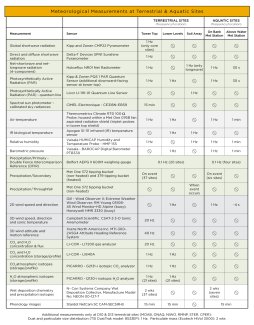
Measurements made at meteorological stations
Measurements made at meteorological stations

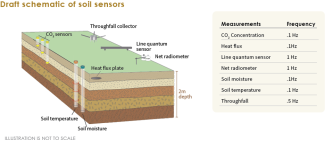
Schematic layout of a sensor-based soil plot. Note that some sensors are only present in a subset of soil plots.

Schematic layout of a sensor-based soil plot. Note that some sensors are only present in a subset of soil plots.

NSF NEON, Operated by Battelle

Follow Us:

Join Our Newsletter

Get updates on events, opportunities, and how NEON is being used today.

Subscribe Now

Footer

  • About Us
  • Newsroom
  • Contact Us
  • Terms & Conditions
  • Careers
  • Code of Conduct

Copyright © Battelle, 2026

The National Ecological Observatory Network is a major facility fully funded by the U.S. National Science Foundation.

Any opinions, findings and conclusions or recommendations expressed in this material do not necessarily reflect the views of the U.S. National Science Foundation.