
Observation Types
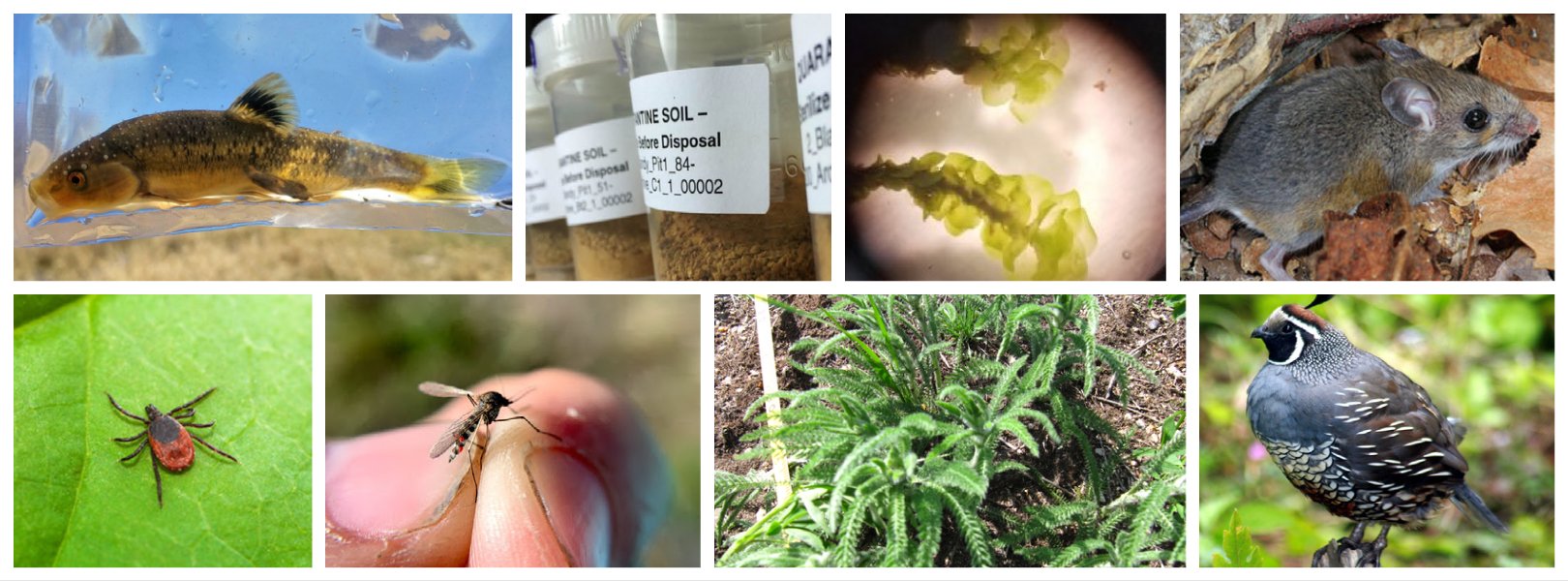
NEON collects terrestrial observations that characterize plant phenology, diversity, biomass, and productivity, as well as the abundance, diversity, phenology, and (for some groups) pathogen status of organisms including birds, small mammals, ticks, mosquitoes, ground beetles, and soil microbes. Additionally, Biogeochemical measurements are made on plants and soils, with sampling designed to complement airborne remote sensing and soil sensor data sets. Learn more about NEON's different observation types below.
Aquatic Organisms
Aquatic organismal sampling covers the common groups of taxa that make up the aquatic community of a stream, river, or lake. Changes in community dynamics, abundance, and biomass across seasons, sites, and years can be determined from these data products. Aquatic organisms are good indicators of ecosystem health and can be used to calculated biodiversity, biotic integrity, and community metrics. Aquatic sampling targets the following groups: aquatic microbes, periphyton, phytoplankton, and aquatic plants, fish, and macroinvertebrates and zooplankton.
Terrestrial Organisms
Terrestrial organismal sampling monitors sentinel taxa or groups of taxa that are widespread, capture a range of turnover times, and have diverse evolutionary histories. Changes in community dynamics of sentinel taxa may reflect the health of an ecosystem and affect ecological processes such as ecosystem structure and function and disease transmission. Terrestrial organism sampling targets the following groups: soil microbes, terrestrial plants, birds, small mammals, ticks, mosquitos, and ground beetles.
Pathogens
NEON assesses the pathogen status of a subset of collected ticks, mosquitoes and small mammals from its terrestrial field sites during observational sampling bouts. Laboratory testing is conducted to determine whether the collected organisms are carrying certain pathogens that can be transmitted to humans or livestock. Pathogen testing is specific to each organism type and targets common diseases associated with each.
DNA Sequences
During observational sampling bouts of certain organisms, NEON field ecologists select a subset of aquatic and terrestrial organisms for generation of DNA sequence data and metadata. Many of the samples are also archived in the NEON biorepository. DNA analysis serves a number of purposes, including verification of taxonomy of specimens that do not receive expert identification, clarification of the taxonomy of rare or cryptic species, characterization of diversity using molecular markers, and functional gene characterization. DNA sequences of organisms vary by site type and include the following groups: benthic, surface water, and soil microbes, macroinvertebrates and zooplankton, fish, ground beetles, mosquitoes, and small mammals.
Soils and Sediments
NEON observational soil sampling provides estimates of key soil physical, chemical, and biological properties across terrestrial sites. Observational sampling includes a suite of initial soil characterization efforts as well as periodic measurements at a variety of temporal scales. Sediment observational samples are collected at wadeable streams, non-wadeable rivers, and lakes across the NEON observatory. Sediments are analyzed for key chemical and physical properties.
Biogeochemistry
Observational biogeochemical measurements quantify the concentrations and fluxes of carbon and nutrients in various ecosystem compartments, with a focus on inputs, outputs, stocks, and select process rates. Stable isotopes are also used to understand sources and processing dynamics of water and critical elements. The NEON observational sampling system collects biogeochemical data from the following types of environments: soils and sediments, terrestrial plants, aquatic plants and algae, surface and groundwater, and atmospheric deposition.
Hydrology and Morphology
Critical physical properties of NEON aquatic ecosystems are quantified as part of the AOS system. In lakes and rivers, such measurements include secchi depth and handheld meter-based temperature profiles. In streams, discharge measurements are conducted via Acoustic Doppler Current Profiler (ADCP), wading surveys, and salt-dilution methods. In rivers, discharge measurements are conducted via ADCP surveys, where velocity profiles are collected off a piloted boat. Wading and ADCP surveys occur at each site throughout the water year across a variety of stream stages (water height) with the goal of capturing different stages to ensure a complete discharge rating curve. At stream sites, salt-based discharge measurements are conducted at the time of the reaeration protocol using simultaneous gas and conservative salt tracer injections to evaluate physical drivers of oxygen fluxes. Reaeration can be estimated using the change in downstream gas concentration normalized to conservative salt tracer concentration using the NEON data package download and an R package created and maintained on NEON's GitHub site. Stream morphology surveys are conducted at stream sites using high-resolution total station surveying equipment. Bathymetry in lakes and rivers is mapped using a side scan and dual-beam down looking sonar system. Both bathymetric and morphology data are compiled to create maps and profiles that delineate habitat distribution and physical stream features.