
Ground Beetles
Ground beetles (Carabidae) are an important family of invertebrates known to strongly influence food web structure, often as key predators or prey species. Prior studies have found that these beetles are an excellent indicator species of arthropod biodiversity and environmental change, as well as past land use and land management.
In addition to being widespread and relatively unambiguous to identify, ground beetles are also useful for assessing changes in major biological phenomena such as the species-latitudinal gradient, a trend where the number of species found increases as you move from higher latitudes (near the poles) towards lower latitudes (near the equator). Lower latitudes are resource-rich year-round and support larger populations than the colder poles; ultimately, the abundance of resources and intense competitive pressure causes speciation and leads to greater diversity in the tropics. Therefore, the distribution of beetle species across the gradient may reflect changing resources availability due to climate shifts.
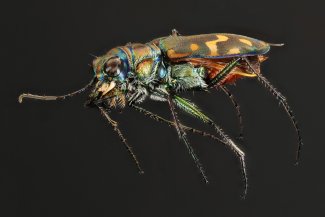
Yellowstone white tiger beetle (Cicindela haemorrhagica) - side view. Photo courtesy of NPS.
Sampling Design and Methods
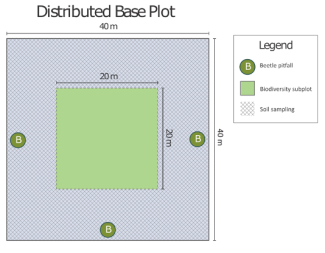
Ground beetle pitfall trap spatial design within a distributed base plot.
Ground beetle data are collected at ten distributed base plots across the greater observational sampling area of a field site. Traps are deployed in each of those plots, with traps arrayed approximately 20 meters from the center of the plot in each cardinal direction. From 2013-2017, four traps were deployed per plot (40 traps per site). In 2018, trapping was reduced to three traps per plot (30 traps per site). The total number of bouts per year varies among sites based on the seasonality of each site (average: 11 bouts per site; range: 3-19 bouts per site):
- During the time of year when carabids are active, sampling bouts occur every two weeks.
- The beetle sampling season ends when temps remain below 4°C. The next season begins when green-up and minimum ambient temperatures (average minimum temperature over the preceding 10 days exceeds 4°C) are observed.
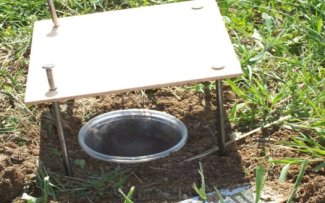
Pitfall trap used for beetle data collection
Pitfall Traps
Pitfall traps are a passive collection technique where a small cup (approximately 11 cm in diameter and 7 cm deep) is sunk into the ground with its rim flush with the soil surface. NEON pitfall traps are filled with a diluted solution of propylene glycol, a colorless and unscented preservative. Insects and other arthropods fall into the cup, suspended in the preservative until they are collected. Because propylene glycol is not an attractant, the number of ground beetles or other arthropods that fall into the trap represent a snapshot of the invertebrate community. As an additional protective measure, every pitfall trap is covered with a 20x20 cm plastic cover installed 1.5 cm above the trap entrance; the cover excludes all but the smallest vertebrates, so that samples target ground beetles and the invertebrate community.
At each terrestrial site, pitfall traps are deployed at each of ten distributed plots. Traps are in place continuously during the entire growing season and sampled (emptied and re-set) every two weeks.
Processing and Lab Analysis
Following trap collection, all beetles from the family Carabidae are sorted by NEON technicians and identified to species or morphospecies. A subset of collected Carabidae are vouchered on points or pins, while remaining specimens (non-pinned/non-pointed carabids, invertebrate bycatch, and vertebrate bycatch) are stored in 95% ethanol for archiving and may be pooled into a single archive vial per plot. Regardless of storage method, all collections data are reported at a per trap resolution. A subset of pinned ground beetles (up to 467 per site per year) are sent to an expert taxonomist for secondary identification. Expert identifications on these individuals may be used to estimate uncertainty in parataxonomist identification by NEON technicians. Some pinned specimens will be DNA barcoded and sequence data for these specimens is available on the Barcode of Life Data Systems within the ‘BETN’ project code.
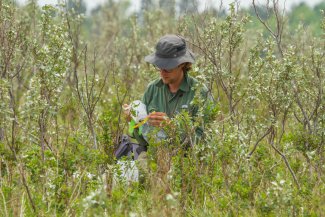
Beetle sample collection at the WOOD field site
Data Products
Taxonomically identified ground beetles and the plots and times from which they were collected:
- Ground beetles sampled from pitfall traps (DP1.10022.001)
CO1 DNA sequences from select ground beetles:
- Ground beetle sequences DNA barcode (DP1.10020.001)
Archival Samples
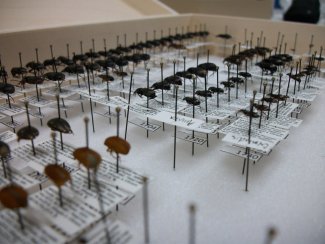
Archive of tagged and identified beetles from NEON pitfall traps.
Pitfall trapping yields a number of sample types, which are archived in a few different locations. Although the target of NEON pitfall trapping are individuals from the family Carabidae, both carabids and all bycatch from pitfall collections (mammals, herptiles, or non-carabid invertebrates) are archived.
Most of these specimens are archived at the NEON Biorepository.
| Types of Samples* | Storage Condition | Storage Container | Quantity Archived (Annually) † | Link to the Collection |
|---|---|---|---|---|
| Ground beetles (Carabidae), bulk | 95% ethanol | 50 mL vials | 600 to 3,300 pools | Carabid Collection (Archive Pooling) (NEON-CARC-AP) |
| Identified ground beetles, vouchers | dry | individuals mounted on pins or points | 12,000 to 16,000 individuals | Carabid Collection (Pinned Vouchers) (NEON-CARC-PV) |
| DNA extracts from vouchered beetles | -80 °C | 96-well plates‡ | 2,900 to 3,000 extracts | Carabid Collection (DNA Extracts) (NEON-CARC-DNA) |
| Vertebrate bycatch (mammals), bulk | 95% ethanol | 50 mL vials | 20 to 55 pools | Mammal Collection (Vouchers [Ground Beetle Sampling Bycatch Archive Pooling]) (NEON-MAMC-VGBA) |
| Vertebrate bycatch (herptiles), bulk | 95% ethanol | 50 mL vials | 330 to 530 pools | Herptile Voucher Collection (Ground Beetle Sampling Bycatch Archive Pooling) (NEON-HEVC-GBAP) |
| Invertebrate bycatch, bulk | 95% ethanol | 50 mL vials | 4,500 to 5,800 pools | Invertebrate Bycatch Collection (Archive Pooling) (NEON-IVBC-AP) |
* Select specimens collected from 2013-2017 and most specimens collected after 2018 are archived at the NEON Biorepository at Arizona State University. See table below for information about the archive locations of early (2013-2017) material.
† Quantities represented in this table are annual quantities expected from sampling conducted throughout the observatory during full Operations. Actual quantities may differ from these projections
‡ Quantities are number of samples (not number of well plates); up to 96 samples are contained on the same well plate
Some legacy material is curated at other institutions, where material was archived before the creation of the NEON Biorepository. NEON is required to continue archiving some materials (e.g., mammal specimens collected in Florida) at these institutions due to permitting requirements that specify certain material must reside in the state where it was originally collected.
| Archive Institution | Collection Years | Types of Samples | Storage Condition | Storage Container | Link to the Collection |
|---|---|---|---|---|---|
| Carnegie Museum of Natural History, Invert Zoology | 2013-2017 | Identified ground beetles, vouchers | dry | individuals mounted on pins or points | The Invertebrate Zoology Collection |
| Essig Museum of Entomology at the University of California, Berkeley | 2013-2017 | Identified ground beetles, vouchers | dry | individuals mounted on pins or points | Essig Museum of Entomology (EMEC-EMEC) |
| Monte L. Bean Life Science Museum | 2016-2017 | Vertebrate bycatch (herptiles), bulk [only specimens collected from Utah] | 95% ethanol | 50 mL vials | Monte L. Bean Life Science Museum Collections |
| Florida Museum of Natural History | 2013-ongoing | Vertebrate bycatch (mammals), bulk [only specimens collected from Florida] | 95% ethanol | 50 mL vials | Florida Museum Mammalogy Collection |