
Megapit and Distributed Initial Characterization Soil Archives
The Megapit and Distributed Initial Characterization Soil Archives provide access to archived soils collected at the time of NEON site construction. Additional archived soils from ongoing sampling activities can be requested through the NEON Biorepository.
Megapit Samples
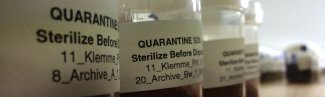
At all terrestrial sites NEON collected soil and root samples from a single, temporary soil pit called the 'megapit.' The pit location was selected to be in the locally dominant soil type surrounding the NEON tower based on available soil maps, accessible by a small excavator, and representative of the soil sensor locations. For soils, samples were collected from each horizon to characterize and archive the soil at the time of site construction. Root samples were collected by depth increment, rather than horizon, in order to quantify root biomass distribution with depth. Soil and root samples were collected to 2m at most sites because that depth range contains the vast majority of plant roots and soil organisms and is the location of most biogeochemical processes that influence, and are influenced by, the aboveground part of the ecosystem. The Megapit Soil Archive is curated at the NEON program headquarters in Boulder, CO. Air-dried soil from each horizon is archived and available for request. Root samples from the Megapit are archived and available from the NEON Biorepository.
Soil samples
Initial Characterization Soil Samples (ICS)
This archive is a joint project of Battelle/NEON and the University of Michigan. During initial operations, NEON partnered with the U.S. Department of Agriculture - Natural Resources Conservation Service (USDA-NRCS) to describe, sample, and analyze soils across NEON sites, generally to a depth of up to 1m. The central goal was the initial characterization of soils and their properties from all major soil types at each NEON site, and thus included multiple components of the NEON spatial design such as tower and distributed plots. Of the 3246 soil horizons characterized from 715 pits across 46 NEON sites, 1991 horizons from 33 sites possessed sufficient material for archiving in the University of Michigan Biological Station - Sample Archive Facility in Ehlers (UMBS-SAFE), a community-accessible soil archive established with NSF support in 2016-18. Subsamples of these well-characterized, air-dried samples are now available to researchers who complete a request and review process, described below.
List of sites with ICS archive material from at least some horizons: ABBY, BARR, BLAN, BONA, CLBJ, DCFS, DEJU, DSNY, GRSM, GUAN, HARV, HEAL, JERC, JORN, KONA, LAJA, LENO, MLBS, NIWO, ONAQ, ORNL, OSBS, PUUM, RMNP, SJER, SOAP, SRER, STEI, TALL, TOOL, TREE, WREF, YELL
List of sites with no ICS archive material: BART, CPER, DELA, KONZ, MOAB, NOGP, OAES, SCBI, SERC, STER, UKFS, UNDE, WOOD
| Megapit Soil | Initial Characterization Soil | |
|---|---|---|
| Horizons | Multiple | Multiple |
| Processing | Air-dried, mineral soil sieved to ≤ 2 mm | Air-dried, mineral soil sieved to ≤ 2 mm |
| Storage Conditions | Ambient temperature, glass jars | Dry archive, 4-20 degrees Celsius, paper cartons |
| Volume/Mass Stored | 1.2 or 3.6 kg per horizon | Varies; typically 25-100 g for O horizons; 100-400 g for mineral horizons |
| Maximum Depth | 2 m (3 m at DEJU) | Generally 1 m, but certain pits are shallower or deeper |
| Sampling Frequency per Site | Once | Once |
| Locations per Site | One | 10-26 |
Data Products
Megapit
A wide range of information about these soils is available in NEON data products, including:
- Texture, bulk density, soil pH, total carbon (C), nitrogen (N), sulfur (S) and other elements (Al, Ca, Fe, K, Mg, Mn, Na, P, Si, Sr, Ti, and Zr): Soil physical and chemical properties, Megapit (DP1.00096.001)
- Root biomass distribution: Root biomass and chemistry, Megapit (DP1.10066.001)
- Pedon description and photos
Soil samples with an “archiveID” in the “…perarchivesample…” file of the Soil physical and chemical properties, - Megapit data product are available for request. Note that the mass listed is the initial mass and is not updated as requests are fulfilled.
Distributed Initial Characterization
A wide range of information about these soils is available in a NEON data product, including:
- Texture, bulk density, soil pH, cation exchange, concentrations of carbon (C), nitrogen (N), phosphorus, sulfur (S), and extractable metals: Soil physical and chemical properties, Distributed initial characterization (DP1.10047.001)
- Site summaries and pedon descriptions
Only soil samples with an “archiveID” in the “spc_perbiogeosample" file of the Soil physical and chemical properties, distributed initial characterization data product are available for request. Please download this table before making your request to ensure archive material is available. Note that the mass listed in the archiveMass field is the initial mass and is not updated as requests are fulfilled
NRCS Mid-infrared Spectroscopy data
In addition to the NEON data products listed above, the USDA NRCS Kellogg Soil Survey Laboratory generated MIR spectra on almost all NEON Megapit and Initial Characterization Soils from the samples that were sent to generate the soil physical and chemical data products (DP1.00096.001, DP1.00097.001, DP1.10008.001, DP1.10047.001). Dataset summary:
- Focus area: MIR spectra
- Sites: All
- Horizons: All
- Project products: Contact Scarlett Murphy or Rich Ferguson, USDA NRCS Kellogg Soil Survey Laboratory, for the data