
Sediments
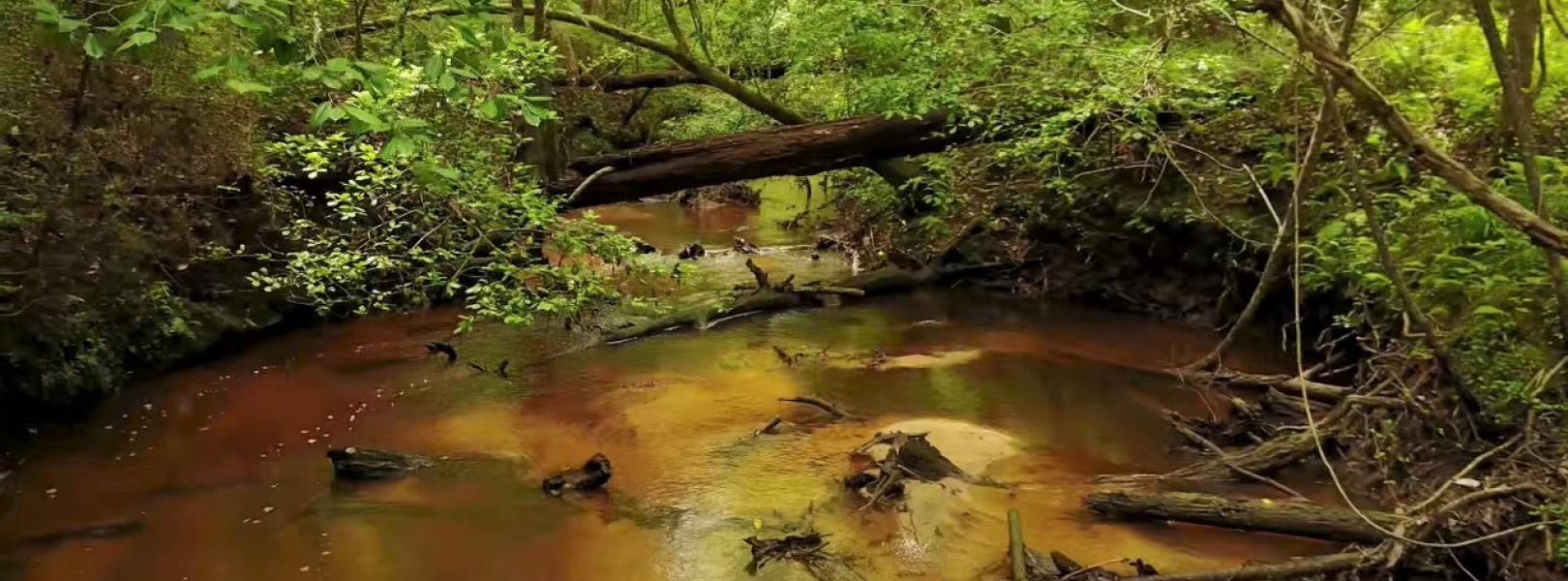
Sediment is crucial to the structure and function of aquatic ecosystems. The benthic environment is often the most biodiverse region of an aquatic ecosystem largely due to sediment providing substrate, shelter, nutrients, and energy to aquatic flora and fauna.
Sediments can be hotspots of carbon and nutrient cycling, acting as a sink when new material is deposited and a source through biogeochemical transformation or resuspension. Sediments are also considered to be one of the greatest sinks of environmental contamination. As waterways and bodies are degraded through modification and contamination, it is important to monitor changes in sediment structure and composition to conserve aquatic ecosystems.
Aquatic sediment observational samples are collected at wadeable streams, non-wadeable rivers, and lakes across the NEON Observatory by field staff using standardized collection methods. Sediments are analyzed for key chemical and physical properties.
Sampling Design and Methods
Integrated sampling designs
Sediment observational sampling at all NEON aquatic sites occurs twice a year, in the fall and spring, in close proximity to in situ aquatic instrumentation. NEON's integrated approach to aquatic sampling allows researchers to connect stream morphology and hydrology to sediment deposition or assess concentrations of nutrients, carbon, metals, and organic contaminants in sediment. Researchers can also observe relationships between the properties of most recent sediment deposition and other observational and instrumental data such as aquatic biology, surface water chemistry, and water quality.
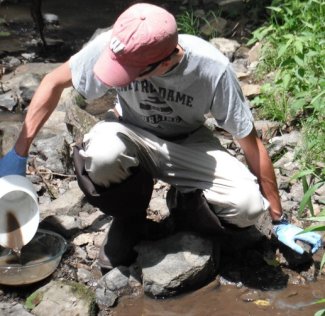
Field technician sampling stream sediments using the hand scoop
Sediment sampling in streams and rivers
At NEON aquatic sites, sediment observational samples are collected twice per year during the spring and fall aquatic biological sampling bouts. NEON sediment samples represent aggregate samples from each of two locations (termed: stations). At wadeable stream and non-wadeable river sites, the sediment sampling reach is divided at the midpoint of the biology/morphology reach into two stations stretching 500 m upstream and downstream of the midpoint.
The sediment sampling protocol for NEON stream sites requires samples to be collected using either a hand corer (deep, high-flow areas) or hand scoop (shallow, low-flow areas) from approximately five to ten depositional zones per station, with a maximum of five individual point samples collected from each depositional zone.
The sediment sampling protocol for NEON river sites requires samples to be collected using a petite ponar (a sediment sampling device) to extract sediment from the riverbed at two to five depositional zones per station.
All sediment samples, regardless of site or sampler type, are to be collected at a maximum of 3 cm deep in order to capture the most recent deposition. Sediments from all depositional zones in a station are combined and homogenized into one aggregate sample. Aggregate samples are collected in order to smooth spatial variation and be representative of reach-scale chemical and physical properties of sediment at a site.
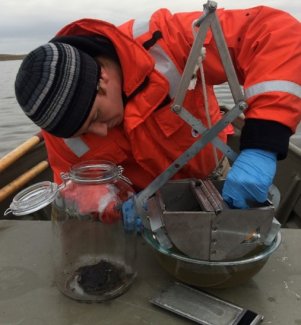
Field technician sampling lake sediments using the petite ponar
Sediment Sampling in Lakes
NEON lake sites are also sampled twice per year at two stations. The first station (station "center") is located within a 5-10 m radius of the NEON buoy anchored at the deep center point in the basin. The second station (station "inlet") is located near the inlet of the basin in close proximity to NEON in situ aquatic instrumentation.
The center station is sampled using a petite ponar, with the aggregate sample being comprised of two to five ponar grabs collected around the NEON buoy. The inlet station is sampled no more than 10 m from the NEON infrastructure and is sampled using a hand scoop due to shallow water, the absence of flow, and the presence of rocks and roots making it hard to use the hand corer.
An aggregate sample from the inlet station is comprised of two to five scoop samples collected from across the inlet sampling zone.
Sediment Sample Processing and Analysis

Sediment sample jars
Aggregate station-level sediment samples are homogenized in the field and subsampled into separate containers for analysis of chemical and physical properties.
During the spring sediment sampling bout, sediments are subsampled for a suite of inorganic biogeochemical properties (nutrients, metals) and physical properties (sediment size, texture). During the fall sediment sampling bout, inorganic chemical properties, and physical properties are measured along with the addition of two subsamples representing a suite of organic biogeochemical properties (carbon, organic contaminants).
Samples are shipped from Domain support facilities on ice within 24 hours of collection to a private laboratory where the samples are analyzed in a state-of-the-art facility that specializes in the analysis of trace-level contamination in sediments. Details on the specific analytical methods used for different groups analytes measured in NEON sediment samples can be found here.
Sediment Substrate Characterization
In addition to analyzing sediment for chemical and physical properties, sediment is characterized by dominant substrate as part of NEON's effort to provide stream morphology survey data and maps at all NEON aquatic sites.
During geomorphology surveys at NEON stream sites, the dominant sediment type is determined at each transect throughout the length of the geomorphology reach at a site. Additionally, pebble counts are performed at each transect to determine sediment size distributions across the site.
At NEON lake and river sites, morphology surveys are conducted using hydroacoustic instruments (i.e., sonar) and reveal the dominant sediment and substrate characteristics and produces high accuracy maps showing the location and distribution of different sediment types across a site.
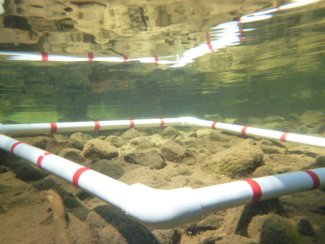
Quadrat used in pebble count assessment for sediment substrate sampling
Data Products
Basic sediments data related products include:
- Sediment chemical properties (DP1.20194.001)
- Sediment physical properties (DP1.20197.001)
Map products include:
- Stream morphology map (DP4.00131.001)
- Bathymetric and morphological maps (DP4.00132.001)