NSF NEON, Operated by Battelle

Main navigation

  • About
    • NEON Overview
      • Vision and Management
      • Spatial and Temporal Design
      • History
    • About the NEON Biorepository
      • ASU Biorepository Staff
      • Contact the NEON Biorepository
    • Observatory Blog
    • Newsletters
    • Staff
    • FAQ
    • Contact Us

    About

  • Data
    • Data Portal
      • Data Availability Charts
      • API & GraphQL
      • Prototype Data
      • Externally Hosted Data
    • Data Collection Methods
      • Airborne Observation Platform (AOP)
      • Instrument System (IS)
        • Instrumented Collection Types
        • Aquatic Instrument System (AIS)
        • Terrestrial Instrument System (TIS)
      • Observational System (OS)
        • Observation Types
        • Observational Sampling Design
        • Sampling Schedules
        • Taxonomic Lists Used by Field Staff
        • Optimizing the Observational Sampling Designs
      • Protocols & Standardized Methods
    • Getting Started with NEON Data
      • neonUtilities for R and Python
      • Learning Hub
      • Code Hub
    • Using Data
      • Data Formats and Conventions
      • Released, Provisional, and Revised Data
      • Data Product Bundles
      • Usage Policies
      • Acknowledging and Citing NEON
      • Publishing Research Outputs
    • Data Notifications
    • NEON Data Management
      • Data Availability
      • Data Processing
      • Data Quality

    Data

  • Samples & Specimens
    • Biorepository Sample Portal at ASU
    • About Samples
      • Sample Types
      • Sample Repositories
      • Megapit and Distributed Initial Characterization Soil Archives
    • Finding and Accessing Sample Data
      • Species Checklists
      • Sample Explorer - Relationships and Data
      • Biorepository API
    • Requesting and Using Samples
      • Loans & Archival Requests
      • Usage Policies

    Samples & Specimens

  • Field Sites
    • Field Site Map and Info
    • Spatial Layers & Printable Maps

    Field Sites

  • Resources
    • Getting Started with NEON Data
    • Research Support Services
      • Field Site Coordination
      • Letters of Support
      • Mobile Deployment Platforms
      • Permits and Permissions
      • AOP Flight Campaigns
      • Research Support FAQs
      • Research Support Projects
    • Code Hub
      • neonUtilities for R and Python
      • Code Resources Guidelines
      • Code Resources Submission
      • NEON's GitHub Organization Homepage
    • Learning Hub
      • Tutorials
      • Workshops & Courses
      • Science Videos
      • Teaching Modules
    • Science Seminars and Data Skills Webinars
    • Document Library
    • Funding Opportunities

    Resources

  • Impact
    • Research Highlights
    • Papers & Publications
    • NEON in the News

    Impact

  • Get Involved
    • Upcoming Events
    • Research and Collaborations
      • Environmental Data Science Innovation and Inclusion Lab
      • Collaboration with DOE BER User Facilities and Programs
      • EFI-NEON Ecological Forecasting Challenge
      • NEON Great Lakes User Group
      • NCAR-NEON-Community Collaborations
    • Advisory Groups
      • Science, Technology & Education Advisory Committee
      • Technical Working Groups
    • NEON Ambassador Program
      • Exploring NEON-Derived Data Products Workshop Series
    • Partnerships
    • Community Engagement
    • Work Opportunities

    Get Involved

  • My Account
  • Search

Search

About

  • NEON Overview
  • About the NEON Biorepository
  • Observatory Blog
  • Newsletters
  • Staff
  • FAQ
  • Contact Us

Breadcrumb

  1. About
  2. Observatory Blog
  3. Neon the sled puppy: how a washed out road led to a new friendship

Neon the sled puppy: how a washed out road led to a new friendship

May 26, 2015
Early this spring, NEON construction manager Frank Ginnie found himself at a crossroads. Well, actually, it was a washed-out road, but it was a pivotal point for Frank: He was tasked with initiating construction at NEON’s Delta Junction site in Alaska (Domain 19) and needed to find an alternate way to access the site.

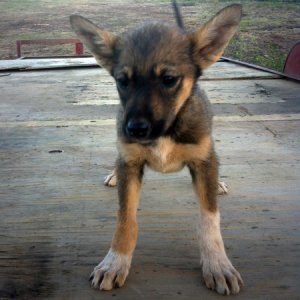
Fortunately, the family living adjacent to Delta Junction encouraged Frank and other NEON staff to access the trailhead leading to the site from their driveway. Frank has since developed a friendship with the family – John Schandelmeier, Zoya DeNure, their two daughters, one horse and 44 sled dogs, including Neon, an Alaskan Husky puppy.

Neon: sled dog in-training

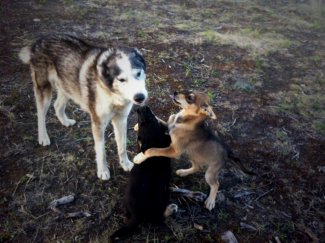
John and Zoya recently named one of their sled puppy Neon in honor of their newfound friendship with Frank and other NEON staff. Neon is almost three months old and the family has big plans for him. This adorable puppy has already started socialization training and will begin harness training at 6 months. As a puppy, he is known for his big ears and affable, adventurous personality. He usually leads the pack on daily walks and is sometimes referred to as “Chewy” because he has an affinity for chewing shoelaces.
John & Zoya: advocating for the humane treatment of sled dogs

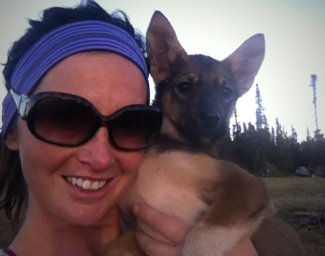
John and Zoya are both professional dog sled racers, or mushers. While the practice of using dogs to pull sleds dates back to 2,000 B.C., the modern sport of mushing is notorious for its intense and physically challenging races, often taking dogs and mushers through blizzards, whiteouts and other extreme weather events.  John ran the Iditarod Trail Sled Dog Race in the 1980s and has raced the 1,000 mile Yukon Quest 19 times, winning it twice and always placing in the top 10. Zoya is a true Renaissance woman – yoga teacher, musher and former model - who raced the Iditarod in 2008, among many other races. As advocates for the humane treatment of sled dogs, John and Zoya also rescue and rehabilitate sled dogs. While they can accommodate 60 dogs, roughly 25 of the 44 dogs currently residing with them are considered “rescues.”
A focus on socialization and positive reinforcement

Through their work with Crazy Dog Kennels, John and Zoya emphasize socialization and positive reinforcement as integral to effective and humane sled dog training. Zoya says, “Dogs are social by nature and we need to encourage that, forever.” With consistent routine, everyday chores, frequent walks, kindness and love, most rescue dogs show behavioral improvements quickly. John and Zoya often place rescue dogs in new homes or on new teams. According to Zoya, “We have had a lot of success over 12 years. We’ve rescued about 160 dogs and about 80% have been placed.” In recent years, Zoya has experienced an increase in inquiries from the international community, including mushers in Norway and Germany, regarding their methods of raising and caring for sled dogs. Learn more about Crazy Dogs Kennels.

A growing NEON community

As our community grows, we are grateful for the wonderful people who support NEON and we recognize that their graciousness is paramount to our success. 
Share

NSF NEON, Operated by Battelle

Follow Us:

Join Our Newsletter

Get updates on events, opportunities, and how NEON is being used today.

Subscribe Now

Footer

  • About Us
  • Contact Us
  • Terms & Conditions
  • Careers
  • Code of Conduct

Copyright © Battelle, 2026

The National Ecological Observatory Network is a major facility fully funded by the U.S. National Science Foundation.

Any opinions, findings and conclusions or recommendations expressed in this material do not necessarily reflect the views of the U.S. National Science Foundation.