Underground biomass: Getting to the root of it
October 29, 2013
By Jen Everhart and Julia Spencer
Adorned with sweet, bright, orange safety vests and serious hardhats--excavation tools in hand--Jen Everhart, Julia Spencer and I are ready for sampling. Our mission: to travel around the nation collecting soil samples and sieving out roots in an attempt to characterize below ground biomass. Wearing capes. (We actually don't wear capes, but I'm working on that.)
One of NEON's goals is to monitor carbon cycling at all its terrestrial sites. Gaining an enhanced understanding of the movement of carbon between the atmosphere, vegetation, and soils may help us better understand and predict ecosystem responses to changing conditions like increased carbon emissions from fossil fuel burning.
NEON is measuring forests, grasslands, and other types of biomass to account for aboveground carbon stores. Underground biomass, such as fine and coarse roots, are also an important component in the total carbon budget of an ecosystem. NEON is currently in a characterization phase in which data collected from preliminary sampling will inform sampling protocols employed throughout the 30-year lifetime of the Observatory.
That is why I recently found myself digging in North Dakota. Surrounded by beautiful, green, rolling hills flecked with sheep and cattle, Jen and I geared up to start our work.
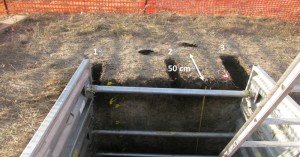
Soil corer? Check. Rubber mallets? Check. Ziplocs to hold the soil samples? Check. Soil pit cape? Check. Starting at the ground’s surface, we collected soil cores in 10cm deep increments. We had three series across the face of the pit where we collected samples, which helped account for the fact that roots are rarely distributed evenly throughout the soil.
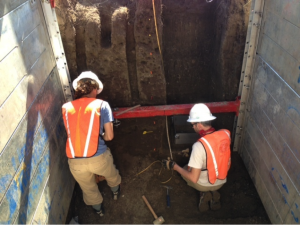
Once we sampled down to about 50 cm, we entered the belly of the beast and hopped into the pit to collect 10x10x10 cm blocks. Switching to this technique was essential because soil is harder at lower depths, and using the soil core from above risks cleaving the soil pit face. If the face cleaves in, it makes collecting subsequent samples more difficult and increases the chance of the pit face collapsing inward. For each of these samples, it is important that we know the volume of soil collected so we can later have an accurate idea of the amount of biomass per volume of soil.
Each site presents its own unique highlights and challenges. Soil pit depth drastically varies, often depending on the depth of the water table. The spacious, luxurious, and dry soil pit of North Dakota was a stark contrast to the mud pit of Alabama that covered any brave soul who wandered near it with clay goo. A water pump constantly ran so the sampling could go on! Although its name is not cheery, Dead Lake was one of my favorite soil pits. The variable nature of the sites entails different safety concerns, and we take every precaution necessary to ensure a safe working environment in and out of the soil pit.
For example, we had the opportunity to practice lightning strike drills (by sitting in our vehicles) when a fast-moving storm rolled in over the plains of North Dakota.
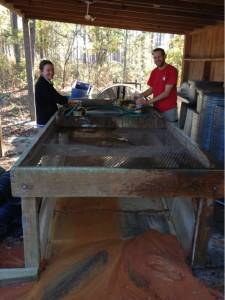
Once the samples are collected, our work is far from over! We wet sieve each sample, making sure to wash away all the soil and collect all roots longer than 1 cm. This process can be long and tedious depending on the nature of the soil – soils with a high clay content stick together and do not easily wash through the sieve, whereas sandy soils wash right through. Processing time can take anywhere from 12-40 hours total. At the end of a full day of sieving, it is likely we will dream about sieving roots that night.
We place the resulting fruits of our labor in coin envelopes corresponding to depth, and into a drying oven for 2 full days. We ship the dry roots back to NEON headquarters where we weigh them. Combined with the volume of soil that the roots came from, we can accurately determine how belowground biomass varies with depth at the site. Voilà!
Our work has taken us from the swamps of Florida to the high Rockies of Northern Colorado, and will continue into the foreseeable future since we have only completed 15 out of 60 sites. Who knows what the future holds- (besides the obvious soil pit sampling)- Bears in Alaska? Heat waves in Puerto Rico? Chiggers in the south? Rabid cows? Sasquatch sighting in the PNW? Stay tuned as our scientific adventures continue.