NEON-QUBES Faculty Mentoring Network Brings Quantitative Methods to Undergraduate Classrooms
July 5, 2018
The NSF’s National Ecological Observatory Network (NEON) and other observatory networks are bringing ecology into the era of "big data." How are undergraduate programs preparing tomorrow's scientists to use the data these programs are producing?
A new partnership between the NEON project and the Quantitative Undergraduate Biology Education and Synthesis project (QUBES) offers mentorship opportunities for undergraduate faculty and hands-on activities to help them bring real-world data into the classroom.
Bringing Data and Educators Together
The NEON Data Education Fellows Faculty Mentoring Network (FMN) is a collaborative effort between scientists from the NEON project and university faculty interested in using NEON data. It is hosted on the QUBES collaboration and education materials sharing platform. The goal is to provide undergraduate faculty with open access tools, resources and support to help them bring quantitative methods into their ecology and biology courses using NEON data.
QUBES, which is also funded by the NSF, is an educator-driven organization whose mission is to bring math and biology educators together to "share resources and methods for preparing students to use quantitative approaches to tackle real, complex, biological problems." Dr. Megan Jones, a Battelle research scientist and science educator, says that working with QUBES was a natural fit for the NEON project. "We are a data-providing organization. We want to get our data into the hands of the next generation of ecologists so they can begin using it and developing the data skills they will need to move ecology forward."
The NEON project generates a wealth of open access data that can be used to explore a broad range of ecological and biological questions. As data are collected they are cleaned and quality checked before being published to the NEON data portal. The accessibility and consistency of the data sets across the NEON field sites makes them ideal for use in undergraduate settings where students are learning quantitative methods.
Joining the Faculty Member Network
The FMN was launched in the spring semester of 2018 with 11 undergraduate faculty members participating from institutions across the country. Each semester, a new cohort of educators comes together to learn about NEON data and resources, get expert advice for introducing real-world data activities into the classroom, and support each other as they implement data-centered learning activities with their own students.
Participants are expected to attend two one-hour virtual meetings per month during the semester. They are also expected to implement at least one quantitative activity using NEON data with their students, provide feedback on materials produced by other FMN members, and contribute modifications or new content to QUBESHub, a growing database of classroom-ready quantitative lessons and resources.
The materials created for QUBESHub by FMN participants include data-centered activities designed to help students learn transferable quantitative skills while exploring relevant topics in biology and ecology. Currently available lessons leverage NEON data to study a diverse range of ecological concepts including the drivers and impacts of natural disturbance events, plant phenology, and ecosystem carbon fluxes. Other lessons focus on specific data skills such as spreadsheet management or working with R (an open-source programming language and software environment used for statistical analysis).
Activities on QUBESHub are freely available for download. As more educators participate in the FMN and submit their own lessons to the portal, its value for the science education community will continue to grow.
Educators who contribute content to QUBESHub are given authorship credit and can choose how they license their work. They are also encouraged to submit original materials created over the course of the FMN to educational journals for publication. Participants who submit original content for publication on QUBESHub or improvements for existing content are recognized as NEON Data Education Fellows.
A Peek Inside a Data-Centered Undergraduate Classroom
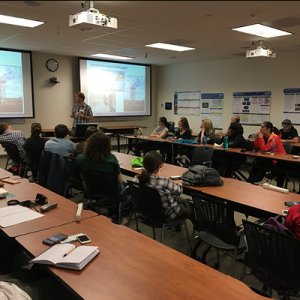
Dr. Naupaka Zimmerman, an Assistant Professor of Biology at the University of San Francisco, is one of the NEON Data Education Fellows. A participant in the Spring 2018 FMN, Dr. Zimmerman built his entire undergraduate ecology course around the use of NEON data. "Because it’s a lecture course, we have very limited ability to do field trips or labs. But I can use NEON data to turn it into an inquiry-based class for my students," he says.
For educators like Naupaka, the FMN is an opportunity to develop new data skills that they can pass on to their students and to share practical ideas with one another for lessons that incorporate quantitative methods.
Most of Naupaka's students come into his class with no prior skills in data management, quantitative analysis, or programming. By integrating activities with NEON data into each of his units, Naupaka can help his students build these critical data skills while studying big concepts in ecology. They may use the NEON small mammal dataset to study communities and populations, plant carbon-nitrogen ratios to study differences in nutrient-cycling over time, and data on insects and pathogens to study species interactions. At the end of the course, each student designs and implements a study using NEON data on a topic of their choosing.
"Students really appreciate the 'real-worldness' of using NEON data. They understand that it is real science, not just a textbook example. They are using the same tools and techniques that actual scientists are using for studies that get published," he says. Along with foundational concepts in ecology, Naupaka's students are learning to use R Markdown, ggplot, GitHub, and other data analysis and visualization tools to work with large ecological data sets.
Naupaka says that NEON data are ideal for use in the classroom because they are consistent and comparable across all of the NEON field sites and do not require extensive cleaning to be usable. In addition, he appreciates the breadth and diversity of data available, which give his students broad latitude in choosing data-centered projects aligned with their own interests.
The FMN that Naupaka participated in gave him a good foundation for using NEON data in his classroom. "It was really helpful to get the inside scoop on what data are available and what new software tools NEON has developed, like an R package for stacking data from different sites," he says. He also appreciated the opportunity to collaborate with peers from different universities. "I got to connect with educators across the country, from different types of institutions, and ask them how they handle issues that we're all struggling with [when using data in the ecology classroom]."
Preparing Tomorrow's Scientists for "Big Data" Ecology
As the NEON project and similar initiatives gain steam, ecology is becoming a more data-centric discipline. Rather than making individual observations in the field, many of tomorrow's ecologists will devote their careers to mining insights from data collected via large-scale observatory networks.
Using these data will require students to develop more extensive quantitative skills than previous generations of scientists were typically exposed to. The NEON FMN is just one way that scientists on the NEON project are helping to fill skills gaps for today's students and faculty.
In addition to hosting the FMN, the NEON project provides workshops and week-long data institutes for researchers and educators wishing to take a deeper dive into the NEON data products and tools. They have also created a series of self-paced online data tutorials for on-demand learning. The NEON Science YouTube channel is another great resource for undergraduate educators, with dozens of short explainer videos that make complex concepts accessible for students and laypeople.