NSF NEON, Operated by Battelle

Main navigation

  • About
    • NEON Overview
      • Vision and Management
      • Spatial and Temporal Design
      • History
    • About the NEON Biorepository
      • ASU Biorepository Staff
      • Contact the NEON Biorepository
    • Observatory Blog
    • Newsletters
    • Staff
    • FAQ
    • Contact Us

    About

  • Data
    • Data Portal
      • Data Availability Charts
      • API & GraphQL
      • Prototype Data
      • Externally Hosted Data
    • Data Collection Methods
      • Airborne Observation Platform (AOP)
      • Instrument System (IS)
        • Instrumented Collection Types
        • Aquatic Instrument System (AIS)
        • Terrestrial Instrument System (TIS)
      • Observational System (OS)
        • Observation Types
        • Observational Sampling Design
        • Sampling Schedules
        • Taxonomic Lists Used by Field Staff
        • Optimizing the Observational Sampling Designs
      • Protocols & Standardized Methods
    • Getting Started with NEON Data
      • neonUtilities for R and Python
      • Learning Hub
      • Code Hub
    • Using Data
      • Data Formats and Conventions
      • Released, Provisional, and Revised Data
      • Data Product Bundles
      • Usage Policies
      • Acknowledging and Citing NEON
      • Publishing Research Outputs
    • Data Notifications
    • NEON Data Management
      • Data Availability
      • Data Processing
      • Data Quality

    Data

  • Samples & Specimens
    • Biorepository Sample Portal at ASU
    • About Samples
      • Sample Types
      • Sample Repositories
      • Megapit and Distributed Initial Characterization Soil Archives
    • Finding and Accessing Sample Data
      • Species Checklists
      • Sample Explorer - Relationships and Data
      • Biorepository API
    • Requesting and Using Samples
      • Loans & Archival Requests
      • Usage Policies

    Samples & Specimens

  • Field Sites
    • Field Site Map and Info
    • Spatial Layers & Printable Maps

    Field Sites

  • Resources
    • Getting Started with NEON Data
    • Research Support Services
      • Field Site Coordination
      • Letters of Support
      • Mobile Deployment Platforms
      • Permits and Permissions
      • AOP Flight Campaigns
      • Research Support FAQs
      • Research Support Projects
    • Code Hub
      • neonUtilities for R and Python
      • Code Resources Guidelines
      • Code Resources Submission
      • NEON's GitHub Organization Homepage
    • Learning Hub
      • Tutorials
      • Workshops & Courses
      • Science Videos
      • Teaching Modules
    • Science Seminars and Data Skills Webinars
    • Document Library
    • Funding Opportunities

    Resources

  • Impact
    • Research Highlights
    • Papers & Publications
    • NEON in the News

    Impact

  • Get Involved
    • Upcoming Events
    • Research and Collaborations
      • Environmental Data Science Innovation and Inclusion Lab
      • Collaboration with DOE BER User Facilities and Programs
      • EFI-NEON Ecological Forecasting Challenge
      • NEON Great Lakes User Group
      • NCAR-NEON-Community Collaborations
    • Advisory Groups
      • Science, Technology & Education Advisory Committee
      • Technical Working Groups
    • NEON Ambassador Program
      • Exploring NEON-Derived Data Products Workshop Series
    • Partnerships
    • Community Engagement
    • Work Opportunities

    Get Involved

  • My Account
  • Search

Search

About

  • NEON Overview
  • About the NEON Biorepository
  • Observatory Blog
  • Newsletters
  • Staff
  • FAQ
  • Contact Us

Breadcrumb

  1. About
  2. Observatory Blog
  3. NEON’s Great Smoky Mountains data will capture Tennessee fire impacts on local ecology

NEON’s Great Smoky Mountains data will capture Tennessee fire impacts on local ecology

December 20, 2016
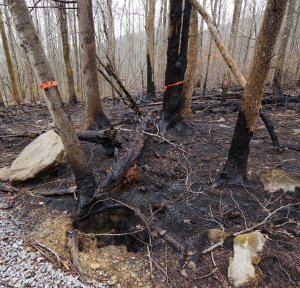
Photos of wildfire damage at GRSM. Associated article "NEON's Great Smoky Mountains Data will capture Tennessee fire impacts on local ecology"

In mid-November 2016, a forest fire started in Great Smoky Mountains National Park, sparking several wildfires that spread uncontrollably throughout the park and into the nearby town of Gatlinburg. The Chimney Top 2 fire caused major destruction that included homes and businesses as well as fatalities and injuries. Over 10,000 acres of Great Smoky Mountains National Park burned including the area in which two NEON field sites are located.
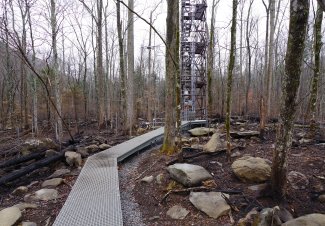
Fire damage from Tennessee Fire at GRSM

Fire damage from Tennessee Fire at GRSM

In early December, a safety team returned to both field sites -- terrestrial site Great Smoky Mountains, Twin Creeks (GRSM) and aquatic site LeConte Creek (LECO) to assess the damage. The majority of the groundcover and litterfall were completely burnt, and 6-foot scorch marks on the trees indicated that the fire burned close to the ground compared to other nearby areas of the park in which the fire crowned the trees. Miraculously, the meteorological station, surface water sensors and groundwater sensors at LeConte Creek were unscathed. Similarly, the flux tower at the Great Smoky site suffered little to no heat exposure.
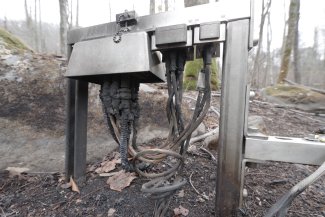
Fire damage on a soil sensor array at Great Smoky Mountains, Twin Creeks field site from the east Tennessee wildfires. Associated article "NEON's Great Smoky Mountains data will capture Tennessee fire impacts on local ecology"

Melting caused by fire damage on a soil sensor array at Great Smoky Mountains field site from the 2016 wildfires.

However, soil sensors in the ground were extensively damaged from the intense heat of the fire. From a scientific perspective, the impact around these sites may prove to be a powerful opportunity for scientific study of how ecological communities will re-establish in an area which has seen very few wildfires in the last century. NEON data can also provide unique insight into what these communities looked like before the fire.

Great Smoky data

NEON began data collection activities at LeConte and Great Smoky in 2015, when the Airborne Observation Platform (AOP) was flown over both sites collecting lidar, hyperspectral and high resolution RGB ortho-photos of the surrounding vegetation and landscape. The sites were flown again in the summer of 2016 at peak greenness. The plan is to continue flying these sites annually. Click here to request the airborne remote sensing data from these field sites. In addition, observational sampling began in 2015  at the Great Smoky site. Field scientists were able to collect two full seasons of organismal and biogeochemical data. Some automated atmospheric and aquatic sensors began to collect data only weeks before the fire began.

All the data are freely available and NEON infrastructure resources can also be made available on a cost reimbursable basis to support proposed research efforts. Please note that much of the automated sensor data and observational data collected at these two sites has not been completely processed. The data should become available in the next year via the data portal. 

Using NEON for long-term investigations of ecological change

Several years ago, in the wake of the High Park, CO wildfire of 2012, researchers from Colorado State University received an NSF RAPID Grant to collaborate with NEON to fly the AOP over the 87,000 acre burn area for a multi-year investigation. This use of NEON resources illustrates how the NEON research platform may be used to support long-term investigations of ecological change. Fast forwarding to today, we plan to get our Great Smoky field sites up and running as soon as possible so that we may continue to collect data via automated sensors, observational sampling and airborne remote sensing sampling. In addition, we have recently formalized a process for investigators to request observatory assets like the AOP to support research investigations. Learn more about the Assignable Assets program.

Community impacts

NEON field sites are managed by Battelle in collaboration with site hosts that grant us permission to construct and monitor instrumentation as well as conduct observational sampling on their land. Day-to-day, our dedicated field staff and related site host staff often come across dangerous situations from extreme weather to dangerous animals. And then there are major and unexpected risks such as wildfires and floods. Our thoughts and condolences go out to the families in the Great Smoky area, like our site hosts, who were greatly impacted by the Tennessee wildfires. We greatly value the partnership we have with Great Smoky Mountains National Park. It is our hope that the long-term data collected by observation systems like NEON will be used to mitigate wildfire impacts on both the ecosystems around us and the communities where we live. If you are interested in contributing to relief efforts for the families and businesses of Gatlinburg, here is some information.

Share

Related Posts:

Unlocking the Secrets of Soil Microbial Metabolites

February 2, 2026

Petri dishes of bacteria cultures

Discontinuation of Select NEON Data Products

January 29, 2026

Modification of Select NEON Data Products

January 29, 2026

NSF NEON, Operated by Battelle

Follow Us:

Join Our Newsletter

Get updates on events, opportunities, and how NEON is being used today.

Subscribe Now

Footer

  • About Us
  • Contact Us
  • Terms & Conditions
  • Careers
  • Code of Conduct

Copyright © Battelle, 2026

The National Ecological Observatory Network is a major facility fully funded by the U.S. National Science Foundation.

Any opinions, findings and conclusions or recommendations expressed in this material do not necessarily reflect the views of the U.S. National Science Foundation.