
NSF NEON, Operated by Battelle

Main navigation

  • About
    • NEON Overview
      • Vision and Management
      • Spatial and Temporal Design
      • History
    • About the NEON Biorepository
      • ASU Biorepository Staff
      • Contact the NEON Biorepository
    • Observatory Blog
    • Newsletters
    • Staff
    • FAQ
    • Contact Us

    About

  • Data
    • Data Portal
      • Data Availability Charts
      • API & GraphQL
      • Prototype Data
      • Externally Hosted Data
    • Data Collection Methods
      • Airborne Observation Platform (AOP)
      • Instrument System (IS)
        • Instrumented Collection Types
        • Aquatic Instrument System (AIS)
        • Terrestrial Instrument System (TIS)
      • Observational System (OS)
        • Observation Types
        • Observational Sampling Design
        • Sampling Schedules
        • Taxonomic Lists Used by Field Staff
        • Optimizing the Observational Sampling Designs
      • Protocols & Standardized Methods
    • Getting Started with NEON Data
      • neonUtilities for R and Python
      • Learning Hub
      • Code Hub
    • Using Data
      • Data Formats and Conventions
      • Released, Provisional, and Revised Data
      • Data Product Bundles
      • Usage Policies
      • Acknowledging and Citing NEON
      • Publishing Research Outputs
    • Data Notifications
    • NEON Data Management
      • Data Availability
      • Data Processing
      • Data Quality

    Data

  • Samples & Specimens
    • Biorepository Sample Portal at ASU
    • About Samples
      • Sample Types
      • Sample Repositories
      • Megapit and Distributed Initial Characterization Soil Archives
    • Finding and Accessing Sample Data
      • Species Checklists
      • Sample Explorer - Relationships and Data
      • Biorepository API
    • Requesting and Using Samples
      • Loans & Archival Requests
      • Usage Policies

    Samples & Specimens

  • Field Sites
    • Field Site Map and Info
    • Spatial Layers & Printable Maps

    Field Sites

  • Resources
    • Getting Started with NEON Data
    • Research Support Services
      • Field Site Coordination
      • Letters of Support
      • Mobile Deployment Platforms
      • Permits and Permissions
      • AOP Flight Campaigns
      • Research Support FAQs
      • Research Support Projects
    • Code Hub
      • neonUtilities for R and Python
      • Code Resources Guidelines
      • Code Resources Submission
      • NEON's GitHub Organization Homepage
    • Learning Hub
      • Tutorials
      • Workshops & Courses
      • Science Videos
      • Teaching Modules
    • Science Seminars and Data Skills Webinars
    • Document Library
    • Funding Opportunities

    Resources

  • Impact
    • Research Highlights
    • Papers & Publications
    • NEON in the News

    Impact

  • Get Involved
    • Upcoming Events
    • Research and Collaborations
      • Environmental Data Science Innovation and Inclusion Lab
      • Collaboration with DOE BER User Facilities and Programs
      • EFI-NEON Ecological Forecasting Challenge
      • NEON Great Lakes User Group
      • NCAR-NEON-Community Collaborations
    • Advisory Groups
      • Science, Technology & Education Advisory Committee
      • Technical Working Groups
    • NEON Ambassador Program
      • Exploring NEON-Derived Data Products Workshop Series
    • Partnerships
    • Community Engagement
    • Work Opportunities

    Get Involved

  • My Account
  • Search

Search

About

  • NEON Overview
  • About the NEON Biorepository
  • Observatory Blog
  • Newsletters
  • Staff
  • FAQ
  • Contact Us

Breadcrumb

  1. About
  2. Observatory Blog
  3. AOP crew takes flight with new LiDAR system

AOP crew takes flight with new LiDAR system

March 17, 2015
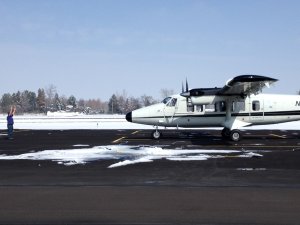
Twin Otter arrival at KBDU

Signaling the imminent start of a new field and flight season, a Twin Otter airplane to be used by NEON’s Airborne Observation Platform (AOP), arrived at NEON’s Payload Installation Facility located at Boulder Municipal Airport earlier this month.

The leased aircraft has been retrofitted with a new full waveform and discrete LiDAR system and the crew is currently conducting training flights over Northern Colorado to become familiar in operating the new equipment.

The plane’s complete payload, which in addition to LIDAR, includes an imaging spectrometer and a high-resolution Red, Blue Green (RGB) camera, will be installed following these engineering flights in time to be deployed to the field. The plane will begin flying with the complete payload in April, with flights scheduled over the High Park burn scar (Northern Colorado), D07 (Appalachians & Cumberland Plateau) and D08 (Ozarks Complex) during June through August.

The measurements provided by AOP play a crucial role in generating truly continental-scale data sets. They help bridge the gap in spatial extent and resolution between measurements collected on the ground and measurements collected by instruments mounted to Earth-orbiting satellites maintained by organizations such as NASA.
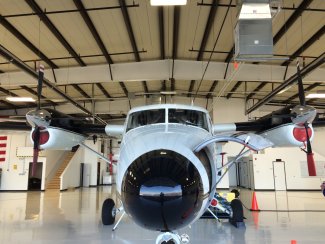
 

View of a twin otter from the nose in the hanger

View of a twin otter from the nose in the hanger

High-level data products derived from AOP data include:

  • Vegetation Leaf Area Index (LAI)
  • Total biomass
  • Vegetation indices (NDVI, EVI)
  • Ecosystem structure
  • Canopy biogeochemistry (multiple products)
  • Land cover
  • Ground elevation: Digital Elevation Model (DEM)
  • Digital Surface Model (DSM)

Eventually, the team will fly over every NEON terrestrial and aquatic site, every year, during the period of peak greenness of the vegetation.

According to NEON’s Director of Remote Sensing, Tom Kampe, during each flight approximately1.0 to 1.5 TB (Terabytes) of raw data are collected. Following the flight, raw data are saved to multiple drives. From there, the data are sent to NEON Headquarters where it is processed to Level-1 data products before being made available to the public in the final format.

For further details on AOP, be sure to visit the Airborne Remote Sensing page on the NEON website.


Share

Related Posts:

Discontinuation of Select NEON Data Products

January 29, 2026

Resolved: NEON AOP Lidar Data Quality Issues Due to Mis-Classified Atmospheric Noise

January 23, 2026

AOP Data Availability Notification – Release 2026

December 15, 2025

NSF NEON, Operated by Battelle

Follow Us:

Join Our Newsletter

Get updates on events, opportunities, and how NEON is being used today.

Subscribe Now

Footer

  • About Us
  • Contact Us
  • Terms & Conditions
  • Careers
  • Code of Conduct

Copyright © Battelle, 2026

The National Ecological Observatory Network is a major facility fully funded by the U.S. National Science Foundation.

Any opinions, findings and conclusions or recommendations expressed in this material do not necessarily reflect the views of the U.S. National Science Foundation.