Research Highlight
AGU-TEX Project Update: Preserving the Oak Ridge Barrens
August 23, 2023
A unique and endangered ecosystem is nestled in the midst of the city of Oak Ridge, Tennessee. The Oak Ridge Barrens (The Barrens) is home to some of the few remaining pockets of natural prairie left in the state. The small parcel of land, set aside as a registered state natural area preserve in 1988, features quintessential examples of native cedar barrens surrounded by cedar glades.
Tennessee Citizens for Wilderness Planning (TCWP), a grassroots volunteer group dedicated to protecting wild areas and unique ecosystems in the state, has been working to preserve these fragile habitats for more than 30 years. As part of their management plan, they wanted to perform a more scientific inventory of the species composition in the cedar barrens. For Margaret Cumberland, a Plant Ecologist working at NEON's Appalachians and Cumberland Plateau Domain (D07), it was a perfect fit for an American Geophysical Union Thriving Earth Exchange (AGU-TEX) community project.
A Unique Prairie Habitat in the City of Oak Ridge
A cedar barren is an open area featuring eastern red cedar (Juniperus virginiana) and various grass and wildflower species. While the name suggests a sparse and bare landscape, cedar barrens are anything but. The Oak Ridge Barrens features a variety of prairie grasses, wildflowers, and herbaceous plants, including big bluestem (Andropogon gerardii), Indian grass (Sorghastrum nutans), and dozens of other species, some now rare in eastern Tennessee. Prairie goldenrod (Solidago ptarmicoides), while not rare globally, is listed as a State Endangered Species in Tennessee, while naked-stem sunflower (Helianthus occidentalis) and Torrey's mountain mint (Pycnanthemum torrei) are both State Special Concern Species. Torrey's mountain mint is also considered to be globally imperiled, with fewer than 3000 plants estimated to remain on Earth as of 2014.
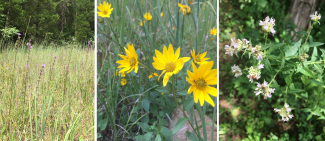
Three rare flower species found at The Barrens in Oak Ridge. Photo credit: Margaret Cumberland.
Like most prairie ecosystems, The Barrens evolved to be dependent on fire. Traditionally, a controlled burn regimen would be used to clear out woody species and maintain the prairie habitat. But in the center of town—next to a middle school—burning isn't a viable strategy. For decades, TCWP has maintained the cedar barrens there by hand, with volunteer labor to physically remove woody plants and invasive species from the remaining expanses of cedar barrens.
Conducting a complete species inventory was always part of the management plan—and with help from the NEON program and other partners, it is finally getting done. With support from NEON – a partnership facilitated by Cumberland, an AGU-TEX Community Fellow – the TCWP completed surveys of three plots of cedar barrens within the preserve, including one pristine area, one that has had extensive management, and a third area that is being considered for management. Data were collected in 2022 from 24 separate 0.5m-radius subplots within each area using methods informed by NEON plant protocols. In addition to plant surveys, they did a bird survey using bird song recordings, and they are looking at other biota as well. Data are currently being compiled from the surveys. Once completed, the surveys will be used to inform future conservation efforts. There may also be an opportunity to publish a peer-reviewed study or journal article.
Cumberland says, "Having a more rigorous scientific inventory of what is here will help them make management decisions moving forward. For the people who have been working on the project for so long, they already know they have something special. This will give them the rigorous data they need to explain to the public why this place is so important."
Reflecting on the TEX Experience
Cumberland is a Plant Ecologist for Domain 07. She holds a Master's degree in ecology from Odum School of Ecology at the University of Georgia, and she has been with the NEON program since 2015.
What did you hope to gain from participating in the TEX program? Were your own personal needs met through the program?
I was very excited to get more involved with outreach. It's an important part of the NEON program and one that I personally enjoy. When this started in 2021, we were just starting to come out of COVID-19 restrictions. I wanted to get out into the community again and connect with the networks of people trying to do environmental work in our local area, and this gave me an opportunity to make that happen. I also was interested in gaining more project management experience. It's something that we all do as part of our work in the field, but it's hard to quantify that experience. This project allowed me to gain managerial experience that's helpful for career building.
What skills, lessons or approaches from this experience have (or will) you apply professionally and academically beyond this program?
One of the fun outcomes of this project is that I am now on the Board of Directors for TCWP! I did end up becoming a member and getting more involved, and I plan to continue that involvement. It has also opened the door to getting involved with other plant conservation efforts locally and across the state. In east Tennessee, TCWP serves as a hub for many other conservation groups. Through them, I've been able to connect with lots of different things going on all over east Tennessee, which is very exciting. Professionally, I think the biggest takeaway in terms of project management experience is knowing that a big part of your job to just to annoy people to get a project done. And it's okay to do that.
Did the program help build capacity for local engagement within your Domain?
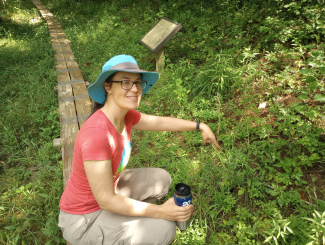
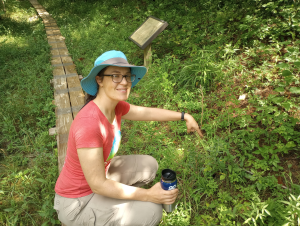
Margaret Cumberland in the field, pointing out a rare plant (not in the barrens).
The AGU-TEX project has generated a lot of local name recognition for the NEON program. Our project was featured in the newsletter from TCWP, which goes out to a lot of people. That has resulted in many more conversations about the NEON program: what it is, what we do, and how NEON data can support these local efforts. We participated in at least one outreach event last year as a direct result of the publicity. The NEON Domain 07 field office also participated in the local Adopt-a-Stream program by running biannual stream clean-ups at a stream that runs by the office building. TCWP has been supportive and helpful with whatever we needed for that project. So now we have a community partner to support our efforts for future events.
In what ways did your project prioritize and support local community needs?
TCWP's core mission is taking care of wild places. This project took one of the wild places that they take care of and focused on highlighting its importance and promoting it. They really appreciated someone paying attention to and recognizing the importance of this rare habitat and their efforts to maintain it. The project helped publicize TCWP and The Barrens. As a result, another TCWP board member and I were invited to present about the project at the Tennessee Plant Conservation Alliance annual meeting. It was incredible to be involved with that and to have the opportunity to present to a group of people whose goal is to identify and preserve plant conservation areas of need across Tennessee. That came about directly from promoting The Barrens area through the AGU-TEX project.
What were or will be the outcomes of your project? What are your hopes for the community/project you matched with?
The main outcome for the AGU-TEX project is the species list. The data we are compiling with the TCWP will showcase the wide variety of species that exist in and depend on this cedar barrens habitat. It shows that the area supports a large number of species, three of which are very rare in this area. One of those, Torrey's mountain mint, is considered globally imperiled by NatureServe, but it is extremely common within this habitat. It's really amazing to have solid evidence that this area is important for this particular species globally. I'm hoping that this study can be used as a baseline for future conservation efforts. I'd love to see a repeat of their survey done in five years, so they can see the impact of management efforts and find out, for example, if more of these rare species are making their way into other areas. Having solid baseline data will enable them to see that progress over time.
Coming out of the program, what are your reflections on community science more broadly?
The AGU-TEX program really opened my mind on the definition of community. It doesn't have to be a strictly organized group with a formal governing body and an official name. It can just be a bunch of people with a common idea, and that's a community. That's how TCWP started, as just a group of people who had an idea and wanted to change something. And I think that's very powerful, and something that I've never really realized. Something I want to keep in mind for the future is that I can get a group of people together to do one thing that they're all excited about. That's a community, and that can be community science. That's all you need.