Spotlight
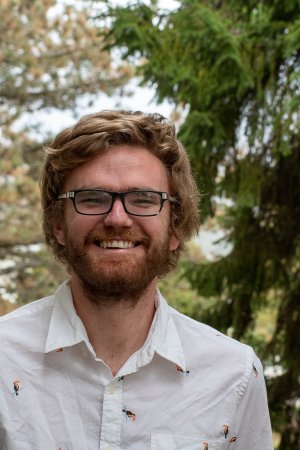
NEON Ambassador Spotlight: Reid Longley
August 3, 2026
The NEON Ambassador Program empowers researchers and educators to expand awareness and use of NEON data, resources, and expertise across scientific and educational communities. Through training, mentorship, and community-building activities, Ambassadors help more people engage with NEON data and advance open, continental-scale ecology.
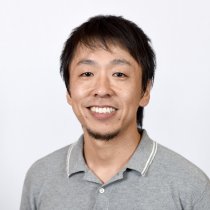
Meet Dr. Reid Longley: Longley is an Assistant Professor at North Carolina State University, where his lab studies how interactions among microbes influence plant health, agricultural productivity, and ecosystem services such as carbon and nutrient cycling. His research focuses on plant-microbe interactions, bacterial-fungal interactions, and the role of microbial communities in agricultural and natural systems.
His Ambassador Experience
Dr. Longley joined the NEON Ambassador Program to gain greater familiarity with NEON data and explore how the Observatory’s publicly available metagenomics datasets could support his research in microbial ecology. But the experience quickly evolved into more than data access. Through the program, he built a stronger professional network that has opened new opportunities for collaboration, publishing, grant development, and presenting his work.
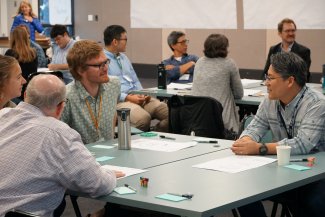
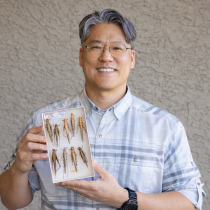
NEON Ambassador Reid Longley talks with NEON Biorepository Principal Investigator, Hojun Song, at the 2025 NEON Convergence Summit.
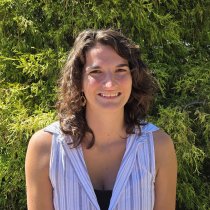
A key part of that experience was his mentorship with Hugh Cross, a NEON Microbial Bioinformatician. Cross helped Longley better understand how NEON metagenomics data are collected, what types of microbial data are available, and how NEON processes large-scale biological datasets. With shared interests in fungal biology and microbial ecology, the mentorship has grown into an active professional partnership. Longley and Cross are now discussing potential grant proposals and papers, and Cross invited Longley to give a talk in a session he organized at the Global Soil Biodiversity Conference in Victoria, Canada.
The Ambassador Program also helped Longley connect with researchers outside his immediate field. At the 2025 NEON Convergence Summit, he joined a working group exploring viruses in NEON metagenomics data to better understand how viral communities are structured at continental scales. While the group’s first small proposal was not funded, the collaboration has continued, helping Longley build relationships with researchers he knew of but had not previously met.
As Longley continues building his lab at NC State, he expects NEON data to play a larger role in future projects. A new postdoc joining his lab will help expand the large-scale informatics work needed to make more complete use of NEON metagenomics datasets. Longley also hopes to continue developing collaborations with his NEON mentor and Convergence Summit working group, with the goal of pursuing grant proposals and papers using NEON data.
“The networking aspect of the NEON Ambassador program has been the most valuable—like meeting Hugh and other researchers at the Convergence Summit. Sometimes when you are a new, younger researcher, it can be tough to really meet people from different fields, so I think it is a great way to expand your network.”
— Dr. Reid Longley.
About His Research: Understanding Microbial Interactions Across Environments
What’s the question?
How do interactions among microbes influence plant health, agricultural productivity, and ecosystem services such as carbon and nutrient cycling?
The big picture:
Microbes play important roles in soil, plant and ecosystem processes, but they don’t act alone. Bacteria, fungi and other microorganisms interact in complex ways that can influence how plants respond to drought, pathogens and other stressors. Understanding these interactions can help scientists better understand ecosystem complexity and may eventually support new strategies for improving crop resilience and agricultural productivity.
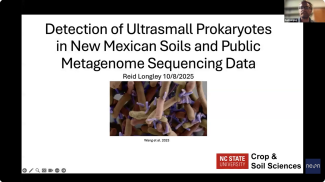
Dr. Reid Longley presents "Detection of Ultrasmall Prokaryotes in New Mexican Soils and Public Metagenome Sequencing Data" during the September 9, 2025 NEON Science Seminar.
How he does it:
During his Ph.D. at Michigan State University, Longley studied how agricultural management practices impact microbes associated with soybeans. As a postdoctoral fellow at Los Alamos National Laboratory, he studied interactions between bacteria and fungi, including bacteria that live inside fungal cells.
Longley is using NEON metagenomics data to look for microbes across different environments. NEON’s publicly available datasets give researchers access to microbial data from many sites, along with extensive associated metadata. That combination can help researchers explore how environmental factors may shape the roles and distributions of microbes across ecosystems.
NEON data products used:
Soil microbe metagenome sequences
Watch the seminar:
From Microbes to the Atmosphere: Research Across Scales from NEON Ambassadors