What's New at the NEON Biorepository? A Conversation With Dr. Hojun Song
February 25, 2026
What does ecological change actually look like—not in models or projections, but in physical evidence you can hold in your hand?
Across the United States, thousands of biological and physical samples are collected every year from the U.S. National Science Foundation’s National Ecological Observatory Network (NEON) field sites: insects, plants, small mammals, and soil and environmental samples rich in microbes and DNA. On their own, each sample is a snapshot in time. Together, preserved year after year using standardized methods, they become something much more powerful: a living record of how ecosystems are changing across the continent. That record is housed at the NEON Biorepository at Arizona State University (ASU).
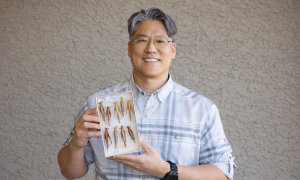
In 2025, Dr. Hojun Song became Principal Investigator of the NEON Biorepository. An entomologist and longtime leader of natural history collections, Song brings a perspective grounded in long-term biodiversity research and the scientific value of well-documented physical specimens. In this conversation, he reflects on what makes the NEON Biorepository unique, the exciting expansion underway, and why long-term investment in this resource is essential for understanding ecological change.
About the NEON Biorepository
The NEON Biorepository at ASU houses biological and environmental samples collected from 81 NEON field sites across all 20 NEON Domains. The collection includes insects, small mammal specimens and tissues, frozen soil samples, plants and plant tissues, aquatic mosses and algae, microbes, fish specimens and tissues, and DNA extractions.
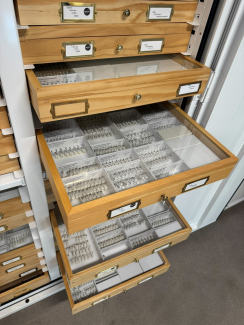
Since becoming fully operational in 2019, the NEON Biorepository has grown to include over one million occurrence records. The collection contains nearly 400,000 frozen or refrigerated specimens, approximately 220,000 dried or pinned specimens, and 88,000 specimens preserved in fluid. With over 4.5 million association records linking specimens to related data, the collection represents one of the fastest-growing natural history collections in the world.
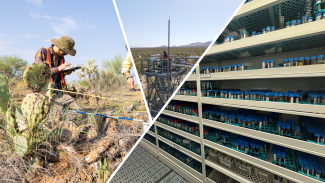
The NEON Biorepository offers "hyper-extended specimens": samples with an unprecedented depth of associated data about when, where and under what conditions they were collected.
Specimens are collected, logged and preserved according to standardized protocols, and each sample is linked to rich environmental data from NEON's network of sensors and weather stations. This creates what researchers call "hyper-extended specimens": samples with an unprecedented depth of associated data about when, where and under what conditions they were collected.
As part of NEON, the NEON Biorepository's mission is to make these samples available to researchers for a wide range of studies. Samples can be explored through the NEON Biorepository portal and requested for both non-destructive and destructive research uses.
A Conversation with Dr. Song
How did you come to this role, and what excites you most about leading the NEON Biorepository?
I joined ASU in August 2025. Previously, I was at Texas A&M University in the Department of Entomology for 10 years. I'm an entomologist by training—I study grasshoppers, katydids and crickets—and I've been involved with natural history collections ever since I was an undergrad at Cornell.
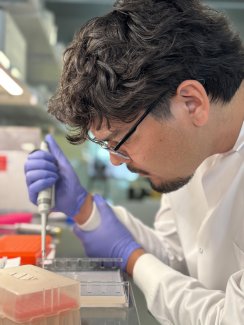
The NEON Biorepository occupies a unique space. Those of us who work in museums tend to think in terms of millions of years, looking at entire clades and global diversity. Ecologists often work on shorter timescales—decades or even years—measuring ecosystem metrics. The NEON Biorepository sits at the intersection: It asks, how can we move ecologists into a space where specimens are vouchered and collected systematically over 30 years? And it pushes collections people toward questions we don't normally ask, especially around ecosystem change.
The NEON Biorepository also archives samples that are normally outside the scope of any natural history collection, such as soil samples, environmental samples and DNA extractions. And unlike traditional collections, these samples are meant to be used, even destructively, to answer important questions. Honestly, there is nothing like it anywhere in the world.
What's new at the NEON Biorepository? We hear there's a major facility expansion underway.
Plans are underway to build out an 8,000-square-foot dedicated NEON Biorepository facility in the same Alameda building where we're currently located. The design is nearly completed, and we expect the construction to begin in the summer of 2026. It's a multimillion-dollar construction project that will include dedicated space for wet collections, dry collections and sample preparation, which will be connected to the NEON cryo facility that was built a few years ago.
Right now, many of the NEON samples are housed within the ASU Natural History Collections space. The new space will be the permanent home for all NEON biosamples for the next 30 years. If everything goes as planned, construction will take about a year. We're hoping for a grand opening in late spring 2027.
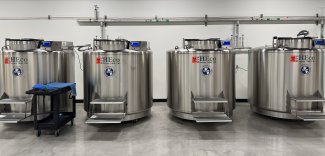
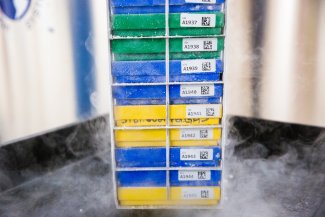
The cryo facility is already a major strength. We have four large liquid nitrogen tanks for cryopreservation, growing at a rate of one every other year, plus a large number of minus-80 freezers. If you visit, it's pretty impressive to see.
What kinds of research are people doing with NEON Biorepository samples?
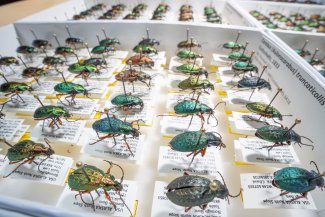
The uses are incredibly varied. We're seeing a lot of interest from researchers who want to leverage advances in AI and imaging technology. Some are using images of specimens, like the NEON ground beetle collection, for computer vision-based identification. Others are using the large-scale associated data to understand patterns of biodiversity.
One of the most exciting resources we have is the bycatch collection: the samples collected in pitfall traps after the target specimens like ground beetles are sorted out. We have over 40,000 vials, each containing hundreds of specimens. It's a tremendous amount of biodiversity, but it's essentially "dark data" because no one has systematically catalogued what's inside. I'm interested in finding ways to reveal this hidden diversity using automation, AI and genomics.
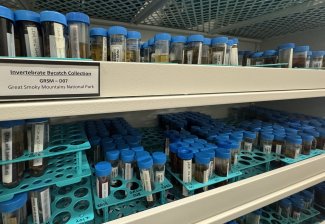
People are also requesting NEON soil samples to study microbiomes, mammal specimens to examine parasites like mites and ticks, and ethanol-preserved samples to assess DNA quality for population genetics studies. Some researchers have even described new species from our collections. People are very creative in finding value in these specimens.
What do you want researchers to know about the NEON Biorepository?
Two things. First, the NEON Biorepository portal is really robust. We've invested a lot of resources into making it user-friendly. You don't have to physically visit to see what's available; you can explore the collection digitally and request samples online.
Second, we are in the business of encouraging people use these samples. You can request them, you can come here and examine them in person. Everything is well-organized and well-documented, with incredibly rich metadata to place these samples in context.
And this collection is growing at an incredible rate. The ASU Natural History Collections took 120 years to grow to three million specimens. NEON hit one million specimens in under six years. Over the 30-year life of the Observatory, this will grow to be one of the largest collections in the world, and it will continue to become more and more valuable over time.
Why is continued investment in the NEON Biorepository so important?
We're living in a time of rapid change. One of the best ways to understand what's changing is to document it systematically. That's what NEON does—documenting environmental change in a standardized way across 30 years at a continental scale. That creates baseline information for making informed decisions about the future.
The NEON Biorepository provides physical evidence of change. It's like having 30 years of evidence to demonstrate what's happening—patterns that you simply can't see with just a few years of data. We're in our sixth year now, so we're still early. But come back in 15 years, and the samples will show continental-scale patterns that can inform policy on everything from water security to food security to ecosystem management.
The type of data required to answer big questions requires long-term investment. NSF has committed to a long-term survey of ecological change. We need to see it through so we have the data to help everyone.
About Dr. Hojun Song
Dr. Hojun Song is a Professor in the School of Life Sciences at Arizona State University, Director of the ASU Biocollections, and Principal Investigator of the NEON Biorepository. An entomologist specializing in grasshoppers, katydids and crickets, his research focuses on biodiversity and evolution, including the study of locust swarming behavior and the acoustic communication of orthopteran insects. Before joining ASU in August 2025, he spent 10 years at Texas A&M University in the Department of Entomology. He has been involved with natural history collections since his undergraduate days at Cornell University.
Learn More
Explore the collection: NEON Biorepository Portal
Request samples or schedule a visit: Contact the NEON Biorepository team at https://www.neonscience.org/about/contact-neon-biorepository.