NSF NEON, Operated by Battelle

Main navigation

  • About
    • NEON Overview
      • Vision and Management
      • Spatial and Temporal Design
      • History
    • About the NEON Biorepository
      • ASU NEON Biorepository Staff
      • Contact the NEON Biorepository
    • Observatory Blog
    • Newsletters
    • Staff
    • FAQ
    • User Accounts
    • Contact Us

    About

  • Data
    • Data Portal
      • Data Availability Charts
      • API & GraphQL
      • Prototype Data
      • Externally Hosted Data
    • Data Collection Methods
      • Airborne Observation Platform (AOP)
      • Instrument System (IS)
        • Instrumented Collection Types
        • Aquatic Instrument System (AIS)
        • Terrestrial Instrument System (TIS)
      • Observational System (OS)
        • Observation Types
        • Observational Sampling Design
        • Sampling Schedules
        • Taxonomic Lists Used by Field Staff
        • Optimizing the Observational Sampling Designs
      • Protocols & Standardized Methods
    • Getting Started with NEON Data
      • neonUtilities for R and Python
      • Learning Hub
      • Code Hub
    • Using Data
      • Data Formats and Conventions
      • Released, Provisional, and Revised Data
      • Data Product Bundles
      • Usage Policies
      • Acknowledging and Citing NEON
      • Publishing Research Outputs
    • Data Notifications
    • NEON Data Management
      • Data Availability
      • Data Processing
      • Data Quality

    Data

  • Samples & Specimens
    • NEON Biorepository Sample Portal at ASU
    • About Samples
      • Sample Types
      • Sample Repositories
      • Megapit and Distributed Initial Characterization Soil Archives
    • Finding and Accessing Sample Data
      • Species Checklists
      • Sample Explorer - Relationships and Data
      • Biorepository API
    • Requesting and Using Samples
      • Requesting Samples from the NEON Biorepository
      • Request Megapit and Initial Characterization Soil
      • Sample Use Guidelines
      • Sample Use Policy
      • Acknowledging and Citing the NEON Biorepository

    Samples & Specimens

  • Field Sites
    • Field Site Map and Info
    • Spatial Data Layers & Maps

    Field Sites

  • Resources
    • Getting Started with NEON Data
    • Research Support Services
      • Field Site Coordination
      • Letters of Support
      • Permits and Permissions
      • AOP Flight Campaigns
      • Research Support FAQs
      • Research Support Projects
    • Code Hub
      • neonUtilities for R and Python
      • Code Resources Guidelines
      • Code Resources Submission
      • NEON's GitHub Organization Homepage
    • Learning Hub
      • Tutorials
      • Workshops & Courses
      • Science Videos
      • Teaching Modules
    • Science Seminars and Data Skills Webinars
    • Document Library
    • Funding Opportunities

    Resources

  • Impact
    • Research Highlights
    • Papers & Publications
    • NEON in the News

    Impact

  • Get Involved
    • Upcoming Events
    • Past Events
    • Research and Collaborations
      • Environmental Data Science Innovation and Inclusion Lab
      • Collaboration with DOE BER User Facilities and Programs
      • EFI-NEON Ecological Forecasting Challenge
      • NEON Great Lakes User Group
      • NCAR-NEON-Community Collaborations
      • Sage Grande Testbed
    • Advisory Groups
      • Science, Technology & Education Advisory Committee (STEAC)
      • Innovation Advisory Committee (IAC)
      • Technical Working Groups (TWG)
    • NEON Ambassador Program
      • Exploring NEON-Derived Data Products Workshop Series
    • Partnerships
    • Community Engagement
    • Work Opportunities

    Get Involved

  • My Account
  • Search

Search

About

  • NEON Overview
  • About the NEON Biorepository
  • Observatory Blog
  • Newsletters
  • Staff
  • FAQ
  • User Accounts
  • Contact Us

Breadcrumb

  1. About
  2. Observatory Blog
  3. What Can Gut Microbes Tell Us About Animal Evolution?

Research Highlight

What Can Gut Microbes Tell Us About Animal Evolution?

July 31, 2026

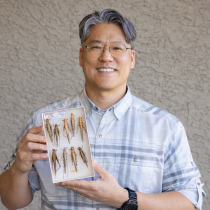
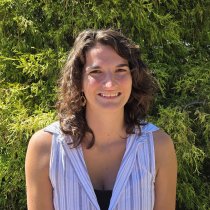
Headshot of Dr. Taichi Suzuki

What’s the question? How do mammals and their gut microbes evolve together, and what can microbial communities reveal about the movement and history of animal populations?

The big picture: Mammals and their gut microbes have evolved in close association, and those relationships can influence health, adaptation and survival. Understanding how these partnerships are maintained—or disrupted—could inform research in ecology, conservation and precision medicine.

NEON Biorepository samples used:  

Researchers used small mammal samples from the NEON Biorepository:

  • Fecal samples from deer mice (Peromyscus) for sequencing the gut microbiome
  • DNA extracts from the same mice to confirm species identity
Researcher(s): Dr. Taichi Suzuki, Assistant Professor, Health Through Microbiomes Faculty, Arizona State University (Suzuki Lab). Study led by Dr. Danielle M. Blumstein with Aishwarya Patel, Dr. Gabriele Schiro, and Dr. Suzuki.  

What they did and what they learned:
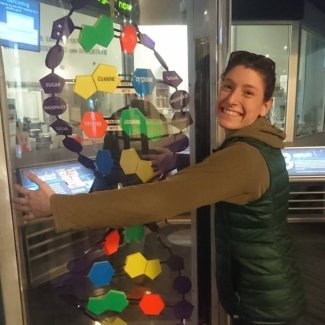
Danielle Blumstein hugging a model of DNA
Dr. Danielle Blumstein with a model of DNA. Photo courtesy of Danielle Blumstein.

Dr. Danielle M. Blumstein (postdoctoral researcher) and her colleagues in the Suzuki Lab analyzed paired fecal and host DNA samples from deer mice in the Peromyscus maniculatus species complex collected from 13 populations across the contiguous United States. The research team used full-length 16S rRNA long-read sequencing to characterize the gut microbiome, while the host DNA helped confirm the identity of each animal. The team then compared microbial communities across locations to see how geographic distance and major landscape features influenced microbiome composition.

“NEON gives us access not only to samples, but also to the standardized metadata that make those samples scientifically useful. That combination allows us to ask questions across geographic scales that would be very difficult to study on our own.” – Dr. Taichi Suzuki, Arizona State University  
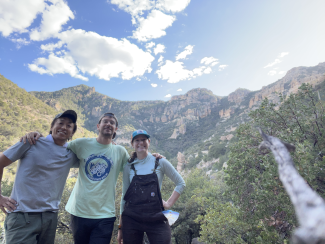
Dr. Suzuki and lab members in front of mountains
Dr. Taichi Suzuki, Dr. Gabriele Schiro, and Dr. Danielle Blumstein (from left to right). Photo courtesy of Taichi Suzuki.

As expected, mice living farther apart tended to have more dissimilar gut microbiomes. However, the Mississippi River created a much stronger divide than distance alone could explain: mice on opposite sides of the river had distinctly different microbial communities. The researchers also found that some bacterial lineages appeared more restricted by the river than others, suggesting that microbes differ in how easily they move through the environment or between hosts.

The study is part of the Suzuki Lab’s broader investigation into host-microbial coevolution: how mammals and their gut microbes evolve together and how those microbes are passed between individuals and populations. It suggests that gut microbes can preserve evidence of a host population’s history and movement across a landscape. The team is also exploring what happens when long-standing host-microbe relationships are disrupted or lost. By identifying which microbes are most closely tied to their hosts and determining how they affect health and biological traits, the researchers hope to generate insights relevant to biodiversity conservation, disease research and precision medicine.  
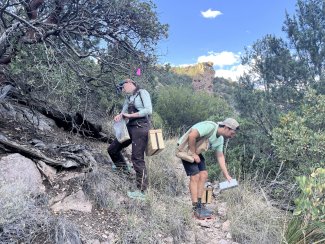
Danielle Blumstein and Gabriele Schiro setting small mammal traps on a hill
Dr. Danielle Blumstein (left) and Dr. Gabriele Schiro (right) setting Sherman traps to capture wild rodents. Photo courtesy of Taichi Suzuki.

Suzuki’s lab is extending that same idea to human health by asking whether some microbes are so closely tied to our evolutionary history that losing them creates a biological mismatch. By examining whether those changes correlate with inflammatory, metabolic or disease markers, the researchers hope to determine whether microbial ancestry should be considered alongside human genetics in precision medicine.

Taichi credited Laura Steger, NEON Biorepository Environmental and Zoological Collections Manager, who helped identify and select the paired samples and supported the technical planning, along with his colleagues at the ASU College of Health Solutions, the Biodesign Center for Health Through Microbiomes and members of his lab.

Read the study: Beyond distance-decay: The Mississippi River shapes gut microbiome communities in the Peromyscus maniculatus species complex (preprint: bioRxiv) 
Share

Related Posts:

What's New at the NEON Biorepository? A Conversation With Dr. Hojun Song

February 25, 2026

photo of person

Unlocking the Secrets of Soil Microbial Metabolites

February 2, 2026

Petri dishes of bacteria cultures

Featured Expert: Tong Qiu - Mapping Forest Fecundity

October 31, 2025

Featured expert Tong Qiu headshot
NSF NEON, Operated by Battelle

Follow Us:

Join Our Newsletter

Get updates on events, opportunities, and how NEON is being used today.

Subscribe Now

Footer

  • About Us
  • Contact Us
  • Terms & Conditions
  • Careers
  • Code of Conduct

Copyright © Battelle, 2026

The National Ecological Observatory Network is a major facility fully funded by the U.S. National Science Foundation.

Any opinions, findings and conclusions or recommendations expressed in this material do not necessarily reflect the views of the U.S. National Science Foundation.