
NSF NEON, Operated by Battelle

Main navigation

  • About
    • NEON Overview
      • Vision and Management
      • Spatial and Temporal Design
      • History
    • About the NEON Biorepository
      • ASU NEON Biorepository Staff
      • Contact the NEON Biorepository
    • Observatory Blog
    • Newsletters
    • Staff
    • FAQ
    • User Accounts
    • Contact Us

    About

  • Data
    • Data Portal
      • Data Availability Charts
      • API & GraphQL
      • Prototype Data
      • Externally Hosted Data
    • Data Collection Methods
      • Airborne Observation Platform (AOP)
      • Instrument System (IS)
        • Instrumented Collection Types
        • Aquatic Instrument System (AIS)
        • Terrestrial Instrument System (TIS)
      • Observational System (OS)
        • Observation Types
        • Observational Sampling Design
        • Sampling Schedules
        • Taxonomic Lists Used by Field Staff
        • Optimizing the Observational Sampling Designs
      • Protocols & Standardized Methods
    • Getting Started with NEON Data
      • neonUtilities for R and Python
      • Learning Hub
      • Code Hub
    • Using Data
      • Data Formats and Conventions
      • Released, Provisional, and Revised Data
      • Data Product Bundles
      • Usage Policies
      • Acknowledging and Citing NEON
      • Publishing Research Outputs
    • Data Notifications
    • NEON Data Management
      • Data Availability
      • Data Processing
      • Data Quality

    Data

  • Samples & Specimens
    • NEON Biorepository Sample Portal at ASU
    • About Samples
      • Sample Types
      • Sample Repositories
      • Megapit and Distributed Initial Characterization Soil Archives
    • Finding and Accessing Sample Data
      • Species Checklists
      • Sample Explorer - Relationships and Data
      • Biorepository API
    • Requesting and Using Samples
      • Requesting Samples
      • Sample Guidelines and Policies

    Samples & Specimens

  • Field Sites
    • Field Site Map and Info
    • Spatial Data Layers & Maps

    Field Sites

  • Resources
    • Getting Started with NEON Data
    • Research Support Services
      • Field Site Coordination
      • Letters of Support
      • Permits and Permissions
      • AOP Flight Campaigns
      • Research Support FAQs
      • Research Support Projects
    • Code Hub
      • neonUtilities for R and Python
      • Code Resources Guidelines
      • Code Resources Submission
      • NEON's GitHub Organization Homepage
    • Learning Hub
      • Tutorials
      • Workshops & Courses
      • Science Videos
      • Teaching Modules
    • Science Seminars and Data Skills Webinars
    • Document Library
    • Funding Opportunities

    Resources

  • Impact
    • Research Highlights
    • Papers & Publications
    • NEON in the News

    Impact

  • Get Involved
    • Upcoming Events
    • Past Events
    • Research and Collaborations
      • Environmental Data Science Innovation and Inclusion Lab
      • Collaboration with DOE BER User Facilities and Programs
      • EFI-NEON Ecological Forecasting Challenge
      • NEON Great Lakes User Group
      • NCAR-NEON-Community Collaborations
    • Advisory Groups
      • Science, Technology & Education Advisory Committee (STEAC)
      • Innovation Advisory Committee (IAC)
      • Technical Working Groups (TWG)
    • NEON Ambassador Program
      • Exploring NEON-Derived Data Products Workshop Series
    • Partnerships
    • Community Engagement
    • Work Opportunities

    Get Involved

  • My Account
  • Search

Search

About

  • NEON Overview
  • About the NEON Biorepository
  • Observatory Blog
  • Newsletters
  • Staff
  • FAQ
  • User Accounts
  • Contact Us

Breadcrumb

  1. About
  2. Observatory Blog
  3. What’s the Big Deal About Continuous Discharge?

What’s the Big Deal About Continuous Discharge?

June 16, 2026
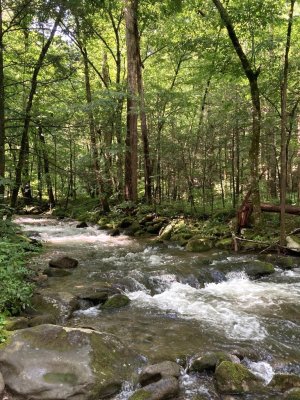
LECO field site in Domain 07 (TN)

How much water is actually moving through a stream at any given moment? That question sounds simple—until you try to answer it continuously, across seasons, storms, droughts and wildly different ecosystems.

That’s what NEON’s continuous discharge data does. It tracks how flow changes over time, turning something dynamic and hard to capture into a consistent, usable record. And once you have that, you can start to understand one of the primary drivers of change in aquatic systems. 

Who cares about continuous discharge? 
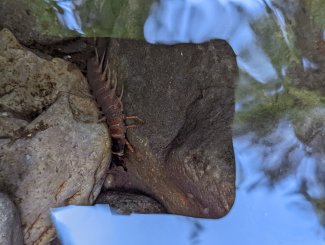
An aquatic invertebrate on a rock in a stream
This hellgrammite, the larval stage of a dobsonfly (family Corydalidae), is one of many aquatic macroinvertebrates affected by the rate of flow in a stream. Photo by of Chris Burton, D16 field technician.  

Anyone trying to understand how rivers and streams function over time needs continuous discharge data, including water managers that track impacts of rainfall and snowmelt on ecosystems and the water supply, engineers that rely on it for design calculations, and state and local agencies that assess flooding risk.  

Discharge drives the physical structure of a stream. It determines how much sediment moves, how channels shift, and what types of habitats form. A high-flow year can reshape an entire system; a dry period can shrink or even eliminate it. If you’re studying geomorphology, hydrology or habitat, you need discharge data.

Flow also controls what’s happening chemically. When water moves through a watershed, it picks up nutrients, pollutants and organic material along the way. Changes in flow directly affect water quality, including turbidity and nitrogen and oxygen levels. Those measurements don’t tell the complete story without discharge.

And then there’s biology. Fish, macroinvertebrates and other aquatic organisms respond quickly to changes in flow: too much water can wash them out, too little can stress or eliminate populations entirely. If you’re trying to explain why species appear, disappear or shift over time, discharge is often the missing piece.

“Discharge is really the foundation. If you’re trying to understand what’s happening in a stream—whether it’s water quality, habitat or biology—you have to start with how the water is moving.” – Nick Harrison, NEON Research Scientist, Hydrologist  

NEON Continuous Discharge Data 

NEON’s Continuous discharge data product provides a time series of streamflow: how much water is moving through a stream or river over time. It is one of NEON’s more complex data products, combining multiple data sources and modeling approaches into a single, continuous record that researchers can use directly. Recent updates have improved data quality and continuity, reducing gaps and making this already powerful dataset even more reliable.

Related data products available in the NEON Data Portal include: 

  • Continuous discharge data (streamflow time series)
  • Stage-discharge rating curves (models linking water depth to flow)
  • Discharge field collection (from field-based surveys)
  • Salt-based stream discharge (using a constant-rate addition salt tracer)

Want to see discharge in action?  

NEON’s Open Flow application lets you visualize discharge alongside precipitation and other hydrology data in just a few clicks—no preprocessing required.
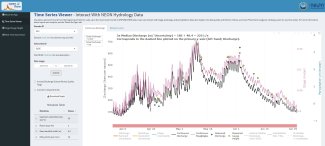
An example of hydrologic data displayed in the visualization tool, openFlow

Continuous discharge data from April 1, 2025-June 30, 2025 from the BLDE field site in Domain 12 (TX) displayed in openFlow.

How does NEON Measure Continuous Discharge?

Here’s the tricky part: you can’t measure discharge continuously with a single sensor. Instead, NEON combines two approaches.

  • Field teams go out regularly and take direct measurements of flow under different conditions to capture real, on-the-ground conditions at specific moments in time.
  • Sensors installed in the stream measure water depth continuously. On their own, those sensors don’t tell you flow, but they do tell you how the water level is changing.

By linking field measurements to sensor data, NEON builds models that translate water depth into discharge. Those models are then applied across the full sensor record to generate a continuous time series.
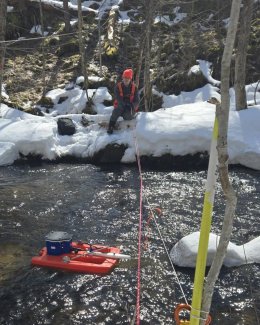
A technician uses an Acoustic Doppler Current Profiler to measure stream velocity
A field technician in D01 (MA) uses an Acoustic Doppler Current Profiler (ADCP) to measure water velocity over a depth range, which is used to calculate continuous discharge. Photo by Annie Vincent, D01 field technician. 

Featured Study:  

Using data from 22 NEON streams across the U.S., researchers found that gas exchange between water and the atmosphere increases with streamflow—but only in steeper, high-energy systems. The study highlights how discharge and stream structure work together to control key biogeochemical processes. Read the study.  

Share

Related Posts:

New resources for site management and event reporting data

June 2, 2026

From Instrument to Insight: How NEON Builds Confidence in Ecological Data

May 29, 2026

Sensor to measure aspirated air temperature

Life in Motion: Understanding Aquatic Ecosystems with NEON

April 30, 2026

Buoy at the Prairie Pothole NEON aquatic site
NSF NEON, Operated by Battelle

Follow Us:

Join Our Newsletter

Get updates on events, opportunities, and how NEON is being used today.

Subscribe Now

Footer

  • About Us
  • Contact Us
  • Terms & Conditions
  • Careers
  • Code of Conduct

Copyright © Battelle, 2026

The National Ecological Observatory Network is a major facility fully funded by the U.S. National Science Foundation.

Any opinions, findings and conclusions or recommendations expressed in this material do not necessarily reflect the views of the U.S. National Science Foundation.