Unlocking the Power of NEON Infrastructure: NEON Research Support Services (NRSS)
March 31, 2026
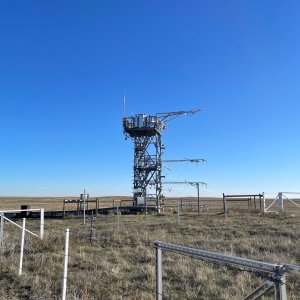
Across the United States, the National Ecological Observatory Network (NEON) provides an extraordinary scientific infrastructure: instrumented towers, airborne remote sensing platforms, field sites spanning diverse ecosystems, and a standardized system for collecting ecological data over decades.
But the Observatory is not just about collecting data. Through NEON Research Support Services (NRSS), researchers can use NEON infrastructure, expertise and long-term data to pursue their own research projects across the Observatory network. Projects may involve installing new instruments at NEON locations, coordinating field research at established sites or requesting airborne data collection through NEON’s Airborne Observation Platform. NRSS operates on a cost-recovery basis, meaning researchers cover the costs associated with their projects (such as staff support or logistics) while benefiting from infrastructure already in place across the Observatory.
Since the Observatory became fully operational in 2019, NRSS has supported more than 200 research projects spanning disciplines from ecology to atmospheric science. Through NRSS, NEON also acts as a test bed for new technologies, from environmental sensors to equipment for precision agriculture.

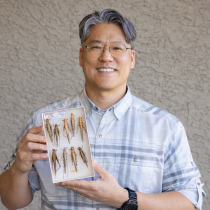
The program is led by Dr. Rommel C. Zulueta, Senior Research Scientist at NEON Battelle and Lead of NRSS. A micrometeorologist who joined the NEON program in 2013 during its construction phase, Rommel initially worked with the Terrestrial Instrument System team to help ensure that the Observatory’s sensor infrastructure met the scientific requirements for long-term ecological monitoring.
Today, he works closely with researchers to help translate new ideas into feasible projects that take advantage of NEON’s unique capabilities.
NRSS: A Conversation with Dr. Rommel C. Zulueta
Why is NEON Research Support Services such an important part of the Observatory?
NRSS allows external researchers to use the infrastructure that the U.S. National Science Foundation has invested in through NEON to pursue their own research questions. Scientists can bring their own ideas and creativity and apply them across the Observatory. Instead of conducting research at just one location, they may be able to scale their work across multiple ecosystems or even across the entire continental-scale network.
Because NEON already has sites, instrumentation and field personnel distributed across the United States, researchers can expand the scope of their work much more efficiently than if they had to build that infrastructure or visit each of those sites themselves. In many cases, that means researchers can ask bigger questions and explore broader patterns across ecosystems.
What kinds of research projects has NRSS supported?
We’ve supported more than 200 projects so far, and they span a wide range of disciplines. (You can find the examples of supported NRSS projects on the website.)
Some researchers use NEON’s sensor infrastructure or sampling plots. Others request support from our scientists, field ecologists or engineers. Some projects involve the Airborne Observation Platform, where researchers request flight surveys over specific areas.
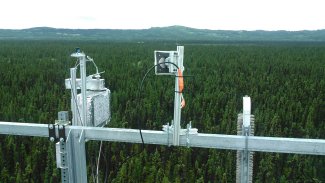
One project that stood out involved a researcher studying atmospheric lidar systems. They were interested in optimizing lidar scan patterns based on upper-atmosphere wind conditions. NEON doesn’t normally work in the upper atmosphere, but because we had the infrastructure—power, communications and suitable sites—they were able to deploy their system and conduct their research.
Another current project in Arizona is examining the effects of elevated hydrogen on soil microbial activity. That’s an emerging research area, and NEON’s infrastructure allows researchers to install instrumentation and run experiments at an established field site.
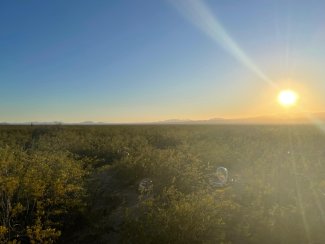
Automated chambers for soil H2 fluxes amongst creosote bushes near the Santa Rita Experimental Range NEON flux tower at sunset. The automated chambers are part of an NRSS project studying the effects of elevated hydrogen on soil microbial activity. Photo Courtesy of Robert Bordelon, University of Arizona.
Many of the projects that stand out are those that ask questions we didn’t originally anticipate when the Observatory was built.
How has the NRSS program evolved over time?
When I took over NRSS in 2018, the Observatory was still coming online, and researchers were still learning what NEON infrastructure was and how they might use it.
A lot of our early work involved helping researchers understand what resources were available and how they could incorporate NEON sites into their research.
Since then, the program has evolved significantly. Researchers are much more familiar with the Observatory and the capabilities it offers. As a result, we’re seeing projects that ask more complex questions and make use of multiple parts of the network, such as field infrastructure, airborne observations, long-term datasets and expertise from NEON scientists.
The program has grown from helping researchers navigate the infrastructure to supporting much more sophisticated and collaborative research efforts.
What does collaboration between researchers and NEON staff typically look like?
It usually begins with a conversation.
Researchers may reach out to us directly or submit a request for research support. From there, we conduct a feasibility review and cost analysis and work with them to determine whether their project can be implemented at NEON sites without affecting NEON data collection or relationships with site hosts.
After that, the level of collaboration can vary widely.
Some projects involve extensive support from NEON staff, including installation of equipment, data collection or ongoing maintenance. Other researchers prefer to conduct their own fieldwork and simply need logistical coordination, access to sampling plots or subject-matter expertise.
So the collaboration can range from very hands-on to more advisory, depending on what the researcher needs.
Who can use NRSS and how can researchers get started?
The program is open to a wide range of users. That includes academic researchers, students, government scientists and even commercial organizations. We’ve received requests from atmospheric scientists, researchers working with satellite data and companies developing new environmental technologies.
Anyone who sees value in NEON infrastructure can potentially use the program.
The best way to get started is simply to contact us. Researchers can contact the NEON Research Support Services team through the NEON website or by email (researchsupport@battelleecology.org) to discuss their ideas. From there, we work with them to determine whether their project is feasible at NEON sites and how we might support it.
Sometimes researchers assume their ideas may be too ambitious or unusual. But because NEON has such a large network of sites, instrumentation and personnel, we’re often able to support projects that would be very difficult for researchers to carry out on their own. I encourage anyone interested to just talk to us and see what’s possible.