NEON Live: Connecting Flux Data, Remote Sensing and AI
May 7, 2026
How do you take measurements collected at a single point on the landscape and turn them into insights that can guide decisions at regional or global scales?
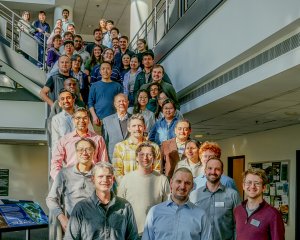
That question brought researchers, practitioners and early-career scientists to Boulder, Colorado, for the Remote Sensing and Fluxes for Real-world Impact Workshop, hosted by NEON in collaboration with AmeriFlux and CarbonDew. Supported by NSF Award 2532339, the event, held in March, focused on connecting eddy covariance flux measurements with remote sensing and geospatial data to support real-world applications, from water management to carbon accounting.
Building on a 2024 workshop, this year’s program emphasized hands-on learning and collaboration, helping participants develop practical approaches for scaling flux data and applying it in decision-making contexts.
NEON data products used:
- Bundled eddy covariance (Bundle of eddy-covariance data products, including related meteorological and soil data products)
Who came? The workshop brought together 55 in-person participants and 18 remote attendees, representing universities, national laboratories, research institutes, private-sector organizations and international partners. The group included not only scientists, but also regulators, land managers and other stakeholders interested in applying flux data in real-world settings.
What We Did:
Across two days, participants moved from foundational concepts to applied workflows. The workshop opened with framing talks that positioned scaling as a central challenge in making ecological flux data useful beyond individual field sites. From there, hands-on tutorials introduced participants to spatial data access, flux scaling approaches across space and time, and emerging AI-enabled workflows.
The program then shifted toward application. Speakers highlighted how integrated flux and remote sensing data are already being used to estimate evapotranspiration for irrigation planning, support carbon measurement and reporting, and inform supply chain sustainability efforts. A career roundtable expanded the conversation beyond academia, exploring how these skills translate into roles in consulting, environmental services and technology.
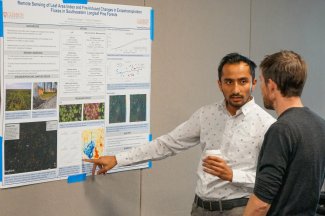
Siddhartha Regmi, Clemson University, talks to other participants about his research, “Remote sensing of lead area index and fire-induced changes in evapotranspiration fluxes in southeastern longleaf pine forests.”
Participants also engaged in poster sessions and collaborative breakout groups. These group projects focused on topics such as comparing flux datasets across scales, linking ecological variation to flux measurements, and developing shared resources to support future research and proposals.
Access materials from the workshop in the Github repository.
What We Learned:
The workshop's central insight was that no single method can take a measurement made at one point on the landscape and reliably scale it up to a region or a continent. Instead, researchers need a deliberate sequence of tools, each one suited to a specific step in that journey, nested together so that the strengths of each approach compensate for the limits of the others. A ground-level flux tower, for instance, captures precise energy and carbon measurements at one location; spatialized analysis reconstructs what that tower "sees" across the surrounding landscape; and machine learning can then extend those patterns to regions with no tower at all. Getting that sequence right, and being transparent about where direct evidence ends and inference begins, is what makes the resulting science trustworthy to act on.
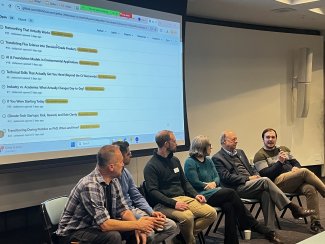
Panelist Justin Coughlin (E&S Environmental) discusses the nexus of science, industry and decision support with fellow panelists, left to right, George Burba (LI-COR), Ketan Kaushish (CarbonSpaceTech), Chris Florian (NEON-Battelle), Joanna Joiner (Asticou Earth Systems, LLC), and Christopher Neale (Parallel 41). Photo by Dave Durden, NEON Research Scientist.
Discussions also pointed to the increasing importance of shared infrastructure. Tools such as cloud-based workflows, benchmark datasets and collaborative platforms like GitHub and Zenodo are becoming essential for enabling reproducible science and scaling results into operational applications.
Several participants are already continuing the work started at the workshop through ongoing collaborations, with some groups planning manuscripts or proposals based on their breakout discussions. A dedicated Zenodo community has also been established to track outputs and maintain shared resources.