Battelle NEON at Premier International Research Infrastructure Meeting
December 23, 2024
Partnerships for Global Ecosystem Research Without Boundaries
2024 has been a year of remarkable international science dialogue and collaboration for Battelle NEON. Following speaking at the G7 Italia Large Research Infrastructure Summit, Dr. Paula Mabee, Director of the National Ecological Observatory Network (NEON), and other NEON leaders attended and presented at the International Conference on Research Infrastructures in Australia in December 2024. During the visit, they engaged with Australia’s Terrestrial Ecosystem Research Network (TERN), a fellow member of the Global Ecosystem Research Infrastructure (GERI).
NEON and TERN: Two Networks with Common Missions
The Terrestrial Ecosystem Research Network (TERN) held its Advisory Board Meeting in Brisbane on December 2, 2024. Battelle attendees included Dr. Mabee, Chris McKay (NEON Operations Manager), Dr. Kate Thibault (NEON Science Lead), Dr. Hank Loescher (NEON Director of Strategic Development, Environment, and Infrastructure), Dr. Mike SanClements (Battelle Research Initiatives Lead), and Dr. Christine Laney (NEON Data Scientist).
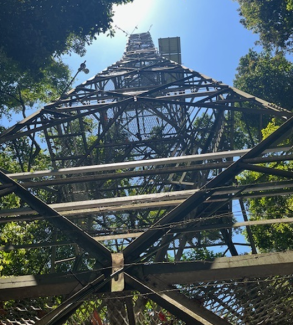
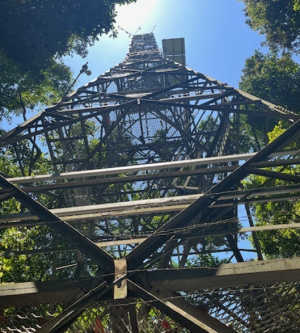
Looking up at the TERN tower infrastructure, similar to NEON towers, at the Robson Creek Rainforest SuperSite. Photo credit: Kate Thibault.
NEON and TERN are both included in the Global Ecosystem Research Infrastructure (GERI), which comprises six national ecological networks: NEON, TERN, the Chinese Ecosystem Research Network (CERN), the European Long-Term Ecosystem Critical Zone and Socio-Ecological Research (eLTER), the Integrated Carbon Observing System (ICOS), and the South African Environmental Observation Network (SAEON).
GERI was envisioned to bring together international environmental research infrastructures (RIs), harmonize their collected data, and reduce uncertainties to enable broader, cross-continental research. This collaboration not only strengthens the research community’s ability to tackle global ecological challenges, but also helps scientists and decision-makers anticipate and prepare for future ones. In 2023, Battelle won a three-year, U.S. National Science Foundation (NSF)-AccelNet (Accelerating Research through International Network-to-Network Collaborations) grant to support efforts to harmonize international, drought-related ecological data across the GERI networks.
While abroad, the Battelle visitors also had the chance to see some field sites of the TERN Australia network, similar to the NEON field sites in the U.S. Dr. Beryl Morris, TERN Director, along with Andrew Ford and Nico Weigand from James Cook University, led a field trip to the TERN site of Robson Creek Rainforest SuperSite (pictured). They were able to connect on challenges common to both TERN and NEON, such as maintaining in-stream water quality monitoring during extreme events like flooding, and share information on emerging technologies such as acoustic monitoring. TERN partners with the Australian Acoustic Observatory, the world’s first national acoustic observatory.
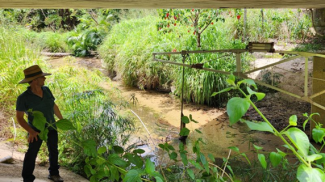
Nico Weigand points out field site infrastructure on a field trip to the TERN Robson Creek Rainforest SuperSite. Photo credit: X/@TERNaus.
Battelle-NEON Expanding Borders at ICRI
From December 3-5, the Battelle delegation presented at the International Conference on Research Infrastructures (ICRI) in Brisbane, Australia. ICRI, a premier forum for the global research infrastructure community, is held biennially. ICRI 2024 was an opportunity to discuss cross-network data integration and interoperability (both within the NSF-AccelNet award and NEON scopes) and to work in person with GERI collaborators.
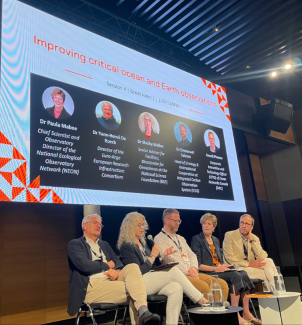
Dr. Paula Mabee moderated a panel exploring how we can advance our understanding of the Earth’s systems. Photo credit: Christine Laney/NEON.
At the conference, Mabee was invited to moderate a panel highlighting best practices in ocean and Earth observation RIs, focusing on strategies to enhance cross-border coordination. Presenters on the panel included members from ICOS, NSF, the Euro-Argo European Research Infrastructure Consortium, and Ocean Networks Canada. Topics ranged from integrating ocean and terrestrial systems to advancing sea-level rise forecasting and exploring next-generation monitoring technologies.
The Battelle NEON team participated across panels. SanClements moderated a panel discussion about global RIs addressing climate challenges through monitoring, mitigation, support for decision-makers, and global environmental accounting and auditing. Loescher presented on a panel that delved into the potential for RI facilities to have real-world impacts on research, industry, and policy. In her panel presentation, Thibault highlighted successful international collaborations, including with the National Institute of Ecology in Korea, emphasizing upcoming projects involving standardization, automation, and integration with related networks.
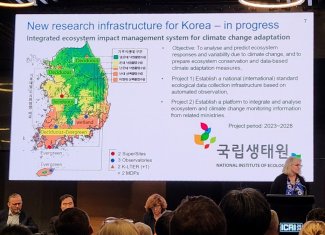
Dr. Kate Thibault discusses a new environmental research infrastructure in South Korea. Photo credit: X/@TERNaus.
ICRI 2024 featured a side event focused on GERI, with presentations and discussions led by Battelle’s Mabee, Loescher, SanClements, and Laney, plus Dr. Isabelle Ceron of TERN and members of the GERI Governance Board. International participants learned how GERI prepares and provides data to better understand environmental change at a global scale and supports the next decade of Earth system science research.
The conference brought together 420 in-person attendees from 50 countries and 500 virtual participants from 39 more. Notably, this year marked the first time Indigenous knowledge and engagement were central themes, with Indigenous representatives sharing insights from their millennia-spanning scientific traditions.
ICRI 2024 was organized by Australia’s Commonwealth Scientific and Industrial Research Organisation (CSIRO), the European Commission, and the Australian Department of Education.
Battelle manages the NEON Program on behalf of the U.S. National Science Foundation (NSF). This participation in global scientific cooperation underscores Battelle’s dedication to advancing science to ensure a better, safer world.