Spotlight
NEON Ambassador Spotlight: Dr. Anna Spiers
August 4, 2026

The NEON Ambassador Program empowers researchers and educators to expand awareness and use of NEON data, resources, and expertise across scientific and educational communities. Through training, mentorship and community-building activities, Ambassadors help more people engage with NEON data and advance open, continental-scale ecology.
Meet Dr. Anna Spiers: Spiers is an ORISE Fellow with the Alaska Climate Adaptation Science Center, a partnership between the U.S. Geological Survey and the University of Alaska Fairbanks. A forest ecologist by training, she uses field observations, remote sensing data, and ecological modeling to study forested landscapes. NEON data have played an important role in her development as a researcher, from her dissertation work to collaborative open-science efforts and her current Ambassador experience.
Her Ambassador Experience
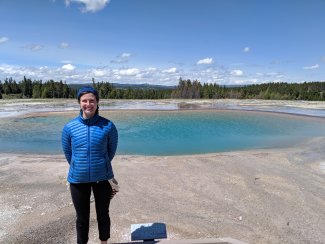
NEON Ambassador Dr. Anna Spiers. Photo courtesy of Anna Spiers.
Spiers’ history with NEON predates her Ambassador term. She credits NEON with saving her dissertation after her original research plans quite literally went up in smoke—the experimental field site she was studying was lost in a fire. Already familiar with NEON data from graduate coursework, Spiers pivoted, using NEON data as the foundation for one of her dissertation chapters, deepening her appreciation for the Observatory as a resource for ecological research. She later contributed to publications that grew out of the 2019 NEON Science Summit and led a team in developing one of the themes in an Ecological Forecasting Challenge that leveraged NEON data, further connecting her to a broader community of researchers using NEON data to advance open, collaborative ecology.
Those experiences are part of the reason that she jumped at the opportunity to become a NEON Ambassador in 2024. She was already an advocate for NEON and open data. For her, the Ambassador program is an opportunity to increase visibility for NEON data among her peers and broaden the community of NEON data users. After all, collecting data is only part of the Observatory’s value. The data also need an active community using the data for applications in research, teaching, and land management decisions.
The Ambassador training also helped Spiers make her own use of NEON data more efficient. Through monthly meetings and homework assignments, she learned about updated software packages and workflows that made it easier to access, harmonize, and work with NEON data. Just as valuable, she could troubleshoot practical challenges with other Ambassadors who were navigating similar steps in their own research.
The peer network was one of the most valuable parts of the Ambassador experience for Spiers. The cohort connected her with early-career researchers she might not otherwise have met: people working in different areas of ecology and evolution but navigating similar career stages and sharing an interest in NEON data. For Spiers, those conversations were energizing because they showed a wide range of researchers using, teaching with, and advocating for NEON data.
“NEON provides a critical service for monitoring our nation’s ecosystems. Finding people to use these data is just as important as collecting the data themselves.”
— Dr. Anna Spiers
About Her Research: Scaling Forest Data from Plots to Landscapes
What’s the question?
How can researchers leverage airborne remote sensing data to characterize vegetation across large landscapes to initialize process-based vegetation models more accurately?
The big picture:
Understanding what is growing where, and how vegetation is arranged is important to predicting how vegetation patterns might change in the future. While field inventory plots provide detailed information about individual trees and plant communities, they are sparse. Airborne remote sensing can extend that information across broader landscapes when paired with field observations. By combining these two types of NEON data, researchers are building a proof of concept for how to build better landscape-scale representations of forest structure and vegetation type for process-based vegetation models to simulate landscape change.
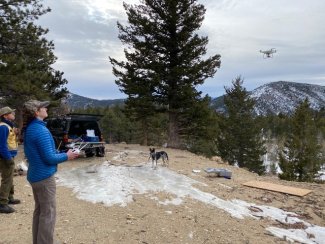
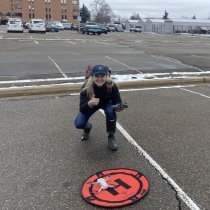
Dr. Anna Spiers piloting an Unmanned Aerial Vehicle. Photo courtesy of Anna Spiers.
How she did it:
In her postdoctoral work at Lawrence Berkeley National Lab, which she leveraged for her NEON Ambassador project, Spiers used NEON forest inventory data as on-the-ground training data, paired with NEON AOP remote sensing data collected from the same sites and years. The field data provide detailed information about the trees and vegetation present in specific plots, while the remote sensing data capture broader patterns in vegetation across the landscape. From these landscape-scale characterizations of vegetation type and structure, she can initialize a process-based vegetation model to simulate landscape-scale experiments of how vegetation and other aspects of the ecosystem may change in the future.
In her workflow, Spiers uses the paired datasets to classify vegetation type and structure across each pixel of the landscape, including information such as plant type and tree height. The result is a more complete picture of what is growing where, extending detailed plot-level observations across a much larger area.
Spiers is sharing this workflow as her final Ambassador Capstone event via a workshop at the Ecological Society of America Annual Meeting. Participants will walk through a demonstration using a NEON site to learn how field observations and remote sensing data can be combined to create landscape-scale vegetation inputs for ecological modeling and analysis.
NEON data products used:
Read more: