G7 Summit: NEON/Battelle Elevate U.S. Ecology and Infrastructure
November 25, 2024
When global leaders meet to discuss science diplomacy and Large Research Infrastructures (LRIs), who better to represent the United States than the director of the only U.S. National Science Foundation (NSF) LRI focused on biological sciences?
Dr. Paula Mabee, Chief Scientist and Observatory Director for the Battelle-managed NSF National Ecological Observatory Network (NEON), spoke in late October at the G7 Italia Science & Technology Conference on LRIs. The conference was co-organized by the Italian Ministry of Universities and Research (MUR) with the Italian National Institute for Nuclear Physics (INFN) and held in Sardinia.
The meeting was convened with representatives from G7 member countries to investigate the critical role that LRIs play in advancing scientific knowledge, as well as their economic, social, and geopolitical implications. Watch the opening session here.
NEON and Battelle: Working towards a global network
Mabee was invited by the NSF to attend the conference this fall as the director of an LRI in the life sciences and a respected U.S. scientist. Also attending from the United States were Dr. Harriet Kung of the Department of Energy, Dr. Ann Schwartz from the White House Office of Science and Technology Policy, and Dr. Linnea Avallone of the NSF.
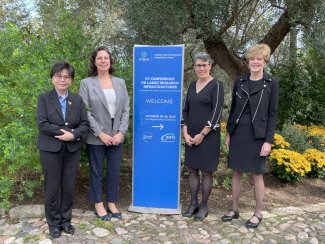
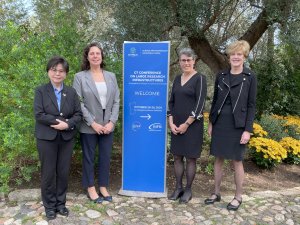
The U.S. attendees to the G7 conference on LRIs. Left to right: Dr. Kung, Dr. Schwartz, Dr. Avallone , Dr. Mabee.
“Beyond my co-attendees from the U.S., I had the opportunity to speak with scientists from Italy, Germany, Canada, Japan… many countries,” says Mabee. “The focus of the conference was about science and diplomacy, and there were many conversations about connecting with other national networks and infrastructures, and their successes and challenges.”
Mabee joined a panel on LRIs and their role in global diplomacy and scientific collaboration, moderated by Giuseppe Pastorelli, Deputy Director General for the Promotion of Italy, Ministry of Foreign Affairs and International Cooperation. Mabee showcased NEON’s highly standardized, interoperable, continental-scale data; the global reach of researchers using the data; and NEON’s collaboration with similar LRIs internationally as part of the Global Ecosystem Research Infrastructure (GERI) network.
Battelle and NEON entered the GERI agreement in 2020 to foster international partnerships for new understandings of global ecology. By connecting infrastructures in Australia, North America, Europe, South Africa, and China, international scientists can investigate environmental questions with both societal and scientific importance across and among continents. In September 2023, Battelle won a three-year AccelNet (Accelerating Research through International Network-to-Network Collaborations) grant from NSF to support efforts to harmonize international, drought-related ecological data across the GERI networks, with NEON leading the project. Battelle’s Michael SanClements, Christine Laney, and Hank Loescher serve as Principal Investigators, along with Bejamin Ruddell from Northern Arizona University. These initiatives are vital for addressing future critical ecological challenges and ensuring long-term human well-being on the planet.
Infrastructure for a changing world
Later in the day, Mabee participated in a roundtable to discuss the challenges of managing LRIs. NEON was designed to understand and forecast the effects of environmental change. The Observatory collects over 180 data products across the U.S. through automated instrument systems, observational field sampling, and remote sensing (Airborne Observation Platform). Field staff also collect and archive over 100,000 samples each year for use at the NEON Biorepository at ASU. In short, it’s an extremely complex research infrastructure network. Battelle has managed NEON for the NSF since 2016 – just one part of a long history of managing large-scale science projects for the U.S. government.
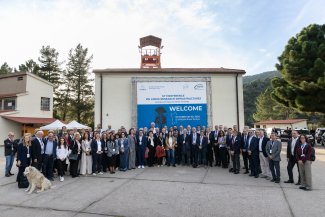
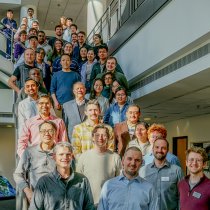
Group photo of attendees at the G7 LRI conference.
Battelle has taken strides to ensure the consistency and continuity of this NSF LRI for the long-term, even with changes to ecosystems. With a 30-year timespan designed to observe most trends in ecology, the infrastructure must be resilient and adaptable. This includes NEON tower infrastructure designed to withstand hurricane-force winds, sensors updated to collect consistent data through extreme weather conditions, and using drones to safely access canopy samples. NEON engineers even built an alert system and dashboard that provides near real-time visibility into instrument health and operation.
“Many people at the roundtable and the meeting in general were interested in learning about Battelle’s management of the Observatory,” says Mabee. “There are plans to make new networks and infrastructures around the world to facilitate research on all areas of science, and learning from successes and challenges of other networks is essential.”
Mabee will be on the international stage in Brisbane, Australia for the International Conference on Research Infrastructures (ICRI), a meeting co-funded by the European Commission. “ICRI 2024 will bring together experts from diverse backgrounds and scientific disciplines to explore trends, challenges, and issues of significance to the international RI community,” states the conference website. Mabee will moderate a panel discussion on “Improving critical ocean and Earth observations.” Other members of NEON Leadership and Battelle staff will also be in attendance for GERI and AccelNet activities.
Learn more about the NEON program here.