NEON Live: Virtual Challenge Hackathon Brings Data Science and Ecology Together
April 6, 2026
Most machine learning models are good at recognizing patterns they have already seen. But what happens when the future looks nothing like the past?
That question drives the NSF Harnessing the Data Revolution (HDR) Scientific Modeling Out Of Distribution (Scientific-MOOD) FAIR Challenge, which asks researchers to test how well machine learning models can make predictions in conditions they were not trained on. It was the focus of a February virtual hackathon hosted by NEON and the Environmental Data Science Innovation & Impact Lab (ESIIL), in collaboration with the HDR Imageomics Institute at The Ohio State University (OSU). Participants gathered to explore the three HDR machine learning benchmark challenges and get support for building submissions.
NEON data used:
• Ground beetles sampled from pitfall traps (DP1.10022.001)
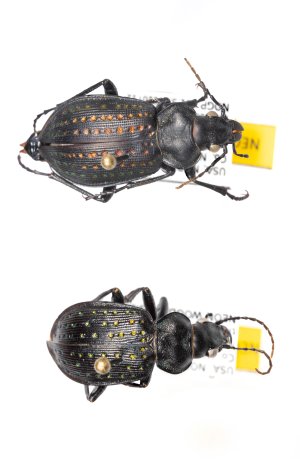
• Images of NEON Biorepository pinned specimens and select metadata (Hugging Face dataset: sentinel-beetles)
Who came? The virtual event attracted 15 participants from across the country, including undergraduate and graduate students in ecology, computer science and data science.
What We Did:
The session opened with an overview of the three HDR challenge tracks: Neural Forecasting, Climate Prediction using Ecological Data and Coastal Flooding Prediction over Time. Participants received guidance on navigating Codabench for model submission and leveraging CyVerse cloud compute resources. A live code-along session demonstrated how to structure and submit a model, after which participants began experimenting with models, testing submissions and discussing approaches with organizers and other attendees.
The NEON ground beetle dataset provided a compelling test case for ecological modeling.
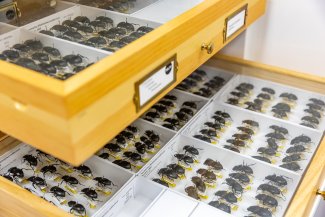
These insects occur across all NEON field sites and can respond quickly to environmental changes. Researchers hypothesize that environmental stressors such as drought may influence subtle traits in these organisms, such as asymmetry, that might not be detected by human researchers. The challenge explored whether machine learning models can detect those signals in image data and determine which signals provide the best predictor of drought conditions, in the absence of human guidance.
In the NEON challenge track, participants explored whether models trained on images of ground beetle specimens could be used to predict the Standardized Precipitation Evapotranspiration Index (SPEI) for the sites where the beetles were collected. Beetle images were collected in a joint effort by Imageomics personnel and NEON Biorepository staff, coordinated by Alyson East, a PhD student at the University of Maine. John Musinsky, a NEON staff scientist, used Google Earth Engine to extract SPEI metrics for NEON sites, which were then joined with the beetle image data. (See full methods.)
What We Learned:
The hackathon highlighted the growing intersection between ecology and data science. By bringing together researchers with different backgrounds, the event created space to explore how machine learning approaches can be applied to ecological questions.
Several individuals and teams ultimately used what they learned during the hackathon to continue developing models and submit entries to the Scientific-MOOD Challenge. Even for participants who did not submit immediately, the event provided a practical starting point for exploring the datasets, tools, and modeling approaches involved in the challenge.
Events like this help connect NEON’s open ecological data with emerging analytical tools and support collaboration between ecologists and data scientists. They also give participants hands-on experience working with new modeling approaches and large, open datasets.
“Machine learning tools offer a new way to look at ecological data. By combining ecological expertise with these analytical approaches, researchers may be able to discover patterns in biological data that we wouldn’t have thought to measure before.” – Eric Sokol, Quantitative Ecologist, NEON Battelle
The winners of the Challenge, announced Mar. 6, will present their solutions in conjunction with the FAIR in ML, AI Readiness, & Reproducibility Research Coordination Network (FARR RCN) workshop in Washington D.C. on Apr. 8. NEON is looking forward to sharing more about their results and the FARR RCN workshop soon.
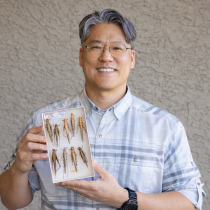
Top photo: Pinned ground beetle specimens at the NEON Biorepository. Photo by Isa S. Betancourt, NEON Biorepository Invertebrate Collections Manager.