
Research Highlight
What Water Isotopes Can Tell Us About Hydrological Timescales
February 28, 2024
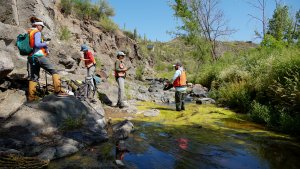
How long does it take for rainwater on land to find its way into streams and waterways? That is the basic question that Zach Butler wanted to explore. Butler – a Ph.D. student in the Water Resources graduate program at Oregon State University (OSU) – and his coauthors used stable water isotope data to trace the movement of water at NEON field sites; in many cases, paired terrestrial and aquatic sites. The results are published in Hydrological Processes: Relationship between isotope ratios in precipitation and stream water across watersheds of the National Ecological Observation Network.
Is This Water Old? Ask The Isotope Ratio
You may not think of water as having an age, but it does! When discussing the "age" of water, especially in hydrological and environmental sciences, it typically refers to the time that has elapsed since the water molecules last entered a particular part of the water cycle. In this case, age refers to the time since the water entered the watershed as precipitation.
Precipitation forms when water vapor condenses into a liquid in the atmosphere. Depending on temperatures, water comes down to terrestrial systems as rain or snow (or sometimes sleet or hail). As precipitation falls, some is intercepted by plants or man-made structures, some reaches the ground, and some falls directly into streams and lakes. Water that reaches the ground may be absorbed into the soil or remain on the surface. Water that is not used by plants, animals, and humans or lost through evaporation will usually (eventually) make its way into the streams, rivers, and lakes that make up a watershed. This can happen through surface runoff, subsurface flow through soil and rock layers, or groundwater systems.
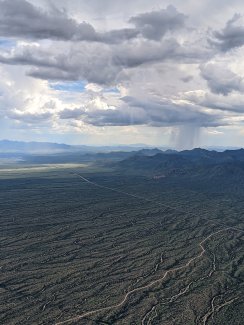
Rain near Tucson, AZ from an AOP flight. Photo credit: Elissa Barris.
The length of time it takes for water from a specific precipitation event to make its way into stream discharge can vary greatly from place to place or over time in a single location. Many variables can impact transit times, including soil type and moisture content, subsurface characteristics, climate conditions, seasonal variations, and human impacts.
But how do we know how long it takes for water to get from one point in the watershed to another? That's where isotopes come in. An isotope is a variant of an element that has a different number of neutrons and, therefore, a different molecular weight. Common stable isotopes used in hydrological studies include oxygen-18 (18O) and deuterium (2H, also known as heavy hydrogen). These isotopes occur naturally in water (H2O) in varying concentrations. Stable isotopes do not change or decay over time, so they make great signatures for tracing water and determining water age.
Water in a particular rainfall event, for example, will have unique ratios of oxygen and hydrogen isotopes determined by the temperature and other factors during water formation in the atmosphere. By measuring the ratios of stable isotopes (δ18O and δ 2H) in water samples, scientists can trace the movement of water through the watershed and find out how long it takes for water with this signature to appear as stream runoff.
The Speed (Or Not) of Runoff at NEON Field Sites
NEON analyzes stable isotopes and their ratios in samples from precipitation, surface water from streams and lakes, and groundwater from wells at aquatic field sites. Butler and his coauthors used these data to examine water transport times at 26 aquatic sites and colocated terrestrial sites across the U.S. Using a mathematical modeling method called a convolution model, they were able to estimate the mean transit time (MTT) for water and the fraction of “young water” in stream discharge at each site. They define young water as runoff with transit times of roughly 2-3 months.
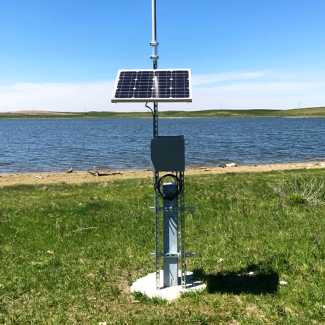
Groundwater well at the NEON PRLA site
Butler says, "These methods are not new, but this is the first study that has been able to look at water transport times on a continental scale across North America. We have several years of data from Alaska to Puerto Rico. NEON provides a novel dataset that allows us to examine these questions at scales that were not possible before."
A main finding of this research is that transit times and young water fractions are highly variable and unique to each site and season. In fact, MTT at NEON sites varies from less than two months to more than 13 years! At half of the sites, MTT estimates are two years or less. The fraction of young water in stream discharge ranged from 1% to 93%, with strong seasonal variability.
The researchers also looked at a variety of site characteristics and found correlations between MTT and latitude, longitude, slope, clay fraction, temperature, precipitation magnitude, and precipitation frequency. Young water fraction was most strongly correlated with watershed size, longest flow length, and slope. "It really shows that each watershed is unique in its own way,” explains Butler. “There are a lot of variables that can impact how water moves through a watershed."
More studies are needed to untangle the relationships between water transport, geological characteristics, climate, and plant, animal, and microbial communities. This study using NEON colocated sites and data is an important step toward understanding variations in water cycling at a continental scale.
Butler is continuing to work on mathematical models for hydrology. He hopes to improve water transport models by comparing model predictions to observed transit times at NEON sites. "Ultimately, we want to create a model that can capture all this so you could potentially apply it to any watershed you want."
Water Cycling for Ecosystem Health
Why does it matter how quickly water travels through a watershed? Water transit times can have important implications for biodiversity, agriculture, movement of nutrients and pollutants, and other aspects of ecosystem health and function such as flushing out pollutants to groundwater availability. Transit times affect nutrient cycling, sediment transport, and the overall health of aquatic ecosystems, which in turn can impact aquatic and benthic population dynamics and biodiversity.
"There hasn't been a lot of research looking at these relationships," Butler says. "With the data available from NEON, I would love to see someone look at correlations, for example, between water age and fish populations or plant health. NEON collects so many different datasets concurrently at their sites that would make these kinds of studies possible."
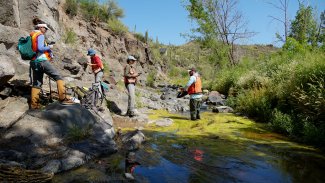
NEON staff doing Water Chemistry sampling and processing at the SYCA aquatic site in D14.
Butler is also interested in how ecosystem change could impact water transit times in the future. For example, many watersheds are historically dependent on heavy snowpack, which melts slowly over many months. If more precipitation instead comes down as rain, that water will cycle more quickly through the ecosystem, resulting in a greater proportion of young water vs. old water in the watershed. These changes are likely to impact water availability during dry months, which in turn will impact plant growth and overall ecosystem productivity and biodiversity. Wildfire events may also impact water cycling; if there are fewer trees to take up water in the landscape, water may cycle through more quickly as runoff or subsurface flow.
The relationships between water movement in the watershed and other features of the landscape are highly complex. More studies are needed to untangle the relationships between water transport, geological characteristics, climate, and plant, animal, and microbial communities. This study using NEON colocated sites and data is an important step toward understanding variations in water cycling at a continental scale.