NSF NEON, Operated by Battelle

Main navigation

  • About
    • NEON Overview
      • Vision and Management
      • Spatial and Temporal Design
      • History
    • About the NEON Biorepository
      • ASU Biorepository Staff
      • Contact the NEON Biorepository
    • Observatory Blog
    • Newsletters
    • Staff
    • FAQ
    • Contact Us

    About

  • Data
    • Data Portal
      • Data Availability Charts
      • API & GraphQL
      • Prototype Data
      • Externally Hosted Data
    • Data Collection Methods
      • Airborne Observation Platform (AOP)
      • Instrument System (IS)
        • Instrumented Collection Types
        • Aquatic Instrument System (AIS)
        • Terrestrial Instrument System (TIS)
      • Observational System (OS)
        • Observation Types
        • Observational Sampling Design
        • Sampling Schedules
        • Taxonomic Lists Used by Field Staff
        • Optimizing the Observational Sampling Designs
      • Protocols & Standardized Methods
    • Getting Started with NEON Data
      • neonUtilities for R and Python
      • Learning Hub
      • Code Hub
    • Using Data
      • Data Formats and Conventions
      • Released, Provisional, and Revised Data
      • Data Product Bundles
      • Usage Policies
      • Acknowledging and Citing NEON
      • Publishing Research Outputs
    • Data Notifications
    • NEON Data Management
      • Data Availability
      • Data Processing
      • Data Quality

    Data

  • Samples & Specimens
    • Biorepository Sample Portal at ASU
    • About Samples
      • Sample Types
      • Sample Repositories
      • Megapit and Distributed Initial Characterization Soil Archives
    • Finding and Accessing Sample Data
      • Species Checklists
      • Sample Explorer - Relationships and Data
      • Biorepository API
    • Requesting and Using Samples
      • Loans & Archival Requests
      • Usage Policies

    Samples & Specimens

  • Field Sites
    • Field Site Map and Info
    • Spatial Layers & Printable Maps

    Field Sites

  • Resources
    • Getting Started with NEON Data
    • Research Support Services
      • Field Site Coordination
      • Letters of Support
      • Mobile Deployment Platforms
      • Permits and Permissions
      • AOP Flight Campaigns
      • Research Support FAQs
      • Research Support Projects
    • Code Hub
      • neonUtilities for R and Python
      • Code Resources Guidelines
      • Code Resources Submission
      • NEON's GitHub Organization Homepage
    • Learning Hub
      • Tutorials
      • Workshops & Courses
      • Science Videos
      • Teaching Modules
    • Science Seminars and Data Skills Webinars
    • Document Library
    • Funding Opportunities

    Resources

  • Impact
    • Research Highlights
    • Papers & Publications
    • NEON in the News

    Impact

  • Get Involved
    • Upcoming Events
    • Research and Collaborations
      • Environmental Data Science Innovation and Inclusion Lab
      • Collaboration with DOE BER User Facilities and Programs
      • EFI-NEON Ecological Forecasting Challenge
      • NEON Great Lakes User Group
      • NCAR-NEON-Community Collaborations
    • Advisory Groups
      • Science, Technology & Education Advisory Committee
      • Technical Working Groups
    • NEON Ambassador Program
      • Exploring NEON-Derived Data Products Workshop Series
    • Partnerships
    • Community Engagement
    • Work Opportunities

    Get Involved

  • My Account
  • Search

Search

About

  • NEON Overview
  • About the NEON Biorepository
  • Observatory Blog
  • Newsletters
  • Staff
  • FAQ
  • Contact Us

Breadcrumb

  1. About
  2. Observatory Blog
  3. North American Soils Analysis Yields New Research Guidelines and Continental-Scale Patterns

North American Soils Analysis Yields New Research Guidelines and Continental-Scale Patterns

February 5, 2014
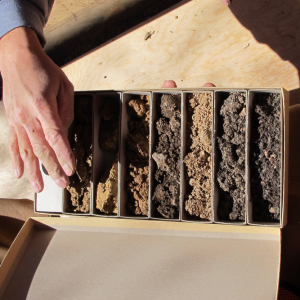
Soil Samples

Just as most of an iceberg stays hidden under the surface of the ocean, many of the most important ecosystem processes happen underfoot. Soil properties, processes and organisms play key roles in everything from climate change to crop growth to clean water and natural disasters.

The National Ecological Observatory Network will be sampling an enormous variety of soils across the U.S. Soil conditions and types vary widely even within a small plot of land, and NEON needs to perform consistent and representative soil measurements at each of its 60 terrestrial sites throughout the network's 30-year lifetime. Optimizing these measurements requires a strategic, quantitative approach. The payoff is new opportunities to study and understand soils and their impact on ecology and natural resources across the country.

In a recent open-access paper published in PLoS ONE, NEON scientists present the results of a continental-scale soil analysis that demonstrates some of the power of consistent, large-scale sampling.

Soil sampling analyses like this one have never before been conducted at this scale. NEON scientists went on a whirlwind tour of 60 NEON field sites and collected hundreds of evenly spaced soil temperature and moisture measurements at each site. They found new evidence of emergent, continental-scale patterns in soil variability, patterns that earlier studies with fewer sites and inconsistent sampling methods couldn't identify.

In addition, NEON scientists used this large body of standardized soil data to demonstrate how NEON sites provide a remarkably representative snapshot of U.S. soils. In the process of using the data to optimize NEON soil sampling, the scientists developed a tool that could help other researchers plan soil sampling campaigns in the U.S. They were also able to test a few hypotheses about soil variability, with some surprising results.

Soil is a reservoir for moisture, nutrients, and hardworking micro-organisms that play a major role in recycling the nutrients necessary to grow plant life and feed animals and plants alike above ground. As part of its mission to collect and provide standardized ecological data from across the United States, NEON will regularly observe and measure soil microbes, belowground root biomass, and the chemical and physical conditions of soil at each of its 60 terrestrial sites.

NEON scientists Hank Loescher, Ed Ayres and Hongyan Luo are coauthors on the PLoS paper, along with former NEON field technician Max Brunke.


Related content

  • Spatial Variation in Soil Properties among North American Ecosystems and Guidelines for Sampling Designs. PLoS ONE, January 17, 2014. DOI: 10.1371/journal.pone.0083216
  • A simple quantitative tool to guide soil sampling designs at the 1 ha scale
  • NEON soil archive

Share

Related Posts:

Unlocking the Secrets of Soil Microbial Metabolites

February 2, 2026

Petri dishes of bacteria cultures

Featured Expert: Tong Qiu - Mapping Forest Fecundity

October 31, 2025

Featured expert Tong Qiu headshot

Discontinuation of Select NEON Data Products

January 29, 2026

NSF NEON, Operated by Battelle

Follow Us:

Join Our Newsletter

Get updates on events, opportunities, and how NEON is being used today.

Subscribe Now

Footer

  • About Us
  • Contact Us
  • Terms & Conditions
  • Careers
  • Code of Conduct

Copyright © Battelle, 2026

The National Ecological Observatory Network is a major facility fully funded by the U.S. National Science Foundation.

Any opinions, findings and conclusions or recommendations expressed in this material do not necessarily reflect the views of the U.S. National Science Foundation.