The Catch: NEON Goes Fishing
February 16, 2017
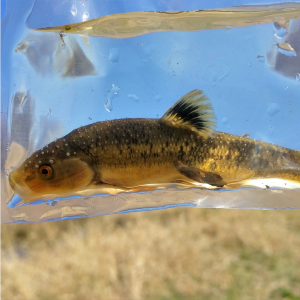
Did you know that each year over 33 million people participate in the the US sport fishing industry, generating over $48 billion dollars, and supporting more than 828,000 jobs annually (ASA 2013)? Not only do fish play a major role in our recreation and food industries, but they are a key part of freshwater aquatic ecosystems, the biological community found in inland streams, rivers, floodplains, lakes, swamps, reservoirs, irrigation canals, etc.
As a keystone predator, fish have an exceptionally large impact on their environment relative to other species. They transfer energy and nutrients up and down the food chain, the sequence of who eats whom in an ecosystem, by eating other fish and macroinvertebrates and in turn being eaten by other predators. Understanding these interactions is critical for determining the route by which pollutants get concentrated up the food chain (e.g., the path of contaminants we consume by eating fish). The knowledge of how species are connected is also vital for understanding how natural and man-made environmental pressures affect ecosystems. By collecting data related to fish diversity and populations, NEON aims to give researchers the tools they need to gain a complete picture of the food chain in aquatic ecosystems across the United States.
NEON’s aquatic scientists have been hard at work creating and implementing a sampling design for 34 aquatic sites across the US (including 7 lakes, 24 streams and 3 rivers). Using standardized sampling protocols at all the sites, NEON will collect and provide data over the next 30 years that can be used to quantify the impacts of environmental change, land use and biological invasions on freshwater environments. Data are collected using automated in situ sensors, airborne remote sensing technologies and a variety of observational sampling techniques.
As part of NEON’s observational sampling methods, field technicians and scientists venture out twice a year to sample fish. NEON aims to sample fish in the spring and fall as this data will provide researchers with a picture of in-season fish development (growth) and how different species use the stream or lake habitats throughout the biologically active period. Although the timing may vary from site to site due to seasonal or logistical constraints (e.g., restrictions during fish spawning seasons), protocols have been developed to ensure those data will be comparable between sites and over time.
Sampling Fish: Diversity and populations
Fish sampled by NEON are photographed, measured, weighed and then released. The length and weight measurements are useful for estimating fish biomass. Seasonal changes in biomass are related to the availability of prey and indicate the overall biological productivity and health of the aquatic system. Some fish tissues will eventually be collected and DNA sequenced for additional taxonomic information. Inadvertently killed fish are be collected as voucher specimens and available to the scientific community at a curation facility or museum.
NEON uses two fish sampling methods: active sampling in wadeable streams and lakes to capture most fish in a specific section of the waterbody, and passive lake sampling to capture larger fish that cruise the shoreline and deeper parts of the lake.
Method 1: Active sampling
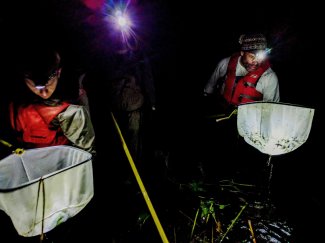
Night lake electrofishing at the CRAM field site (Photo by: Brandon Jensen).
Active fish sampling uses electricity to catch fish. The process requires up to four staff: one armed with a backpack electrofisher and anode (a positive electrode), two with nets, and one with a bucket to collect the immobilized fish. First, they measure the water’s conductivity to determine the appropriate settings for the backpack electrofisher. The goal is to immobilize fish just enough to capture them without harm. When a fish swims into the electric field, an involuntary muscular response in the fish causes them to swim towards the anode (electrotaxis). Once a fish reaches the anode, it’s easily netted by the field crew. Fish should only be immobilized for few seconds, so staff must quickly net the fish, then put it into the bucket for sampling. After staff have identified, photographed, measured, and weighed the specimen, they return the fish to the water unharmed.
If you’re interested in learning more about this process, keep an eye out for The Catch Part 2 where we will dive into electrofishing at our Crampton Lake site in Wisconsin.
Method 2: Passive sampling
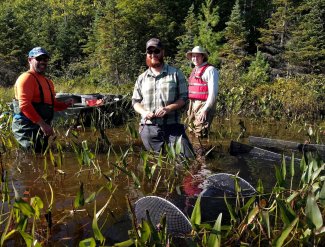
Passive fish sampling
NEON also utilizes two different passive sampling methods, one for sampling fish in shallow nearshore habitats and the other for sampling fish at deeper depths. In shallow areas, mini fyke nets are deployed for eight to 12 hours. These nets are long and stationary, with a leading panel that extends perpendicular to the lake’s edge and is designed to direct fish cruising the nearshore into a series of netted chambers and into the final collection chamber (cod end). In deeper areas, experimental gill nets are used. These nets have several panels of various mesh sizes to collect both small and large fish and thus a representative sample of the fish community. Because gill nets capture fish by entanglement, these nets are only deployed for 1-2 hours to reduce fish injuries.
To date, fish sampling has taken place at 14 sites in 11 of NEON’s domains. At some sites, such as Prairie Pothole and Prairie Lake in D09 - Northern Plains, more than 100,000 fish were caught during one sampling bout. Although very successful, catching an overabundance also comes with the challenge of keeping as many fish as possible alive during the sampling period, requiring aquatic staff to focus on getting a representative sample with fewer fish captured. Meanwhile at Crampton Lake in Domain 05, gill nets have only caught a single fish, an old largemouth bass.
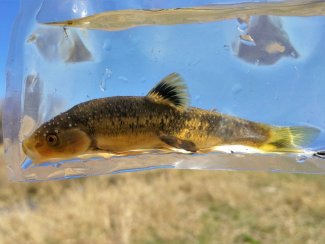
Live fish sample from a NEON site
Reference:
Southwick Associates. Sportfishing in America: An Economic Force for Conservation. Produced for the American Sportfishing Association (ASA) under a U.S. Fish and Wildlife Service (USFWS) Sport Fish Restoration grant (F12AP00137, VA M-26-R) awarded by the Association of Fish and Wildlife Agencies (AFWA), 2012.