
NSF NEON, Operated by Battelle

Main navigation

  • About
    • NEON Overview
      • Vision and Management
      • Spatial and Temporal Design
      • History
    • About the NEON Biorepository
      • ASU NEON Biorepository Staff
      • Contact the NEON Biorepository
    • Observatory Blog
    • Newsletters
    • Staff
    • FAQ
    • User Accounts
    • Contact Us

    About

  • Data
    • Data Portal
      • Data Availability Charts
      • API & GraphQL
      • Prototype Data
      • Externally Hosted Data
    • Data Collection Methods
      • Airborne Observation Platform (AOP)
      • Instrument System (IS)
        • Instrumented Collection Types
        • Aquatic Instrument System (AIS)
        • Terrestrial Instrument System (TIS)
      • Observational System (OS)
        • Observation Types
        • Observational Sampling Design
        • Sampling Schedules
        • Taxonomic Lists Used by Field Staff
        • Optimizing the Observational Sampling Designs
      • Protocols & Standardized Methods
    • Getting Started with NEON Data
      • neonUtilities for R and Python
      • Learning Hub
      • Code Hub
    • Using Data
      • Data Formats and Conventions
      • Released, Provisional, and Revised Data
      • Data Product Bundles
      • Usage Policies
      • Acknowledging and Citing NEON
      • Publishing Research Outputs
    • Data Notifications
    • NEON Data Management
      • Data Availability
      • Data Processing
      • Data Quality

    Data

  • Samples & Specimens
    • Biorepository Sample Portal at ASU
    • About Samples
      • Sample Types
      • Sample Repositories
      • Megapit and Distributed Initial Characterization Soil Archives
    • Finding and Accessing Sample Data
      • Species Checklists
      • Sample Explorer - Relationships and Data
      • Biorepository API
    • Requesting and Using Samples
      • Loans & Archival Requests
      • Sample Guidelines and Policies

    Samples & Specimens

  • Field Sites
    • Field Site Map and Info
    • Spatial Data Layers & Maps

    Field Sites

  • Resources
    • Getting Started with NEON Data
    • Research Support Services
      • Field Site Coordination
      • Letters of Support
      • Permits and Permissions
      • AOP Flight Campaigns
      • Research Support FAQs
      • Research Support Projects
    • Code Hub
      • neonUtilities for R and Python
      • Code Resources Guidelines
      • Code Resources Submission
      • NEON's GitHub Organization Homepage
    • Learning Hub
      • Tutorials
      • Workshops & Courses
      • Science Videos
      • Teaching Modules
    • Science Seminars and Data Skills Webinars
    • Document Library
    • Funding Opportunities

    Resources

  • Impact
    • Research Highlights
    • Papers & Publications
    • NEON in the News

    Impact

  • Get Involved
    • Upcoming Events
    • Research and Collaborations
      • Environmental Data Science Innovation and Inclusion Lab
      • Collaboration with DOE BER User Facilities and Programs
      • EFI-NEON Ecological Forecasting Challenge
      • NEON Great Lakes User Group
      • NCAR-NEON-Community Collaborations
    • Advisory Groups
      • Science, Technology & Education Advisory Committee (STEAC)
      • Innovation Advisory Committee (IAC)
      • Technical Working Groups (TWG)
    • NEON Ambassador Program
      • Exploring NEON-Derived Data Products Workshop Series
    • Partnerships
    • Community Engagement
    • Work Opportunities

    Get Involved

  • My Account
  • Search

Search

About

  • NEON Overview
  • About the NEON Biorepository
  • Observatory Blog
  • Newsletters
  • Staff
  • FAQ
  • User Accounts
  • Contact Us

Breadcrumb

  1. About
  2. Observatory Blog
  3. Data in Action: What Keeps Stream Critters in Sync (or Not)?

Research Highlight

Data in Action: What Keeps Stream Critters in Sync (or Not)?

May 18, 2026
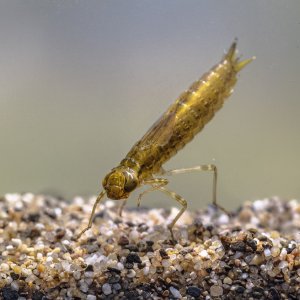
Dragonfly larvae on sand

What’s the question? When stream environments fluctuate, do aquatic macroinvertebrate communities respond together—or does each species follow its own pattern?

The big picture: Streams are constantly changing systems, shaped by shifts in temperature, water flow and available resources. Scientists use aquatic macroinvertebrates—organisms like insect larvae, snails and small crustaceans—as indicators of ecosystem change because they respond quickly to local conditions. Understanding how these communities fluctuate over time helps reveal how stable and resilient stream ecosystems may be.

NEON data products used:
  • Aquatic macroinvertebrate collection (DP1.20120.001)
  • Temperature (PRT) in surface water (DP1.20053.001)
  • Continuous discharge (DP4.00130.001)  
Researcher(s): Anthony Pignatelli and Dr. Tad Dallas, University of South Carolina

What they did and what they learned
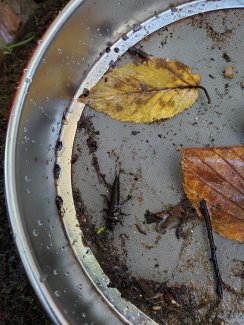
Aquatic macroinvertebrates in Domain 01 (MA)
Aquatic macroinvertebrates during NEON sampling in D01 (MA). Photo by Annie Vincent, NEON field science technician.

Using NEON’s standardized, long-term data products, researchers analyzed aquatic macroinvertebrate communities across 18 streams in the United States from 2014 to 2022. They were interested in community synchrony: whether species increase and decrease in abundance together or fluctuate independently over time.

The team compared the patterns in community abundance to differences in stream conditions, including temperature variability, discharge (streamflow) variability and species turnover (the rate at which species appear and disappear in a community).

They expected that more variable conditions would lead species to respond differently, resulting in less synchrony. But that’s not what they found. Across sites, community synchrony was not related to temperature variability, discharge variability or species turnover. Even streams with very different environmental conditions showed similar patterns in how species fluctuated over time. Instead, the clearest differences emerged when researchers looked at how species feed.

  • Feeding strategy helped explain which species contribute most to overall community dynamics
    • Scrapers (which graze algae) and filterers (which capture particles from the water) were more likely to fluctuate in sync with other species
    • Shredders (which break down leaf litter) were less likely to move in step with the community

These findings suggest that biological roles—particularly how organisms acquire resources—may be a key factor shaping how communities change over time. By combining NEON’s long-term environmental data with species traits, this study highlights a more nuanced view of stream ecosystems.  

“Our results show just how complex freshwater ecosystems can be and how the life history of these critters is important to consider when trying to understand large-scale dynamics. This research underscores just how important it is to have continuous monitoring of ecological populations over multiple years. NEON is the reason we can ask large-scale temporal questions in our research.” 

-Anthony Pignatelli, Department of Biological Sciences, University of South Carolina
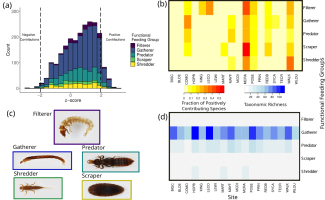
Figure showing results of A. J. Pignatelli and T. A. Dallas research on aquatic macroinvertebrate communities

Note. Figure that provides a summary of the functional feeding group analysis including a stacked histogram of z-scores for each functional feeding group, a heat map showing contributions to community synchrony, example images of taxa found in each functional feeding group provided by The Atlas of Common Freshwater Macroinvertebrates of Eastern North America and a heat map showing the number of taxa for each group that were used to estimate functional feeding group contributions to community synchrony. Full description available from "Community synchrony in aquatic macroinvertebrates is unrelated to environmental variability but differs among functional feeding groups," by A. J. Pignatelli and T. A. Dallas, 2026, Ecology & Evolution, V16(2), https://doi.org/10.1002/ece3.72999. CC BY 4.0. Reprinted with permission.

Read more: Pignatelli, A. J., & Dallas, T. A. (2026). Community synchrony in aquatic macroinvertebrates is unrelated to environmental variability but differs among functional feeding groups. Ecology & Evolution, 16(2). https://doi.org/10.1002/ece3.72999


Share

Related Posts:

Biology, sediment chemistry, and groundwater chemistry sampling windows for all aquatic sites updated

April 6, 2026

Modification of Select NEON Data Products

January 29, 2026

Discontinuation of Select NEON Data Products

January 29, 2026

NSF NEON, Operated by Battelle

Follow Us:

Join Our Newsletter

Get updates on events, opportunities, and how NEON is being used today.

Subscribe Now

Footer

  • About Us
  • Contact Us
  • Terms & Conditions
  • Careers
  • Code of Conduct

Copyright © Battelle, 2026

The National Ecological Observatory Network is a major facility fully funded by the U.S. National Science Foundation.

Any opinions, findings and conclusions or recommendations expressed in this material do not necessarily reflect the views of the U.S. National Science Foundation.