Confronting ecological change takes a collaborative leap with the NEON Ecological Forecasting Challenge
December 2, 2020
Press release - Virginia Tech Daily
Looking to predict beetle abundance and springtime greenness, among other things, the NEON Ecological Forecasting Challenge is looking to mobilize researchers and forecast answers to a complex set of ecological questions.
The National Ecological Observatory Network, otherwise known as NEON, is a continental-scale network of 81 monitoring sites that collects open access ecological data to better understand how ecosystems across the U.S. are changing over time.
“It’s the first of its kind,” said Quinn Thomas, director of the Challenge and associate professor in the Department of Forest Resources and Environmental Conservation in the College of Natural Resources and Environment at Virginia Tech. “Running models to predict ecological data that has yet to be collected across the U.S. is really novel, and doing it across many different fields of ecology simultaneously has never been done before.”
Designed and hosted by 200 contributors within the National Science Foundation-funded Ecological Forecasting Initiative Research Coordination Network (EFI-RCN), the trans-institutional Challenge will launch in 2021 and use data from NEON sites. The Challenge will provide resources and a common framework for generating and submitting forecasts of ecological processes.
“Fundamentally, it’s a means to an end: to advance our capacity to predict the future of nature while generating forecasts that are usable to stakeholders. From a community standpoint, the Challenge is a focal point for sharing knowledge and building a network of scientists and stakeholders engaged in the practice of ecological forecasting,” said Thomas, who is also an affiliated faculty member of the Global Change Center within the Fralin Life Sciences Institute.
The Challenge highlights five different themes: aquatic ecosystems, terrestrial carbon exchange, tick populations, plant phenology, and beetle communities. Each theme involves a different aspect of ecology meant to engage a wide array of researchers.

Beetle samples
Since ecological forecasting is a relatively young field, the hope is that the Challenge will build a foundation for ecological forecasting and unravel the uncertainty stakeholders face when managing natural systems.
Institutional stakeholders, such as the National Phenology Network and the National Oceanic and Atmospheric Administration, are partnering with the EFI-RCN to refine forecasts during the challenge and reduce uncertainty.
“The ‘if you build it, they will come’ mentality doesn’t work for most decision support,” said Michael Dietze, associate professor in the Department of Earth and Environment at Boston University and lead of the affiliated Ecological Forecasting Initiative. “You have to have the decision-makers involved, and you have to really understand what their needs are.”
A major goal of the Challenge is to foster an atmosphere of community. Participants, no matter their forecasting experience, will have the opportunity to collectively share their forecasts, therefore improving future forecasting models.
“One of the fundamental goals in EFI is to bring the community together and understand what are the cross-cutting challenges that we face regardless of what particular system we work in,” Dietze said. “I think the forecast challenge is a rallying cry for the community to come together behind this effort.”
One of the challenges that the ecological forecasting community faces, Dietze said, is education and training. Thomas, at Virginia Tech, will teach an ecological forecasting course in the spring, as will Dietze at Boston University and Carl Boettiger at UC Berkeley. Undergraduate and graduate students in these courses will be directly participating in the NEON Ecological Forecasting Challenge.
“We hope that it can pull in a new generation of scientists who think about the aspects of ecological forecasting early in their career training,” Thomas said. “Not only does that include producing forecasts, but that’s learning how to do ecology in the context of computational sciences and reproducibility.”
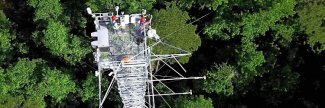
Bird's eye view from the LENO tower.
To galvanize these early-career scientists, graduate and postdoctoral students are also going beyond the classroom and leading Challenge themes.
“This grassroots effort that the Ecological Forecasting Initiative is bringing on is really awesome, and beyond that, it’s an honor to be a part of it,” said Anna Spiers, a Ph.D. student at the University of Colorado and team leader for the beetle community theme. “I’m really excited to see the range of participants who come to the challenge and the range of models that people create.”
The EFI-RCN encourages students, both undergraduate and graduate, to join the challenge alongside faculty, institutional researchers, and international groups. Participants can submit forecasts as individuals or teams and will be evaluated based on their forecasts’ precision and accuracy. Evaluations and data will be available in real-time through an automated cyberinfrastructure.
Being the Challenge’s inaugural year, Thomas understands this year will look to increase participant numbers and smooth over any wrinkles in anticipation of running the Challenge in future years. Regardless, this year’s challenge is the first step for the EFI-RCN and the ecological community at large to better predict and understand the vital forces of nature.
To register for the EFI-RCN NEON Ecological Forecasting Challenge, visit the challenge’s website.
- Written by Tyler Harris