Spotlight
Bringing NEON Data into the Classroom: Lessons from ESA
December 5, 2023
Ecology education is vital to understanding and safeguarding our environment and to fostering a sense of responsibility toward conservation and habitat health. Equipping future generations with the skills to explore ecology questions not only ensures informed decision-making, but also paves the way for innovative solutions to address pressing environmental challenges, securing a healthier planet for decades to come.
The availability of large, open data sets is changing the way ecologists conduct research and the way ecology is taught. Open data from the NEON program and other large ecology networks are a potential goldmine for undergraduate and graduate educators. Two presentations at this summer's Ecological Society of America (ESA) 2023 annual meeting evaluated ways in which NEON data are leveraged in publicly available lesson plans. The presenters also shared practical advice to help educators get the most out of NEON's data products and abundant learning resources.
The Power of Authentic Ecology Data
In the era of Big Data, data science is an important part of the postsecondary ecology curriculum. Dr. Joe von Fischer, a professor in the Department of Biology at Colorado State University (CSU), is using NEON data in his graduate ecology classes to introduce students to data science methods and allow them to explore ecological concepts using real-world data. He says, "As ecology moves more toward Big Data, I think we as a field are well poised to ask interesting questions about how ecological systems work and then to use data and data analyses in order to move the field forward."
Josie Otto, a third-year Ph.D. student and teaching assistant in von Fischer's class, says she appreciates "the power of messy, authentic data in the classroom" and the potential of open networks like NEON to reshape ecology curriculums. "I think the biggest potential that I see in the NEON data is the ability to integrate multiple datasets to provide more holistic views of ecosystems and how they're changing," she says. For example, instead of starting with a hypothesis and then conducting field research, researchers might start with the data and see what patterns unfold and what questions are suggested by those patterns.
However, using the data requires a high level of quantitative literacy, including the ability to clean and manipulate raw datasets and analyze and interpret the results. "Students have a much more engaging and thoughtful time when they're interacting with authentic data, which is exactly what NEON can provide," says Otto. "There needs to be a shift in education to focus more on quantitative literacy in ecology, which can be difficult for people who don't have the background and content knowledge to do that."
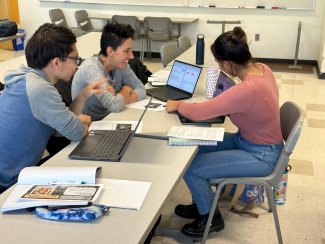
Students Arsen Yerlan (left), Lauren Hafford (middle), and Alyssa Mathews (right) learn data skills with NEON data in the classroom. Photo credit: Joe von Fischer.
A View from the Classroom: Data Science vs. Ecology
Otto is a discipline-based education researcher; her dissertation focuses on methods of teaching ecosystem ecology. Her experience in von Fischer's class inspired her to look closely at how NEON data are being used in postsecondary classrooms. Along with several coauthors, Otto conducted a comprehensive review of publicly available NEON lesson plans from the NEON website and on QUBESHub, which houses lesson plans developed by the NEON Data Education Faculty Mentoring Network. The analysis resulted in two presentations at ESA 2023:
- "NEON in the classroom: a systematic review of what and how NEON data are used to promote ecological literacy" (presented by Otto with von Fischer and other coauthors)
- "How is NEON leveraged to meet the 4DEE framework" (presented by Elizabeth Diaz-Clark – a CSU Ecology graduate student – with Otto and other coauthors)
Otto's analysis shows that the lessons use a range of different data products and are aligned with a variety of ecological concepts. However, most of the available lesson plans focus on the "getting started" phase, using NEON data to teach data science skills starting with how to download, manipulate, and analyze NEON data products. While these skills are critical, Otto's analysis suggests that NEON data is not yet being used to its full potential in ecology classrooms to explore key concepts in ecology.
The second presentation focused on how well the published lesson plans align with ESA's Four-Dimensional Ecology Education (4DEE) curricular framework. Released in 2018, the 4DEE Framework outlines 21 essential elements of ecology education organized in four dimensions: Core Ecological Concepts, Ecology Practices, Human-Environment Interactions, and Cross-Cutting Themes. Analyzing the same lesson plans against the 4DEE Framework shows that they rarely address human dimensions such as socioeconomics or human dependencies on ecosystem services – aspects of ecology health research that fall outside the scope of NEON but that could be readily supplemented with NEON resources. "Combining NEON datasets with other datasets focused on human dimensions could be a very powerful way to understand how humans are coexisting with or managing ecosystems," says Otto.
Overall, both Otto and von Fischer would like to see more uses of NEON data in the classroom, including lesson plans that go beyond teaching data science to using the data to understand ecological concepts and explore research questions in classrooms. "NEON is really a gift to the scientific community," says von Fischer. "It provides us with the potential to learn about diverse ecosystems, with data that are collected in a uniform way. Creating an access point for students into that world is powerful because, more and more, the way that they will interface with their world will be about data. But you have to be able to connect data to ideas. Otherwise, it's just making up stories. So, it's important for students to learn about the basic principles of how ecosystems work and then to be able to evaluate their ideas by looking at the data NEON makes available."
Lowering the Barriers to Using NEON Data
Von Fischer hopes to see the growth of an active community of educators who are using NEON data in the classroom. While the published lessons on the NEON website and QUBESHub are valuable, especially for teaching data science skills, he envisions a community-driven online hub where people can share lesson plans, ideas, and code for analysis or development of derived data products.
In the meantime, Otto and von Fischer have several suggestions for educators getting started with NEON data:
- Think about your learning goals. Is your primary goal to teach ecology concepts, enable student-driven ecology research, or teach data science skills? In choosing or designing lesson plans, consider the desired learning outcomes and tailor the plan accordingly.
- Partner with colleagues. Ecology educators who do not have strong data science skills themselves should not feel like they have to do it all themselves. This is a great opportunity to form collaborations with other colleagues who have expertise in data analysis.
- Focus on process, not product. In von Fischer's class, he makes sure that students who are just starting out in data analysis are paired with those with more background in data science. The goal is for everyone to grow their skills and make progress, regardless of where they are starting from. Von Fischer stresses the importance of having realistic expectations for project outcomes grounded both in data availability and the data science skills of students.
- Don't trust data blindly. Students should learn to examine data sets skeptically and be aware of the potential impact of data gaps, instrument errors, and other data quality issues. NEON puts significant resources into ensuring data quality, and understanding these issues is an important quantitative literacy skill.
- Start local. Using data from nearby NEON field sites is a great way to engage students with local or regional ecological issues. While not every college has a NEON field site in their backyard, students can start by looking for data from sites located in the same region or ecoclimate zone.
The NEON program has extensive Learning Resources for researchers, educators and students getting started with NEON data, including:
- The Getting Started Guide
- The Learning Hub, which includes teaching modules and tutorials geared for postsecondary educators and students
- The Code Hub, with downloadable R packages and utilities for working with NEON data or creating derived data products
- Webinars, workshops and data institutes to train students and researchers on key skills to work with NEON and NEON-like data
Otto encourages educators who are curious about NEON data to start with something simple and go from there, without worrying about perfection. She says, "Just be brave and start integrating it into your curriculum and see what happens. As you learn more, you can change it for future semesters."