
Tutorial
The Importance of Reproducible Science
Last Updated: Jul 1, 2026
"Reproducibility is a key tenet of the scientific process that dictates the reliability and generality of results and methods." From Powers, S. M., and S. E. Hampton (2019), Open science, reproducibility, and transparency in ecology (Abstract)
This lesson introduces the core principles of reproducible science in ecology and provides practical ways to apply them in your own research workflows.
In ecological science, reproducibility is especially important because observations are often context-dependent in space and time, so transparent and computationally reproducible workflows are critical for credible science, management, and policy decisions.
NEON data are especially well suited for reproducible ecological workflows because they are collected using standardized protocols across sites and time, include rich metadata and documentation, and are delivered in formats that make analyses easier to trace, rerun, and compare.
Learning Objectives
At the end of this activity, you will be able to:
- Summarize the four facets of reproducibility.
- Describe several ways that reproducible workflows can improve your workflow and research.
- Explain several ways you can incorporate reproducible science techniques into your own research.
Getting Started with Reproducible Science
This lesson summarizes key concepts about reproducible science, adapted from the Reproducible Science Curriculum.
Why use reproducible methods?
Reproducible methods make science more efficient, more collaborative, and more trustworthy across the full lifecycle of a project. Some benefits to reproducibility include:
- More efficient, less redundant.
- Allows for continuity in your own work over time.
- Facilitates collaboration, review, and re-use by others.
- Provides stronger transparency and trust in results.
What research products should be shareable?
To support reproducibility, key research products should be publicly available in forms that others can find and understand:
- Data
- Code
- Documentation about methods and workflow
Who needs to understand your workflow?
- Collaborators
- Peer reviewers and journal editors
- The broader scientific community
- The public
The Four Facets of Reproducibility
Reproducibility is often discussed as one idea, but in practice it has several connected facets. Improving all four helps make your work more robust and more useful to others.
- Organization: use clear file structures, informative file names, and explicit separation of raw, intermediate, and final outputs.
- Automation: prefer scripts over point-and-click steps so analyses can be rerun, modified, and reviewed efficiently.
- Documentation: record decisions, code purpose, inputs/outputs, and workflow steps so others (and your future self) can understand the work.
- Dissemination: share data, code, and workflows in accessible repositories and formats so others can find, evaluate, and build on your results.
In practice: You can be strong in one facet and weak in another, so reproducibility is usually a work in progress rather than an all-or-nothing goal. For example, sharing code without data provenance may limit reproducibility even when the analysis itself is well documented.
How Reproducible Workflows Improve Research
Reproducible workflows provide benefits both during a project and after publication.
- Fewer errors and faster debugging: scripted workflows make mistakes easier to detect and fix.
- Easier collaboration: shared conventions (file naming, documentation, version control) reduce friction across teams.
- More efficient updates: when data are revised, automated workflows can rebuild results quickly.
- Greater trust and re-use: transparent methods improve confidence and make it easier for others to build on your work.
- Stronger scientific impact: reproducible outputs are more likely to be re-analyzed, cited, and used for synthesis.
Incorporating Reproducible Science Into Your Workflow
You do not need to adopt everything at once. Start with small, high-impact changes and build over time.
Quick Wins (start this week)
- Use descriptive file names and a consistent folder structure.
- Keep raw data read-only; write processed outputs to separate directories.
- Record software versions and package dependencies.
- Add a project
READMEwith goals, inputs, and run instructions.
Next Steps (this month)
- Move repeated analyses from point-and-click tools into scripts.
- Use version control (for example, Git) for code and documentation.
- Add lightweight quality checks for expected rows, columns, units, and ranges.
- Archive analysis-ready data and scripts with a persistent identifier (DOI).
Advanced Practices (ongoing)
- Build end-to-end pipelines that regenerate figures and tables.
- Use computational environments (for example, containers) to improve run-to-run consistency.
- Add executable reports/notebooks that pair narrative, code, and outputs.
- Include clear licensing, citation, and contribution guidance for re-use.
Practical Challenges and Tradeoffs
Adopting reproducible methods often requires more setup time at the beginning. However, this up-front investment usually saves time later by making analyses easier to update, repeat, and explain. Moving towards reproducibility can be approached with a "good-better-best" framework. See the figure below to assess where your work lies on the reproducability spectrum.
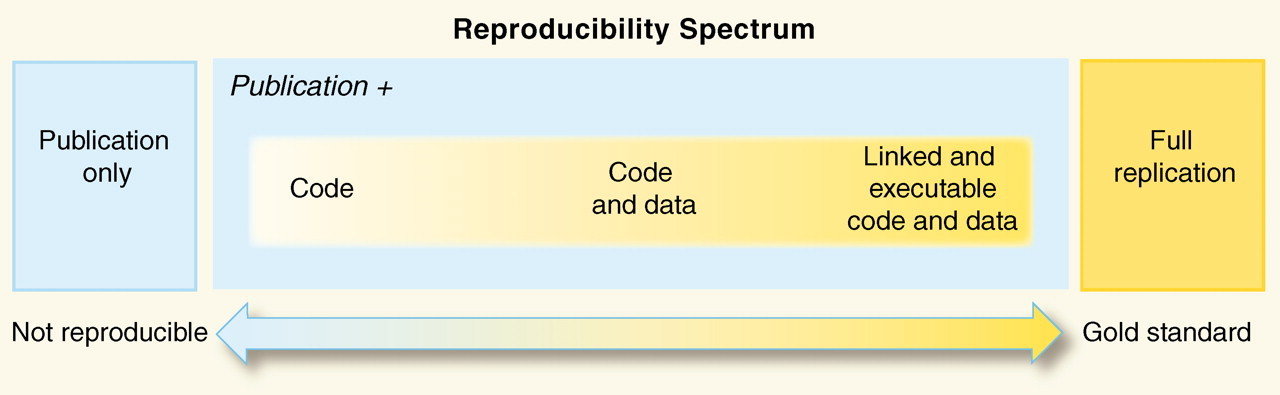
How reproducible is your current research?
View Reproducible Science Checklist
Thought Questions: Have a look at the reproducible science check list linked above and answer the following questions:
- Do you currently apply any of the items in the checklist to your research?
- Are there elements in the list that you are interested in incorporating into your workflow? If so, which ones?
Self-Check Quiz
Use this quick quiz to check your understanding of the learning objectives.
-
Which list matches the four facets from the NEON reproducible science slides?
A. Computation, Statistics, Visualization, Reporting B. Organization, Automation, Documentation, Dissemination C. Planning, Coding, Publishing, Archiving D. Collection, Cleaning, Modeling, Interpretation
-
Which practice is most aligned with the Organization facet?
A. Using informative file names and a clear directory structure B. Writing results directly over raw input data C. Keeping steps undocumented but fast D. Sharing only a figure in a slide deck
-
Why is scripting preferred over manual steps for many analyses?
A. It always requires less up-front time B. It makes methods harder for collaborators to inspect C. It supports efficient reruns and updates over time D. It removes the need for version control
-
Which audiences may need access to your research workflow?
A. Principal investigators B. Peer reviewers C. Collaborators, peer reviewers/editors, the scientific community, and the public D. Data managers
-
Which option best reflects the Dissemination facet?
A. Publishing ends the workflow; no further sharing is needed B. Share data snapshots and workflows in accessible platforms (for example, repositories and notebook-sharing tools) C. Keep data private unless requested by email D. Share code only if journal reviewers ask for it
Quiz Key
- B
- A
- C
- C
- B
Reflection Prompts
Use these prompts for discussion, journaling, or a short assignment.
- Which of the four facets is currently strongest in your workflow? Which is weakest?
- Identify one analysis step in your current project that is hard to rerun. What single change would make it easier to reproduce?
- If a collaborator joined your project tomorrow, what three artifacts (files, notes, metadata, or scripts) would help them reproduce your results fastest?
- What is one reproducibility practice you can adopt this week and one you can adopt this month?
- How might improved transparency change trust in your results for a policy, management, or stakeholder audience?
Additional Readings and Resources (optional)
Resources
- Nature magazine's special archive on the Challenges of Irreproducible Science.
- Open-access issue of Ecography focusing on reproducible ecology and software practices.
- Hampton, S. E., et al. (2015). Open science, reproducibility, and transparency in ecology. Ecological Applications.
- NASA Open Science (TOPS): Open Science at NASA.
- The Turing Way (living handbook): The Turing Way: A handbook for reproducible, ethical, and collaborative data science.
Hands-on tutorials and workshops
- NASA Open Science training catalog (includes Open Science 101 and Open Science Essentials): Open Science Training.
- Software Carpentry lesson (R): R for Reproducible Scientific Analysis.
- Reproducible Data Science in Python: Textbook on reproducible workflows in Python.