Behind the Scenes in Domain 05: The Great Lakes Domain
September 30, 2026
High-quality ecological data start with people: people who know the landscape, follow rigorous protocols, solve problems in the field, and build the relationships that make long-term research possible.
In NEON’s Great Lakes Domain (Domain 05), that work takes place across the forests, wetlands, and lakes of northern Wisconsin and Michigan’s Upper Peninsula. Field teams work through a compressed seasonal window, supported by site hosts that range from universities and government agencies to private landowners. Together, those people, places, and partnerships form the foundation for the ecological data, samples, and infrastructure that researchers access through NEON.
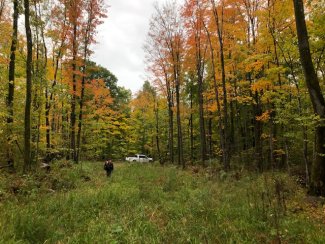
Fieldwork in fall at the Domain 05 Steigerwaldt-Chequamegon NEON (STEI) field site in the Chequamegon-Nicolet National Forest.
Ashley Spink, Field Operations Manager for Domain 05, knows the foundation for quality ecological data well. She joined NEON in Domain 05 in 2014 and spent nearly 11 years as a field ecologist before becoming Field Operations Manager in 2025. In her current role, she coordinates field teams and the daily operations to keep Domain 05 running smoothly. She also works closely with the site hosts and researchers to support access and use of NEON data, samples, and resources.
We spoke with Ashley about what NEON looks like in real time in Domain 05: the people doing the fieldwork, the places where data and sample collection happens, and the partnerships that strengthen the scientific value of the Observatory’s data and samples.
A Conversation with Ashley Spink
What makes the Great Lakes Domain a distinctive place to do field science?
Domain 05 is a really beautiful place to work, but I am a Midwesterner through and through, so I may be a little biased. Our field sites include forests, wooded wetlands, and lakes across northern Wisconsin and Michigan’s Upper Peninsula. It is green, lush, and biologically diverse, but it can also be a challenging environment for fieldwork.
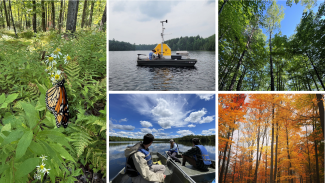
Domain 05 field sites. Clockwise from left: Monarch butterfly (Danaus plexippus) on an aster at Domain 05 Treehaven (TREE) field site. D05 staff work on the Aquatic Observation System buoy at Little Rock Lake NEON (LIRO) field site. The forest at Domain 05 University of Notre Dame Environmental Research Center NEON (UNDE) field site. Chequamegon-Nicolet National Forest in Autumn at the Domain 05 Steigerwaldt-Chequamegon NEON (STEI) field site. University of Notre Dame students learn about NEON aquatic sampling at Domain 05 Crampton Lake NEON (CRAM) field site.
One of our biggest challenges is the relatively short field season. Most of our fieldwork has to happen during the snow-free months, generally from April through October or early November. That means we have a lot of work to accomplish in a compressed period of time. Our teams are also working in wet, forested environments with plenty of insects, difficult terrain, and changing seasonal conditions.
Those same characteristics are part of what makes the Domain so interesting scientifically. We have three terrestrial sites and two aquatic sites, both of which are lakes, and the data that is collected spans a wide variety of organisms and ecological processes. The wooded wetlands can be especially challenging to sample, but, by collecting in these areas, NEON provides data in places researchers might not otherwise be able to study as consistently.
Who are the people behind the data collected in Domain 05, and how do they work together to keep the Domain running?
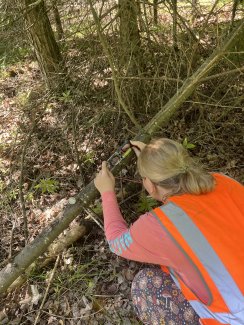
Domain 05 botanist Sierra Schaff-Sattler measures the angle of a leaning tree while collecting data for the Vegetation Structure dataset.
We have a really strong mix of experience in Domain 05. Several of our full-time staff have been with NEON for close to a decade or more, including two tower technicians who have reached the level of master technician and now support both the Domain and the NEON Science team. We also have staff focused on aquatic instrumentation and sampling, as well as terrestrial field ecologists working across plants, soils, small mammals, and invertebrates.
Alongside that experienced core, we bring in seasonal technicians and interns each year, and some return for multiple seasons. That continuity is incredibly valuable, especially when experienced staff can help newer team members build skills and confidence in the field.
What really stands out to me is how supportive the team is of one another. There is a strong culture of sharing knowledge, both within the Domain and throughout the Observatory, which helps new employees grow and stay focused on the quality of the data. That combination of experience, mentorship and attention to detail is what keeps the work moving year after year.
How does working in Domain 05 help early-career scientists build skills and find their place in ecology?
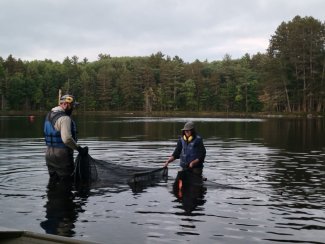
Aquatic ecologist Aaron Schoofs and technician Francesca Rossi set nets for fish sampling at the Domain 05 Little Rock Lake NEON (LIRO) field site.
A lot of our seasonal technicians are recent college graduates, so for many of them, NEON is one of their first field jobs. They get exposure to a wide range of ecological sampling methods, and, after completing extensive training, are afforded a high level of autonomy to complete protocol work in the field while maintaining rigorous safety standards. That helps them build both practical skills and confidence. We also try to be intentional about professional development, providing the training and tools for seasonal technicians to be successful in their career paths. Some former Domain 05 seasonal technicians have gone on to full-time roles within NEON, while others have continued into graduate school and even used NEON data in their research.
Our interns are part of that too. This year, one Domain 05 intern used NEON beetle data for a capstone project and presented her work through the Battelle internship program and at a University of Notre Dame research symposium. Those experiences help people see how fieldwork, data, and research connect, and that is an important part of developing the next generation of ecologists.
Seasonal Field Technician and Intern positions open in October and November. Stay informed by signing up for the NEON Newsletter or checking for open positions.
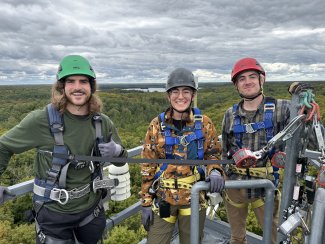
Domain 05 Temporary Field Technicians Jack Schafer, Anna Wood, and Brandon Schmit at the top of the tower at the University of Notre Dame Environmental Research Center NEON field site (UNDE).
NEON field sites are located on land managed by many different organizations and landowners. What role do these site hosts play in making the work possible in Domain 05?
Our site hosts are instrumental. NEON does not own the properties where field sites are located, so good communication and collaboration with those partners are essential to everything we do.
In Domain 05, we work with a broad range of site hosts, including the University of Notre Dame, the University of Wisconsin-Stevens Point, the Wisconsin Department of Natural Resources, the U.S. Forest Service, and a private landowner. Each relationship looks a little different. With our university partners, for example, there is often a lot of interaction around research and data use, while with other site hosts, interactions may focus more on access, permitting, or coordinating land-management activities.
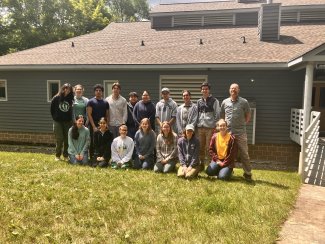
Students from the University of Notre Dame pose for a photo with NEON ecologist Caleb Slemmons after a week of instruction learning about NEON sampling and data.
A large part of my role is supporting the site host relationships. That can mean regular meetings, ensuring people are informed of our activities, or fostering opportunities to collaborate. Maintaining these on-the-ground connections helps us operate smoothly and keeps NEON integrated into the local community at the site.
How do relationships with site hosts and local researchers help connect NEON data to real-world research?
One of the most rewarding parts of our local relationships is finding ways NEON data can support research that is already happening in the area. Sometimes that starts with a simple conversation about what someone is studying and whether NEON has data that could help.
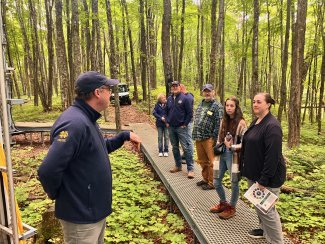
University of Notre Dame Environmental Research Center (UNDERC) Gillen Director, Nathan Swenson, speaks to visitors at the flux tower at the UNDE field site. Standing on the path, from left to right: Donna McClellan, Matt McClellan, Michael Cramer (UNDERC Assistant Director), Emma Woelkers, and Aubrey Moore.
Our university site hosts are especially collaborative because many of their faculty and students are doing research near a NEON field site. At the University of Notre Dame Environmental Research Center, for example, I meet regularly with staff, and those conversations often lead to opportunities to support one another’s work or connect researchers with NEON resources. For example, Assistant Director Michael Cramer conducts small mammal research on the property and uses NEON data alongside his own. Because our research overlaps geographically, we occasionally even capture animals tagged by the other team, which creates interesting connections between the datasets.
We see similar opportunities at Treehaven, the University of Wisconsin-Stevens Point field campus. Our relationship there recently connected us with a professor studying ticks who was not aware of the full breadth of NEON tick data available from the site. Those are the kinds of connections I really enjoy: learning what someone is working on and being able to say, “We have something that may help.”
What role does the Great Lakes User Group play in building a community around NEON data?
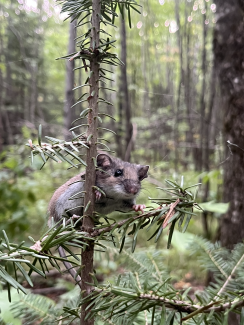
A white-footed deermouse (Peromyscus leucopus) on a balsam fir (Abies balsamea) in the Chequamegon National Forest at the Steigerwaldt-Chequamegon NEON (STEI) field site.
The NEON Great Lakes User Group—or GLUG—brings together researchers from universities, government agencies and other organizations with NEON Domain 05 staff who are interested in Great Lakes ecology and in how NEON data can support their work. This community group holds quarterly meetings to share updates and create space for researchers to exchange ideas and identify opportunities to collaborate.
One example is the group’s Warm Winter Project. After an unusually warm winter, members developed a research question around how those conditions affected different parts of the ecosystem, from plant phenology and small mammals to aquatic systems. They are combining NEON data with other datasets and are now working toward publishing their scientific findings.
That is really what NEON is designed to enable: bringing standardized data together with the expertise and questions of a broader research community so people can ask questions that cross disciplines and ecosystem components.
Interested in joining GLUG? Learn more here: NEON Great Lakes User Group.
When you look across the people, places, and partnerships that make Domain 05 thrive, what holds the system together?
A lot of it comes down to collaboration and a shared passion for ecology, data and research. The field teams, site hosts, and researchers all bring different expertise and different needs, but the connections between them are what make the system work.
That is what makes these relationships so valuable. We are not collecting data and samples for ourselves. We are collecting them so the public can use them, build on them, and ask questions we may not even have imagined when the data were first collected.
For our field teams, seeing that connection can be especially rewarding. It gives the work they do every day a direct connection to the larger purpose of NEON and to the science the data and samples ultimately enable.
Learn more about the 20 Domains and 81 field sites in NEON.