Spotlight
NEON Ambassador Spotlight: Alexi Besser
August 7, 2026
The NEON Ambassador Program empowers researchers and educators to expand awareness and use of NEON data, resources, and expertise across scientific and educational communities. Through training, mentorship and community-building activities, Ambassadors help more people engage with NEON data and advance open, continental-scale ecology.
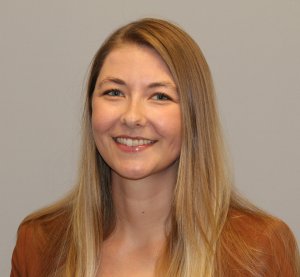
Meet Dr. Alexi Besser: Besser is a postdoctoral research scholar in the School of Earth and Space Exploration at Arizona State University. She uses field and lab-based approaches to study how energy and nutrients move through ecosystems. Her current work focuses on dryland ecosystems in the western U.S., where she studies connections among plant production, decomposition, microbial activity, and food web dynamics.
Her Ambassador Experience
Dr. Besser became a NEON Ambassador because she wanted to better understand the full range of NEON resources and become more involved in the NEON community. She had already worked at NEON field sites and with NEON data products through her postdoctoral research, but the Ambassador Program gave her something equally valuable: direct guidance from people who know NEON from the inside.
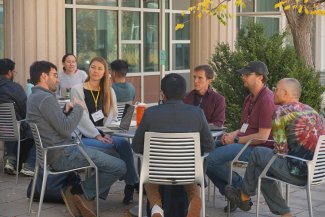
Alexi Besser listens to another participant during working group discussions at the 2025 NEON Convergence Summit.
The mentorship component became one of the most important parts of her Ambassador experience. Besser was paired with NEON mentor Dr. Samantha Weintraub-Leff, who helped her navigate NEON data, protocols, and project planning. For Besser, that kind of mentorship was especially valuable at her current career stage, as she transitions to becoming an independent researcher and defining the questions and methods that will shape her future work.
That guidance also helped Besser design her Ambassador capstone project for IsoCamp, a training program for stable isotope ecology. Working with Dr. Weintraub-Leff and staff from the NEON Biorepository (including Isabelle Betancourt, Dr. Kelsey Yule, Dr. Hojun Song, and Annette Contreras), Besser and her co-instructors introduced students to NEON, the NEON Biorepository, and the protocols behind the specimens they were analyzing. The project used archived beetle specimens from the Toolik Field Station NEON site, linking those samples with existing NEON data and newly generated stable isotope measurements. The project group included six participants, mostly first- and second-year graduate students, along with an assistant professor. Besser also led a broader one-hour workshop for approximately 20 to 30 IsoCamp participants on NEON, its stable isotope data products, and how to access and work with existing NEON stable isotope data.
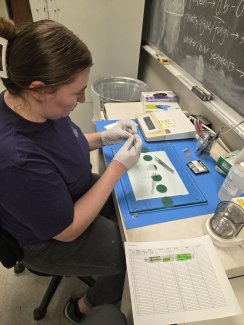
A student prepares beetle tissues for stable isotope analysis during IsoCamp. Photo courtesy of Alexi Besser.
For Besser, the capstone showed how mentorship can ripple outward. Support from her NEON mentor helped her create a hands-on learning experience for IsoCamp participants, while also sparking ideas for future research using NEON Biorepository samples and stable isotope data. The Ambassador Program did not just help her learn more about NEON; it helped her share that knowledge with other scientists who may use NEON resources in their own work.
“Mentorship is super valuable at this stage in my career because I am becoming an independent researcher. Having a NEON mentor and other scientists to look to when I have questions has helped me figure out what I’m interested in pursuing in the future and how I can carve out my own niche.”
— Dr. Alexi Besser
About Her Research: Following Energy Through Food Webs
What’s the question?
How can stable isotope analysis help researchers understand where organisms get their energy and how that energy moves through ecosystems?
The big picture:
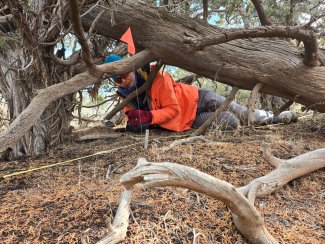
Alexi Besser collects data about dryland plant litter decomposition at the Moab NEON field site. Photo courtesy of Alexi Besser.
Plants produce the organic matter that supports ecosystems, but that energy does not move through one simple pathway. Some plant material is eaten directly, while much of it enters decomposition pathways involving microbes, like bacteria and fungi, and invertebrates. Stable isotopes give researchers a way to trace those pathways, helping them understand whether consumers are drawing energy from plant-based, fungal, or bacterial sources.
How she did it:
For her Ambassador capstone project, Besser and her co-instructors (Josh Cortez, Dr. Matt McCarthy, Mariah Schlis-Elias, and Dr. Seth Newsome) used preserved pooled beetle specimens from the NEON Biorepository to give students at IsoCamp a hands-on research experience in stable isotope ecology. The project focused on a predatory ground beetle collected at the Toolik Field Station NEON site in Alaska. During the first week, students prepared beetle tissues for bulk stable isotope analysis, which looks at the isotope values of a whole tissue or organism. During the second week, they helped prepare samples for a more advanced technique used to examine stable isotope values in individual amino acids.
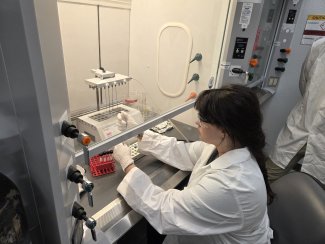
A student participating in IsoCamp prepares beetle tissues for stable isotope analysis. Photo courtesy of Alexi Besser.
In simple terms, stable isotopes are chemical clues preserved in an organism’s tissues. Carbon isotope values can help researchers trace the original sources of energy at the base of a food web, including whether that energy comes from different types of primary producers, such as grasses or trees. Nitrogen isotope values tend to increase as one organism eats another, making them useful for understanding where an organism sits in the food chain. The amino acid isotopic approach allowed them to look more closely at whether plant, fungal, or bacterial sources were contributing to the beetles’ nutrition.
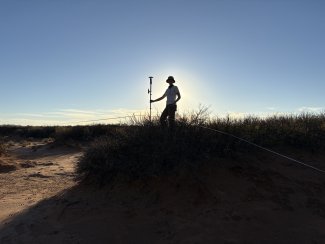
Alexi Besser collecting data for her research at the Jornada Experimental Range NEON field site. Photo courtesy of Alexi Besser.
Early results from the project suggested that fungal sources may be an important contributor to the beetles’ nutrition, raising new questions about how decomposition-driven energy pathways support Arctic food webs. Because the initial project used a small number of samples, Besser sees it as a starting point for future work rather than a final answer. With NEON’s long-term sampling, archived specimens, and associated environmental data, future studies could examine how these food web pathways vary across years, sites, and environmental conditions.
The project connects directly to Besser’s broader research on decomposition and nutrient cycling. In her current postdoctoral work with Dr. Heather Throop (Decomposition Across Drylands, or DeAD), she studies dryland plant litter decomposition across four NEON dryland sites, examining how plant material breaks down in different microsites and how that process influences carbon and nitrogen cycling. Together, the beetle and leaf litter projects reflect the same larger interest: understanding where plant-derived energy goes after plants grow, die, and decompose.
NEON Biorepository specimens used: