Spotlight
NEON Ambassador Spotlight: Dr. Max Glines
August 6, 2026
The NEON Ambassador Program empowers researchers and educators to expand awareness and use of NEON data, resources, and expertise across scientific and educational communities. Through training, mentorship, and community-building activities, Ambassadors help more people engage with NEON data and advance open, continental-scale science.
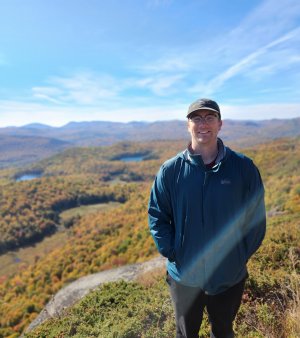
Meet Dr. Max Glines: Glines is a postdoctoral associate and data scientist at the Cary Institute of Ecosystem Studies. A limnologist by training, Glines studies lakes using large-scale datasets, remote sensing, high-frequency sensor data, and other tools to understand how lake ecosystems function and change across broad spatial and temporal scales.
His Ambassador Experience
Dr. Glines joined the NEON Ambassador Program with a specific community-building goal: to learn more about NEON aquatic data and help raise awareness of NEON resources within the Global Lake Ecological Observatory Network (GLEON), a grassroots network of lake researchers who share data and collaborate across sites.
For Glines, the 2025 NEON Convergence Summit was a highlight of the Ambassador experience. The Summit brought together NEON staff, Ambassadors, and interdisciplinary research teams to explore new ways to use NEON data, samples and infrastructure to advance continental-scale biology. There, he connected with other Ambassadors, NEON scientists, and researchers from different disciplines and career stages.
At the Summit, Glines joined a working group focused on linkages between aquatic and terrestrial ecosystems. The group is exploring how terrestrial processes influence streams and lakes, and how aquatic systems connect back to surrounding landscapes. For Glines, the interdisciplinary mix was especially valuable: the group brought together terrestrial ecologists, aquatic ecologists, remote sensing experts, large-scale data analysts and field-based researchers who approached related questions from different perspectives.
“Meeting new people and getting to talk with them about how they think about things is always the most fun part of science. You learn from other people about how they think about things, and how you might help each other’s research.”
— Dr. Max Glines
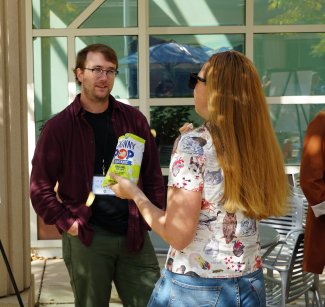
Dr. Max Glines conversing with other participants at the NEON Convergence Summit, October 2025.
About His Research: Understanding Flux Data Across Observatory Networks
What’s the question?
How can standardized, open ecological data help researchers understand patterns in lake ecosystems across many different lake types and landscapes?
The big picture:
Many lake studies are built on deep knowledge of one lake or a small number of well-studied systems. That local expertise is essential, but it can be difficult to know whether the same patterns apply to lakes with different physical, biological or watershed conditions. Large-scale, open datasets help researchers compare many lakes at once and look for broader patterns in how lake ecosystems function.
How he did it:
Glines used NEON lake data in a published study on water clarity across 35 lakes, including seven NEON lake sites. The study used high-frequency sensor data to examine how much light enters lakes and how water clarity patterns vary across systems. NEON data were valuable because they added a wider range of lake types to the study. Many long-term lake datasets come from large, clear or heavily studied lakes. The NEON lake sites, by contrast, are diverse and distinct from one another, making them useful for comparisons across different ecological conditions.
Glines’ Convergence Summit working group is also exploring aquatic-terrestrial linkages using NEON data. The group has derived an index known as specific ultraviolet absorbance from NEON aquatic measurements. This index can help researchers understand sources of dissolved organic matter in aquatic systems, including whether material likely comes from the surrounding watershed or is produced within the aquatic system itself. The group is working to publish the index as a data product for the broader research community.
NEON data products used:
- Photosynthetically Active Radiation at Water Surface (DP1.20042.001)
- Photosynthetically Active Radiation Below Water Surface (DP1.20261.001)
- Water Quality (DP1.20288.001)
Read more: