Research Highlight
Data in Action: Is There More to Autumn Leaf Changes Than the Weather?
November 12, 2026
What’s the question
How does the balance of nutrients in forest canopies influence the timing of autumn leaf senescence, and can nutrient data help scientists better predict when trees lose their greenness in the fall?
The big picture
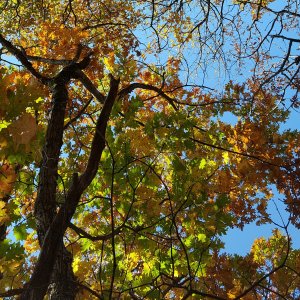
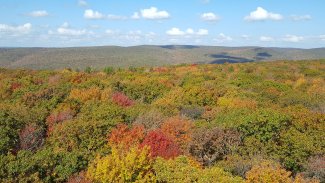
Autumn leaf senescence marks the end of the growing season, with important implications for forest productivity and carbon cycling. Temperature, daylight, and precipitation all play a role in determining when leaves begin to lose their green color, but these factors don't explain all the variation among forests. New research suggests that the balance of nutrients within forest canopies could be an important missing piece of the puzzle.
Read the study: Canopy Nutrient Balance Predicts Autumn Senescence Across U.S. Forests
NEON data products used
- Airborne imaging spectroscopy (surface directional reflectance, DP1.30006.001)
- Airborne lidar point cloud data (DP1.30003.001)
- Elevation data (DP3.30024.001)
"Previously, studies of nutrient balance and phenology were limited to a few species or individual sites. NEON's open-access data allow us to examine these relationships across forest ecosystems at a continental scale." – Dr. Tong Qiu, Duke University

Hanshi Chen (left) and Dr. Tong Qiu (right).
Researcher(s)
Hanshi Chen and Dr. Tong Qiu, Duke University. Dr. Philip Townsend and Dr. Kyle Kovach, University of Wisconsin-Madison.
What they did and what they learned:
Led by Hanshi Chen, a PhD candidate at Duke University, the research team used data from 25 NEON field sites to investigate how nutrient balance relates to the timing of autumn leaf senescence across diverse U.S. forests.
Using hyperspectral imagery from NEON's Airborne Observation Platform (AOP) and previously developed models, the researchers created maps estimating nitrogen, phosphorus, and potassium concentrations across large forested areas. By combining these nutrient maps with satellite-derived observations of seasonal vegetation changes and other environmental data, they examined relationships between nutrient balance and senescence, accounting for climate, species composition, and canopy structure.
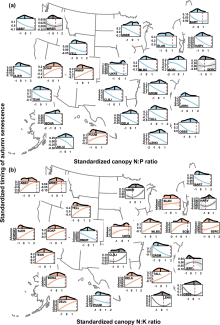
The results revealed a striking pattern: At 20 of the 25 sites, higher nitrogen-to-phosphorus ratios were associated with earlier autumn senescence. Higher nitrogen-to-potassium ratios, meanwhile, were generally associated with later senescence. At the remaining sites, the nitrogen-to-phosphorus relationship was reversed, weak, or more complex, potentially reflecting local conditions such as high elevation or volcanic soils.
The researchers also investigated whether nutrient balance might influence senescence indirectly through its relationship with forest productivity. Here, the findings were more complicated. Adding nutrient data improved the explanatory power of models at 22 of the 25 sites, suggesting that nutrient balance explains some of the variation in senescence timing that climate variables alone do not.
"The relationship between nutrient balance and forest productivity wasn't the same everywhere. At some sites, higher nitrogen-to-phosphorus ratios were associated with lower productivity, while at others we found the opposite," Chen explained.
These findings may help scientists understand how forests respond to environmental change. Earlier autumn senescence could shorten the period when trees actively photosynthesize and take up carbon, affecting forest carbon budgets. The research also suggests new questions about how shifts in forest phenology may affect wildlife and other ecological relationships.
Because agriculture and industry are altering nutrient availability, adding nutrient balance into ecological models could improve predictions of growing-season length and carbon cycling. With further research, the findings may also inform forest management and, potentially, fertilization practices in agriculture.