Spotlight
NEON Ambassador Spotlight: Dr. Yujie Liu
August 1, 2026

The NEON Ambassador Program empowers researchers and educators to expand awareness and use of NEON data, resources, and expertise across scientific and educational communities. Through training, mentorship, and community-building activities, Ambassadors help more people engage with NEON data and advance open, continental-scale ecology.
Meet Dr. Yujie Liu: Liu studies carbon cycling in terrestrial ecosystems, with a focus on how large-scale ecological datasets can help scientists better understand ecosystem change. As a postdoctoral researcher at Northern Arizona University, she is working on an NSF-funded project evaluating the continuity of NEON and AmeriFlux data streams.
Her Ambassador Experience
Dr. Liu joined the second cohort of NEON Ambassadors after beginning her research projects on NEON-AmeriFlux continuity. She saw the program as an opportunity to deepen her NEON data skills, learn best practices for using NEON data, and build leadership experience as an early-career scientist.
Through the Ambassador Program, Liu participated in monthly data trainings and connected directly with NEON data scientists when questions came up in her own research. Those interactions helped her navigate NEON’s many data types and formats, from flux data to spatial data, and other resources outside her primary area of focus.
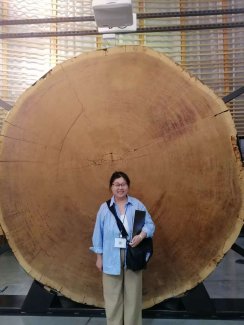
NEON Ambassador Dr. Yujie Liu
The cohort experience also broadened her view of how NEON data can be used across disciplines. Other Ambassadors work in areas very different from her own, including aquatic ecology, remote sensing, and microbial ecology. Those connections helped Liu learn more about the range of resources NEON provides and how researchers can work together across disciplines to ask questions that help us understand our complex ecosystems.
For her Ambassador Capstone project, Liu led a breakout session at the 2025 AmeriFlux Annual Meeting titled “Gap-Filling Flux Data Made Easy with Machine Learning.” With support from her NEON mentor and colleagues, she developed the session from proposal to presentation, gaining experience organizing a scientific training activity and translating complex data science methods for a broad audience.
“The Ambassador Program helped me build my data skills and gave me a new leadership experience: organizing a short course and thinking about how to explain complex concepts in simple language.”
— Dr. Yujie Liu
About Her Research: Understanding Flux Data Across Observatory Networks
What’s the question?
How well do NEON and AmeriFlux eddy covariance measurements agree, and what can those comparisons tell scientists about interpreting gas exchange between ecosystems and the atmosphere?
The big picture:
Flux measurements help scientists understand how gases, water, and energy move between ecosystems and the atmosphere. These exchanges are important for studying long-term ecosystem functions and responses to environmental change. NEON data collection across all sites began in 2019, whereas some AmeriFlux sites have records that extend further back in time. Integrating newer NEON datasets with the records from AmeriFlux offers a promising opportunity to better understand dynamics over longer timescales.
How she did it:
Liu compared eddy covariance data from NEON and AmeriFlux, including carbon, water, and energy fluxes. Liu concludes that, for most paired sites, the patterns of interannual variation differ between NEON and AmeriFlux towers, suggesting that a single tower may not adequately represent broader ecosystem dynamics. The results highlight the need for caution when merging long-term flux data from different measurement platforms, or when using data from a single measurement platform to inform decision-making.
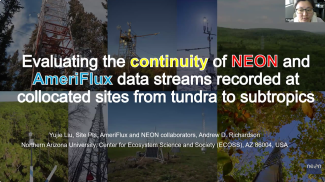
Dr. Yujie Liu presents "Evaluating the continuity of NEON and AmeriFlux data streams recorded at collocated sites from tundra to tropics" during the September 9, 2025 NEON Science Seminar.
A key part of the work is gap-filling. Gaps in eddy covariance measurements occur when data do not meet quality standards or when environmental conditions prevent valid observations. Traditional gap-filling methods can be limited for long gaps, so Liu uses machine learning approaches that learn from high-frequency, long-term flux records to predict missing values. This helps produce more complete datasets for analyzing gas and energy exchange.
Learn more: What is eddy covariance?
NEON data products used:
- Bundled data products - eddy covariance (DP4.00200.001)
- Phenology images (DP1.00033.001)
- Ecosystem structure (DP3.30015.001)
- LAI - spectrometer – mosaic (DP3.30012.001)
Read more:
- Watch Dr. Liu present during the NEON Science Seminar series
- A tale of two towers: Comparing NEON and AmeriFlux data streams at Bartlett Experimental Forest
- Robust filling of extra-long gaps in eddy covariance CO2 flux measurements from a temperate deciduous forest using eXtreme Gradient Boosting
- Poster: Evaluating the continuity of NEON and AmeriFlux data streams recorded at collocated sites from tundra to subtropics
- AmeriFlux and the NEON Program Join Forces for Eddy Covariance Data