Spotlight
Meet the 2026-2028 NEON Ambassador Cohort
October 1, 2026
The NEON Ambassador Program empowers and connects a cohort of early-career researchers and educators eager to augment NEON’s engagement with a breadth of scientific communities of practice. Each cohort is designed as two years of programming to help Ambassadors use NEON data and resources to increase participation of the scientific community, accelerate scientific or technological discovery, translate knowledge into innovative applications and effective public policy, and enhance educational and workforce development opportunities. The 2026-2028 cohort is the third cohort of the program.
Meet the 2026-2028 NEON Ambassador cohort:
Israel Borokini
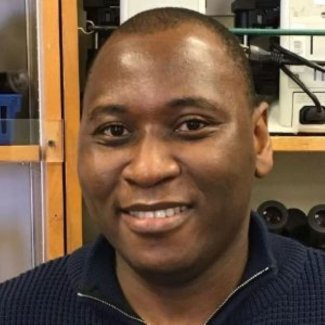
Montana State University - Assistant Professor, Biodiversity scientist
Israel Borokini is an assistant professor in the Department of Ecology at the Montana State University, Bozeman. Previously, Borokini completed his PhD in Ecology, Evolution and Conservation Biology at the University of Nevada, Reno. His dissertation led to the discovery of nine new locations of a rare and federally threatened plant in the Great Basin Desert, investigated predictions of isolation by distance and by landscape barriers using the population genetic diversity of Ivesia webberi, and resulted in five research publications. Borokini then completed a two-year Smith Conservation Postdoctoral Fellowship at the University of California, Berkeley, where he expanded his analytical skills integrating geospatial and phylogenetic data to investigate distribution and diversification patterns of plants at multiple temporal and spatial scales. Borokini’s contributions to the research community have continued to grow since beginning his professorship in 2023. Borokini has developed research in Africa and North America, investigating macroecological and evolutionary patterns of plant distributions, understanding drivers of biological invasion, and modeling responses of plants and vegetative communities to environmental changes.
Alyson East
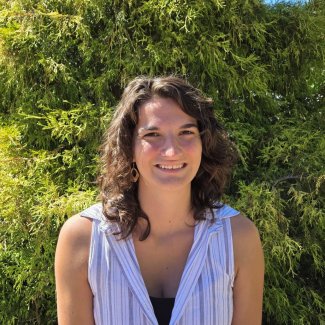
University of Maine - PhD candidate, Quantitative Ecologist
Alyson East is a PhD candidate in Quantitative Ecology at the University of Maine. Her research intersects artificial intelligence, macroecology, and biodiversity informatics, spanning functional traits, landscape ecology, ecological structure, and scale. East co-developed a continental-scale ground beetle dataset drawn from NEON specimens, a subset of which became a benchmark for the NSF Harnessing the Data Revolution Machine Learning Challenge. She further supported this effort by co-organizing the FuncaPalooza hackathon to bring ecologists and computer scientists together to investigate novel computer vision methods for extracting functional traits from images. During East’s research, she has developed high-resolution images with validated morphological trait measurements, used NEON AOP data for training and validation of landscape scaling forest structural assessments, and co-authored the Terrestrial Ecosystems chapter of The Nature Record. East was also awarded the Best NEON Presentation award at the 2026 Ecological Society of America (ESA) Annual Meeting for her talk on AI-enabled macroecology using NEON ground beetles. Beyond research, East provides programming and mentoring for early-career ecologists, previously serving as Chair of ESA's Early Career Ecologists Section.
Yiting Fan

University of Virginia - Postdoctoral Research Associate, Quantitative Forest Ecologist
Yiting Fan is a Postdoctoral Research Associate and quantitative forest ecologist in the Department of Environmental Sciences at the University of Virginia. Fan received a PhD in Geography from West Virginia University and now uses lidar, airborne remote sensing, and field observations to study forest canopy structure, plant functional traits, phenology, and ecosystem responses across spatial and temporal scales. Fan has used NEON data and infrastructure to investigate broadleaf deciduous forests across the eastern United States, including research that connects individual-tree traits and seasonal dynamics with landscape-scale patterns. She also works on developing reproducible geospatial and data-analysis workflows for integrating multi-sensor ecological datasets. In addition to research, Fan brings experience in teaching, conducting collaborative field campaigns, mentoring undergraduate researchers, and communicating interdisciplinary science to both technical and broader audiences.
Isadora Fluck Essig
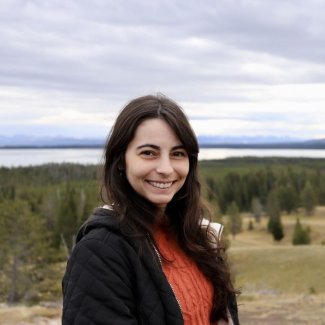
University of Wisconsin–Madison - Postdoctoral Research Associate, Biodiversity Ecologist
Isadora Fluck Essig is a postdoctoral research associate at the University of Wisconsin-Madison. Isadora studies how biodiversity is organized across biological levels and environmental gradients, from variation among individuals to the taxonomic, functional, and phylogenetic structure of communities. To investigate broad ecological questions about the structure of biodiversity and develop the methods needed to answer them, she combines ecological datasets (e.g., long-term ecological monitoring, museum collections, and image-based biodiversity resources) with quantitative approaches. Underlying her work is a commitment to open science, with an emphasis on reproducibility, transparency, and openly available computational tools that enable others to build upon and extend her work. Her research has evolved from studying species turnover in Amazonia to investigating population-level trait variation and community functional structure across North America during her PhD at the University of Florida. In her current postdoctoral position, Isadora is integrating NEON data products to examine how multiple trophic levels are jointly structured across environmental gradients.
Rohit Jha

Louisiana State University - PhD candidate, Plant Ecologist
Rohit Jha is a PhD candidate in the Department of Biological Sciences at Louisiana State University, researching how plants respond to environmental change, with particular emphasis on flowering phenology, biological invasions, urbanization, and environmental sensitivity. Jha completed his master’s degree in Wildlife Biology and Conservation in 2021 and then worked on biodiversity conservation and disaster management in Nepal before beginning his PhD. His PhD research involves integrating large biodiversity datasets including community-science observations, herbarium records, species-distribution data, and atmospheric data with spatial and hierarchical statistical models. Jha has coordinated the annotation of more than one million iNaturalist observations and conducted analyses across local, national, and global scales as part of the research. Through his experience with collaborative working groups, teaching, and interdisciplinary research, Jha seeks to make quantitative ecological resources more accessible to researchers, students, and practitioners.
Kelly Loria

Desert Research Institute - Postdoctoral Researcher, Aquatic Ecosystem Ecologist
Kelly Loria is a postdoctoral researcher in the Division of Hydrologic Sciences at the Desert Research Institute. Loria earned her PhD in Natural Resources and Environmental Science from the University of Nevada, Reno as an NSF Graduate Research Fellow. Her research has examined stream and lake ecosystem metabolism, nutrient cycling, and long-term hydroclimate changes in mountain lakes. Her current work involves leading a Desert Research Institute-funded project that uses machine learning to predict wildfire impacts on stream water quality across the western United States and collaborating on post-fire concentration-discharge dynamics. Loria is interested in developing accessible, reproducible approaches for using long-term ecological data to understand ecosystem change and currently teaches and mentors undergraduate and graduate students.
Gabriela Shirkey
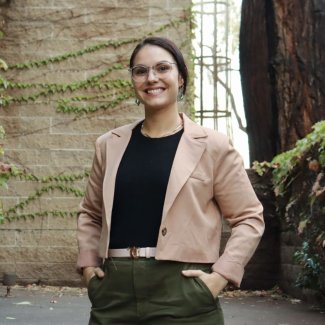
Chapman University - Postdoctoral Fellow, Geographer and Global Change Biologist
Gabriela Shirkey is Grand Challenges Postdoctoral Fellow at Chapman University. She is currently the PI of a NASA grant that introduces undergraduate researchers to hyperspectral-thermal remote sensing through coursework and NASA Jet Propulsion Laboratory internships—serving applications for monitoring coastal/marine and terrestrial ecosystem health and biodiversity. Shirkey leads curriculum development for Chapman University's Grand Challenges Initiative where she mentors undergraduate STEM majors in designing and leading interdisciplinary research projects. Shirkey is also the Co-PI on a NASA Biodiversity and Ecological Conservation grant to model plant taxonomic diversity relationships to satellite observations of structure, function, and composition over more than 30 NEON sites. Shirkey completed her PhD at Michigan State University, where she was awarded an NSF Graduate Research Fellowship to integrate ecosystem atmospheric carbon processes with spatial life cycle assessments of land management. She has been actively involved with AmeriFlux and FLUXNET, organizing workshops on behalf of their Early Career Network.
Mariah Schlis-Elias
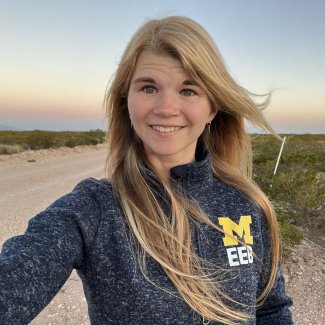
University of Michigan - PhD candidate, Rackham Merit Fellow, Food web ecologist and mammalogist
Mariah Schlis-Elias is a PhD candidate and Rackham Merit Fellow in the Department of Ecology and Evolutionary Biology at the University of Michigan, where she studies food web ecology and mammalogy. Using stable isotopes to assess the flow of energy and nutrients at multiple biological scales, Schlis-Elias applies classic ecological theory to understand the interactions and relationships between agriculture, food web structure, and wildlife foraging. Her current research looks at small mammals in row-crop agroecosystems to learn about the fundamental drivers of wildlife resource use and provide novel insights into crop damage and ecosystem services that may inform agricultural management or policy decisions. Before beginning her doctoral studies, Schlis-Elias earned her M.S. in Biology from Austin Peay State University where she studied biogeographic patterns in mammalian morphology. Schlis-Elias brings her experience in stable isotope analysis to the classroom through outreach activities with students at the University of New Mexico and supports student engagement at the science-policy interface as the current Chair of the Student Science Policy Award Committee for the American Society of Mammalogists.
Christa Torrens
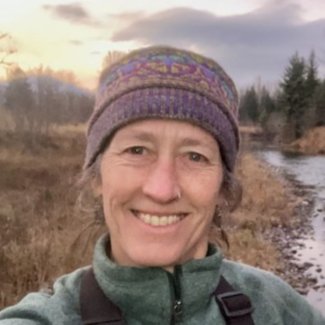
University of Montana - Researcher, Quantitative Aquatic Ecologist
Christa Torrens is a quantitative aquatic ecosystem ecologist specializing in statistical and process-based modeling of nutrient and carbon fluxes through watersheds. As a postdoctoral researcher at the Flathead Lake Biological Station, she used NEON aquatic data to develop a Bayesian process model to estimate total and autotrophic nitrate uptake in six high-light streams. Torrens’s expertise also includes integrating machine learning, GIS, and remote sensing into ecosystem models. She has co-developed and presented a workshop on sparse modeling methods, developed ecological-modeling focused manuscripts through collaborative writing and coding, and has contributed to recommended guidance on documenting and distributing data products derived from NEON data. Torrens completed her PhD in Environmental Studies/Hydrologic Sciences at the University of Colorado Boulder, where she studied biogeochemical dynamics and disturbance ecology in Antarctic streams. She currently serves as modeling lead for the Aquatic Nitrogen Fixation Research Coordination Network, building multilevel Bayesian models to identify drivers of nitrogen fixation across habitats.