NSF NEON, Operated by Battelle

Main navigation

  • About Us
    • Overview
      • Spatial and Temporal Design
      • History
    • Vision and Management
    • FAQ
    • Contact Us
      • Contact NEON Biorepository
      • Field Offices
    • User Accounts
    • Staff
    • Code of Conduct

    About Us

  • Data & Samples
    • Data Portal
      • Explore Data Products
      • Data Availability Charts
      • Spatial Data & Maps
      • Document Library
      • API & GraphQL
      • Prototype Data
      • External Lab Data Ingest (restricted)
    • Data Themes
      • Atmosphere
      • Biogeochemistry
      • Ecohydrology
      • Land Cover and Processes
      • Organisms, Populations, and Communities
    • Samples & Specimens
      • Discover and Use NEON Samples
        • Sample Types
        • Sample Repositories
        • Sample Explorer
        • Megapit and Distributed Initial Characterization Soil Archives
      • Sample Processing
      • Sample Quality
      • Taxonomic Lists
    • Collection Methods
      • Protocols & Standardized Methods
      • Airborne Remote Sensing
        • Flight Box Design
        • Flight Schedules and Coverage
        • Daily Flight Reports
          • AOP Flight Report Sign Up
        • Camera
        • Imaging Spectrometer
        • Lidar
      • Automated Instruments
        • Site Level Sampling Design
        • Sensor Collection Frequency
        • Instrumented Collection Types
          • Meteorology
          • Phenocams
          • Soil Sensors
          • Ground Water
          • Surface Water
      • Observational Sampling
        • Site Level Sampling Design
        • Sampling Schedules
        • Observation Types
          • Aquatic Organisms
            • Aquatic Microbes
            • Fish
            • Macroinvertebrates & Zooplankton
            • Periphyton, Phytoplankton, and Aquatic Plants
          • Terrestrial Organisms
            • Birds
            • Ground Beetles
            • Mosquitoes
            • Small Mammals
            • Soil Microbes
            • Terrestrial Plants
            • Ticks
          • Hydrology & Geomorphology
            • Discharge
            • Geomorphology
          • Biogeochemistry
          • DNA Sequences
          • Pathogens
          • Sediments
          • Soils
            • Soil Descriptions
        • Optimizing the Observational Sampling Designs
    • Data Notifications
    • Data Guidelines and Policies
      • Acknowledging and Citing NEON
      • Publishing Research Outputs
      • Usage Policies
    • Data Management
      • Data Availability
      • Data Formats and Conventions
      • Data Processing
      • Data Quality
      • Data Product Bundles
      • Data Product Revisions and Releases
        • Release 2021
        • Release 2022
        • Release 2023
        • Release 2024
        • Release-2025
      • NEON and Google
      • Externally Hosted Data

    Data & Samples

  • Field Sites
    • About Field Sites and Domains
    • Explore Field Sites
    • Site Management Data Product

    Field Sites

  • Impact
    • Observatory Blog
    • Case Studies
    • Papers & Publications
    • Newsroom
      • NEON in the News
      • Newsletter Archive
      • Newsletter Sign Up

    Impact

  • Resources
    • Getting Started with NEON Data & Resources
    • Documents and Communication Resources
      • Papers & Publications
      • Document Library
      • Outreach Materials
    • Code Hub
      • Code Resources Guidelines
      • Code Resources Submission
      • NEON's GitHub Organization Homepage
    • Learning Hub
      • Science Videos
      • Tutorials
      • Workshops & Courses
      • Teaching Modules
    • Research Support Services
      • Field Site Coordination
      • Letters of Support
      • Mobile Deployment Platforms
      • Permits and Permissions
      • AOP Flight Campaigns
      • Research Support FAQs
      • Research Support Projects
    • Funding Opportunities

    Resources

  • Get Involved
    • Advisory Groups
      • Science, Technology & Education Advisory Committee (STEAC)
      • Innovation Advisory Committee (IAC)
      • Technical Working Groups (TWG)
    • Upcoming Events
    • NEON Ambassador Program
      • Exploring NEON-Derived Data Products Workshop Series
    • Research and Collaborations
      • Environmental Data Science Innovation and Inclusion Lab
      • Collaboration with DOE BER User Facilities and Programs
      • EFI-NEON Ecological Forecasting Challenge
      • NEON Great Lakes User Group
      • NEON Science Summit
      • NCAR-NEON-Community Collaborations
        • NCAR-NEON Community Steering Committee
    • Community Engagement
      • How Community Feedback Impacts NEON Operations
    • Science Seminars and Data Skills Webinars
      • Past Years
    • Work Opportunities
      • Careers
      • Seasonal Fieldwork
      • Internships
        • Intern Alumni
    • Partners

    Get Involved

  • My Account
  • Search

Search

Breadcrumb

  1. NEON Website and Biorepository Sample Portal Updates

NEON Website and Biorepository Sample Portal Updates

At NEON, we’re always looking for ways to improve the community’s experience across all aspects of the Observatory. Over the past several months, we have conducted a comprehensive review of our website, including gathering user feedback through a series of focus groups. The result is an updated site that includes:

  • Streamlined navigation: A simplified main menu for quicker access to the information you need.
  • Integrated Biorepository portal: The Biorepository data portal is now part of the main NEON site and navigation, with a consistent look and feel.
  • Improved user experience: Content has been reorganized and consolidated to make browsing more intuitive and seamless.

These enhancements will make it easier to explore NEON data, samples and resources in one place. Below is a summary of some key updates.

Updated Main Navigation

  • Split current "Data & Samples" into separate sections “Data” and “Samples & Specimens”
  • Reordered “Resources” and “Impact"
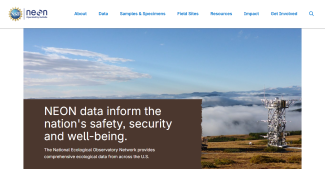
Updated Main Navigation January 2026

Updated Main Navigation

Updated "About" Menu (formerly "About Us")

  • “Observatory Blog” now lives here (formerly under “Impact”)
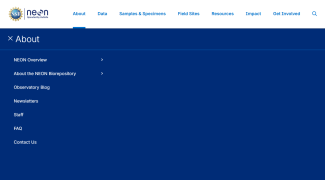
  • Added new section “About the NEON Biorepository”
  • “Newsletters” now lives here (formerly under “Impact”)
About Menu Update January 2026

Updated About Menu


Updated "Data" Menu (Formerly "Data & Samples")

  • Consolidated Data menu for simplified access
  • Consolidated pages under Data
  • Elevated “Getting Started with NEON Data” to this menu
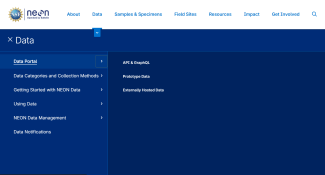
Updated Data Menu January 2026

Updated Data Menu


NEW "Samples & Specimens" Menu

  • Direct link to the newly integrated “Biorepository Sample Portal at ASU”
  • A new set of pages related to the Biorepository
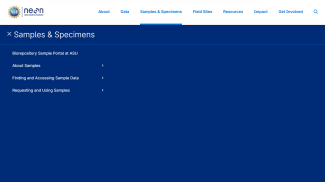
New Samples and Specimens Menu January 2026

NEW Samples & Specimens Menu


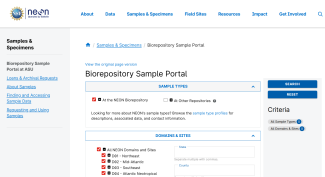
NEW Biorepository Sample Portal

  • Seamless integration of the Biorepository Sample Portal at ASU into the NEON website
  • Upgraded underlying Symbiota Code, including major security improvements, schema changes and bug fixes
  • Simplified “Search” with images and map-based discovery
  • Improved user experience
NEW Biorepository Portal January 2026

NEW Integrated Biorepository Sample Portal at ASU


NEW "Sample Types Browser"

  • Includes redesigned profiles, linked data products/protocols and direct access to browse/search
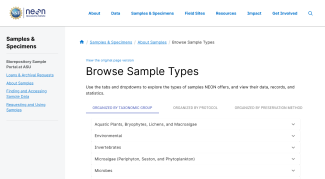
New Biorepository Browse Sample Types Page January 2026

NEW Biorepository Browse Sample Types Page

We are always looking to improve the user experience of the site; after this transition ends please continue to feel free to send ideas for improvement using the Contact Us page.


NSF NEON, Operated by Battelle

Follow Us:

Join Our Newsletter

Get updates on events, opportunities, and how NEON is being used today.

Subscribe Now

Footer

  • About Us
  • Newsroom
  • Contact Us
  • Terms & Conditions
  • Careers
  • Code of Conduct

Copyright © Battelle, 2026

The National Ecological Observatory Network is a major facility fully funded by the U.S. National Science Foundation.

Any opinions, findings and conclusions or recommendations expressed in this material do not necessarily reflect the views of the U.S. National Science Foundation.