
Ordway-Swisher Biological Station NEON (OSBS) Soil Descriptions
Distributed Soils Reports
Pedon Descriptions
Pit‐level observations and field measurements reported using the standard NRCS format. They contain volume estimates for coarse fragments > 20 mm where applicable.
Site Level Plot Summary
A narrative summary that places the sampled soil pedons in the broader context of soils and geomorphology for the entire NEON site.
Megapit Images
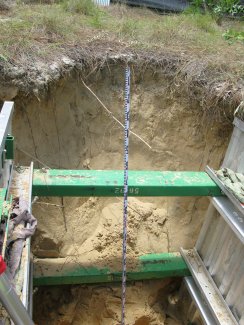
D03 OSBS megapit soil profile 0-200 cm
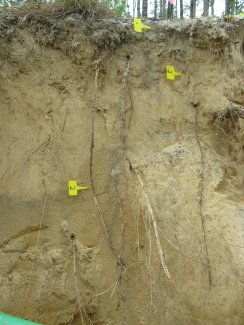
D03 OSBS megapit A, Bw1, and Bw2 soil horizons
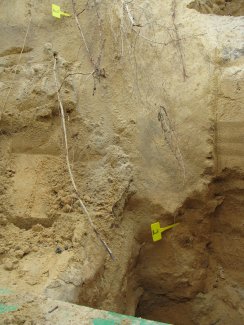
D03 OSBS megapit Bw2 and Bw3 soil horizons
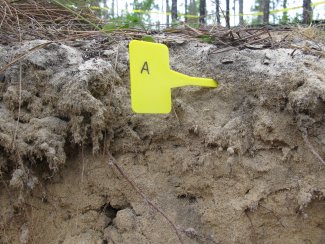
D03 OSBS megapit A soil horizon
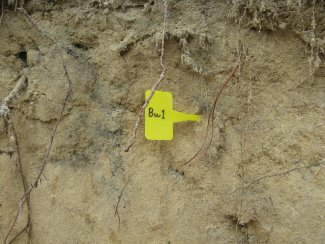
D03 OSBS megapit Bw horizon
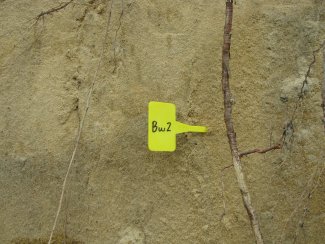
D03 OSBS megapit Bw2 soil horizon
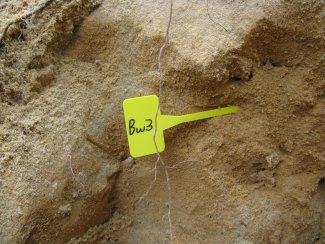
D03 OBSB megapit Bw3 soil horizon
Megapit Pedon Description
| Print Date | May 10 2016 |
|---|---|
| Description Date | Jun 19 2012 |
| Site ID | S2012FL107001 |
| Pedon ID | S2012FL107001 |
| Lab Source ID | KSSL |
| Lab Pedon # | 12N7948 |
| Soil Name as Described/Sampled | Astatula |
| Classification | Hyperthermic, uncoated Typic Quartzipsamments |
| Taxon Kind | series |
| Geomorphic Setting | None Assigned |
| Description origin | NASIS |
| County | Putnam |
| Std Latitude | 29.6882139 |
| Std Longitude | -81.9934250 |
| Latitude | 29 degrees 41 minutes 17.57 seconds north |
| Longitude | 81 degrees 59 minutes 36.33 seconds west |
| Description database | KSSL |
| Horizon Details |
A--0 to 7 centimeters (0.0 to 2.8 inches); dark grayish brown (10YR 4/2) sand; weak granular structure; very friable; few medium roots and few fine roots; few charcoal particles; clear smooth boundary. Lab sample # 12N02700 Bw1--7 to 28 centimeters (2.8 to 11.0 inches); brown (10YR 5/3) sand; single grain; loose; few medium roots and few fine roots; few charcoal particles; clear smooth boundary. Lab sample # 12N02701 Bw2--28 to 125 centimeters (11.0 to 49.2 inches); brownish yellow (10YR 6/6) sand; single grain; loose; few medium roots; few charcoal particles; gradual smooth boundary. Lab sample # 12N02702 Bw3--125 to 200 centimeters (49.2 to 78.7 inches); reddish yellow (7.5YR 6/8) sand; single grain; loose; few charcoal particles. Lab sample # 12N02703. Assessed by use of auger from the bottom of the pit: well expressed redoximorphic features (concentrations and depletions) at 340 cm; slight pick-up in clay at 354 cm |
Credits: We thank Willie Harris (University of Florida) for the megapit soil pedon description at OSBS.