
Macroinvertebrates & Zooplankton
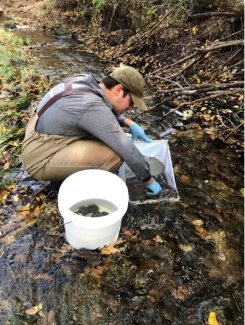
Collecting macroinvertebrates using a Surber sampler at the Domain 11 PRIN field site (Photo by Kaitlan Jones).
Macroinvertebrates are important indicators of change, and taxa are strongly affected by abiotic factors such as disturbance, shifts in nutrient concentrations, pollutants, temperature, and pH; by environmental factors such as scouring, freezing, flooding, drought; and by biological factors such as vegetation structure and predation (Allan 1995, Wetzel 2001). Such sensitivity to environmental conditions makes benthic invertebrates ideal for use in environmental monitoring programs.
For example, members of the Ephemeroptera (mayflies), Plecoptera (stoneflies), and Trichoptera (caddisflies) are often thought to be the most sensitive taxa and, when present in the aquatic habitat, can be indicators of good to excellent water quality. However, other taxa such as members of the family Chironomidae (midges, non-biting flies) and oligochaetes are ubiquitous and highly tolerant and can be indicators of poorer water quality.
NEON’s macroinvertebrate and zooplankton sampling is designed to collect long-term data from across the United States that are compatible with existing national-scale datasets and long-term ecological studies. Sampling stream, river, and lake macroinvertebrate and zooplankton communities over the span of the NEON program will help data users determine changes in presence and absence of taxa, taxonomic diversity and richness, community structure, and species gain or loss through morphological taxonomy (identification using a microscope) and DNA metabarcoding (community barcoding analysis).
Sampling Design and Methods
Temporal and Spatial Sampling Design
Macroinvertebrate morphological taxonomy samples are collected at eight locations per site on a given sampling day. With 3 sampling bouts per year, each site will have 24 morphological taxonomy samples collected per year. Zooplankton samples are collected at 3 locations near sensor infrastructure 3 times per year. Three additional samples for metabarcoding are collected for macroinvertebrates and zooplankton during each sampling bout.
Sample Collection
NEON collects macroinvertebrate data at all NEON aquatic sites, and zooplankton at lake sites. The goal of aquatic invertebrate sampling is to determine taxonomic diversity, the number of species present (richness), biomass, and to enable metabarcoding analysis for benthic invertebrates at each aquatic sampling site. These variables, especially diversity and biomass, can be tracked over time to detect changes in species loss, changes in community structure and function, as well as the introduction and the spread of invasive taxa (presence/absence).
Macroinvertebrates

Field ecologists collect zooplankton from the water column at the Domain 18 TOOK field site (Photo by Josh Monroe)
NEON’s macroinvertebrate samples are collected using a percent-based macrohabitat approach, with samples collected in the two most dominant habitat types at each site. Field protocols and samplers differ depending on the habitat and substrate being sampled. All samples are collected from the stream, river, or lake bottom in each habitat using standard quantitative and semi-quantitative sampling methods. Samples are preserved in the field to reduce predation and sent to the morphological taxonomy lab and/or the metabarcoding lab.
Macroinvertebrate DNA metabarcode samples are collected at the same time and location as morphological taxonomy samples so taxonomic data from both data products may be correlated by data users. Midsummer samples are processed by the sequencing lab, while samples collected in spring and fall are preserved in bulk and sent to the Biorepository.
Zooplankton
Zooplankton are collected from the water column of lakes near NEON sensor infrastructure. The type of sampler used depends on the depth of water at the sampling location. Multiple tows or traps are collected at each location and composited into a single sample. Zooplankton sampling is quantitative and based on the volume of water collected during sampling. Samples are preserved in the field to reduce predation and sent to the morphological taxonomy lab and/or the metabarcoding lab.
Zooplankton metabarcode samples are collected at the same time and location as morphological taxonomy samples so taxonomic data from both data products may be correlated by data users. Midsummer samples are processed by the sequencing lab, while samples collected in spring and fall are preserved in bulk and sent to the Biorepository.
Data Products
The aquatic macroinvertebrate collection and zooplankton collection data products include information on subsampling and quality control, taxonomic identification, abundance, and morphometrics. The DNA metabarcoding data products provide DNA sequence data, processed bioinformatics data, and metadata for macroinvertebrate and zooplankton communities from NEON aquatic sites. These data can be used to assess the health of aquatic ecosystems.
- Macroinvertebrate collection (DP1.20120.001)
- Macroinvertebrate metabarcoding (DP1.20126.001)
- Zooplankton collection (DP1.20219.001)
- Zooplankton metabarcoding (DP1.20221.001)
Archival Samples
Archival samples of macroinvertebrates, zooplankton, and DNA extracts from both are available from the NEON Biorepository.
| Types of Samples | Storage Condition | Storage Container | Quantity Archived (Annually) † | Link to the Collection |
|---|---|---|---|---|
| DNA extracts from macroinvertebrates | -196°C | 2 mL cryovials | 90 to 110 samples |
Benthic Macroinvertebrate Collection (DNA Extracts) (NEON-BMIC-DNA) |
| Macroinvertebrate, sorted; oligochaetes, chironomids | 70 to 95% ethanol | 500 mL jar or smaller | 1750 to 2125 samples |
|
| Macroinvertebrate, unsorted whole samples | 70 to 95% ethanol | 500 mL jar or smaller | 180 to 220 samples |
Benthic Macroinvertebrate Collection (Unsorted Bulk Sample) (NEON-BMIC-UB) |
| Macroinvertebrate, slides | dry | slides | 800 to 1500 slides |
Benthic Macroinvertebrate Collection (Microscope Slides) (NEON-BMIC-MS) |
| Zooplankton samples, unsorted material derived from samples collected for taxonomy (all bouts) | 70% or 95% ethanol | 500 mL jar or smaller | 50 to 75 samples | Zooplankton Collection (Remaining Bulk Taxonomy Sample) (NEON-ZOOC-RB) |
| DNA extracts from zooplankton (bout 2) | -196°C | 2 mL cryovials | 21 samples | Zooplankton Collection (DNA Extracts) (NEON-ZOOC-DNA) |
| Zooplankton samples, unprocessed (bouts 1 and 3) | 70% or 95% ethanol | 500 mL jar or smaller | 42 samples | Zooplankton Collection (Unsorted Bulk Sample) (NEON-ZOOC-UB) |
† Quantities represented in this table are annual quantities expected from sampling conducted throughout the observatory during full Operations. Actual quantities may differ from these projections
‡ Quantities are number of samples (not number of well plates); up to 96 samples are contained on the same well plate