
History
A Telescope Trained on Earth
The National Ecological Observatory Network (NEON) was conceived in the late 20th century as an instrument to advance the ability of scientists to examine and understand the interactions between life and the environment at the scale of an entire continent. Since then, technology and research tools have rapidly evolved to support science at a scale that hardly anyone imagined a generation ago.
Hundreds of scientists and engineers have contributed their expertise to plan, design, and operate a grand instrument that can harness the power of networked technology to gather and provide high-quality information on interactions between land, life, water, and climate across a continent and over the course of a human generation. The insights gleaned from NEON data and tools can inform decisions at the national and community levels that will impact natural resource management and human well-being for generations to come.
The First Big Ecology Project
The NEON program is the first life science project to be constructed solely with U.S. National Science Foundation (NSF) Major Research Equipment and Facilities Construction (MREFC) funding. This type of funding is reserved for national or international projects such as space telescopes and particle accelerators that advance the boundaries of science and engineering and generate data and resources to support the work of hundreds or thousands of researchers over several decades.
A Brief History
The NEON program could not have become a reality without contributions from many dedicated scientists to conceptualize and design the Observatory. As early as 1999, ecologists and biologists were meeting to discuss a need for a Biodiversity Observation Network (BON). By 2000, the idea had developed into a more comprehensive "ecological observatory network" that would address continental-scale questions. Ideas for NEON officially began to gel in 2000 with a series of workshops that continued until 2005. An initial plan for NEON was completed in 2006.
Over the next five years the NEON design, plan, and budget were formally reviewed and revised multiple times until NSF, the National Science Board, and Congress approved funds to build NEON in 2011.
After NSF awarded the management of the NEON program to Battelle in 2016, construction of the Observatory was completed in early 2019. The completed Observatory includes 81 field sites and an airborne observation platform as well as the information infrastructure needed to gather data and metadata from sensors and field sampling, ensure data quality, process the information into data products, and deliver those products to users via an online portal. Subsequently, NEON entered its operations phase in the summer of 2019.
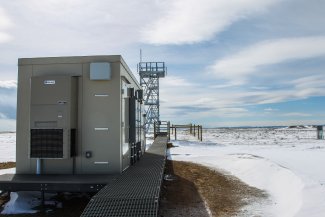
First day of field deployment at the CPER field site.