
Request Megapit and Initial Characterization Soil
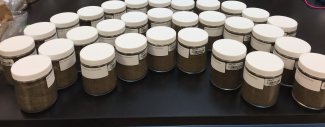
Terrestrial soil samples
Permit Requirements
All requesters must have a Permit to Receive Soil (PPQ 525), or equivalent permit, from the USDA Animal and Plant Health Inspection Service (USDA-APHIS), or from an equivalent international service. Find information about the permit at the APHIS website. Samples will not be shipped to facilities that do not have an active permit.
Considerations for Approval
In order to balance preservation and sample use, request only the minimum amount of soil needed for your study. Any amount of material may be requested; however, requests for smaller quantities of soil per sample (e.g., <20 g/Megapit sample or <10 g/ICS sample) are more likely to be approved. Requests for larger quantities may be approved if justified, the aim of the study passes the merit review, and sufficient material is available in the archive to support future requests. Do not request spare or extra soil. A minimum quantity of "forever sample" (10 g) will be reserved in the ICS archive for each sample for long-term keeping and potential re-analysis. All requests undergo a review process to evaluate the intellectual merit, quantity justification, and data management plan. Requests are evaluated to ensure that:
- A legitimate research project is the basis for the request, including agency and award information if applicable;
- The use of NEON soil samples is important to achieve the study goals;
- The quantity is justified. Staff also review whether a sample was previously used for the same purpose; and
- A specific data management plan describing how the data generated from the request will be made publicly available in a format suitable for reuse by others (e.g., see FAIR data principles). If possible, include links to publicly available data that you have previously generated to demonstrate a commitment to open science.
In addition, the evaluation will consider the impact of fulfilling the request on the samples’ projected exhaustion date, specifically whether they will be exhausted prior to NEON’s expected 2049 end date (megapit requests) or the ICS project end date (ICS requests), in order to maintain the ability to support future requests. This is achieved by extrapolating the sample consumption rate after fulfilling the proposed request into the future to determine the projected sample mass at the end date (Ayres et al. 2019). Given that some samples have a faster consumption rate than others and some samples had a lower original mass than others, NEON may approve a request for some samples but not others included in the request. Staff will typically reject requests for a specific sample in cases where fulfilling the request would result in that sample being exhausted prior to the end date. In this case, a requester may provide a justification explaining why that sample is essential to their project and the decision will be reevaluated.
In the event that a request is rejected or partially rejected, a requester may ask for a second evaluation by an external panel if they deem it necessary.
Request review procedure and timeline
The approval of requests for ≤20 g soil/Megapit sample is determined internally by NEON staff, while the approval of requests for ≤4 g (organic horizons) or ≤15 g (mineral soils)/ICS samples is determined internally by NEON and UMBS-SAFE staff. A recommendation is sought from an external group of experts prior to determining an approval decision for requests above these thresholds. A first decision, which may be requesting additional information, is typically achieved within 1 week for requests reviewed internally and within 2 weeks for requests reviewed externally.
Tips to avoid delays in the review of your request include:
- Provide all requested information
- Justify the quantity of soil requested for each analysis (include relevant citations where appropriate)
- Avoid requests for soil analyses to be run in duplicate or triplicate, or if absolutely necessary, provide a suitable justification (include relevant citations where appropriate)
Request fulfillment
To maximize the representativeness of the subsample, requests for ≤1 g/megapit sample are fulfilled with finely ground soil generated with a ball mill, whereas larger requests are fulfilled with soil sieved through 2 mm mesh (mineral horizons) or hand sorted (organic horizons), unless otherwise requested.
Megapit soil samples are typically shipped within 2 months of request approval as long as permitting delays are not encountered. ICS samples are typically shipped within 1-4 months of request approval, depending on the number of samples requested, and provided permitting delays are not encountered.
In order to maintain the quality of the archived soils, returning subsamples to the archive after nondestructive analyses is not permitted due to the reduction in quality assurance that can be provided for material that has changed hands, as well as to protect the archives from external contaminants (e.g., isotopic tracers or biological contaminants). As a result, every subsampling event results in the permanent loss of soil from the archive.
Acknowledgement and Citation Policy
See NEON Data Policies and Citation Guidelines for details.
Suggested Megapit Archive acknowledgement: "The National Ecological Observatory Network is a program sponsored by the National Science Foundation and operated under cooperative agreement by Battelle Memorial Institute. This material is based in part upon work supported by the National Science Foundation through the NEON Program, including samples provided by the NEON Megapit Soil Archive."
Suggested ICS Archive acknowledgement: "The National Ecological Observatory Network is a program sponsored by the National Science Foundation and operated under cooperative agreement by Battelle Memorial Institute. This material is based in part upon work supported by the National Science Foundation through the NEON Program, including samples from the NEON Initial Characterization Soil Archive, a joint project of NEON and the University of Michigan Biological Station, as supported by the National Science Foundation (DBI-1624205) and Battelle Memorial Institute (US001-0000757206)."
The following documents, available through the NEON document library, describe procedures related to the Megapit Soil Archive samples and can be cited as necessary:
- Megapit Soil Archive field sampling and collection methods: Ayres E, Zulueta R (2013) TIS Soil Pit Sampling Protocol. NEON.DOC.001307;
- Megapit Soil Archive sample processing: Ayres E and Loescher HW (2012) NEON Field and Lab Procedure and Protocol: TIS Soil Archiving. NEON.DOC.000325; and
- Megapit Soil Archive requestor subsample processing: Ayres E (2013) NEON Procedure and Protocol: Producing TIS Soil Archive Subsamples for Users. NEON.DOC.001306.
The following documents, available through the NEON document library in the External Lab Protocols > NRCS Initial Soil Characterization folder, describe procedures related to the Initial Soil Characterization sampling effort and can be cited as necessary:
- Browning, D. and L. Stanish. 2017. Guidelines for the NEON Soil Characterization Effort.
- Schoeneberger, P.J., D.A. Wysocki, E.C. Benham, and Soil Survey Staff. 2012. Field book for describing and sampling soils, Version 3.0. Natural Resources Conservation Service, National Soil Survey Center, Lincoln, NE.
Additionally, the following paper outlines key guidelines and procedures that will be used in administering the soil archives:
- Ayres, E. 2019. Quantitative guidelines for establishing and operating soil archives. Soil Science Society of America Journal 83:973-981. doi: 10.2136/sssaj2019.02.0050
Previous Megapit Soil Archive Requests
Wondering how others are using NEON soil samples? Here is a list of previous requests. We encourage you to collaborate with these researchers if you have similar interests!
Focus area: Humic and fulvic acids
Sites requested: All
Horizons requested: All
Years samples provided: 2013-2016
Requestor: Geoff Davies, Northeastern University
Project products:
- Ghabbour et al. 2015 Measuring the total and sequestered organic matter contents of grassland and forest soil profiles in the National Ecological Observatory Network Initiative. Soil Horizons 56, doi: 10.2136/sh15-07-0014
- Davies & Ghabbour 2015 Measuring Sequestered Carbon Contents of Grassland and Forest Soil Profiles in the Neon Initiative, National Cooperative Soil Survey National Conference, Duluth, MN
Focus area: Bulk 14C content
Sites requested: All
Horizons requested: All
Years samples provided: 2015-2018
Requestor: Carlos Sierra, Max Planck Institute for Biogeochemistry
Project Products:
- Beem-Miller, J., & Sierra, C. A. (2023). NEON Soil Radiocarbon Data [Data set]. Zenodo. https://doi.org/10.5281/zenodo.10126878
Focus area: Bulk 15N, 13C, oxalate and dithionite extractable Fe, Al, Si and oxalate and dithionite extractable Fe, Al, Si on the silt and clay fraction
Sites requested: All
Horizons requested: All
Years samples provided: 2014-2018
Requestor: Marc Kramer, University of Florida
Project products:
- Kramer & Chadwick 2018 Climate-driven thresholds in reactive mineral retention of soil carbon at the global scale. Nature Clim Change 8, 1104–1108. https://doi.org/10.1038/s41558-018-0341-4
Focus area: Oxygen isotope systematics during nitrification
Sites requested: HARV, OSBS, ORNL, TALL, CPER, JORN
Horizons requested: A (shallowest subhorizon)
Years samples provided: 2015
Requestor: Greg Michalski, Purdue University
Focus area: FTIR, mineral-associated OM, metal extractions
Sites requested: HARV, BLAN, SCBI, OSBS, JERC, DSNY, DELA, UNDE, KONZ, UKFS, DCFS, WOOD, NOGP, CPER, STER, RMNP, OAES, NIWO, JORN, ONAQ
Horizons requested: All mineral
Years samples provided: 2016-2018
Requestor: Jonathan Sanderman, Woods Hole Research Center
Project products
- Dangal & Sanderman 2020 Is Standardization Necessary for Sharing of a Large Mid-Infrared Soil Spectral Library? Sensors 20, 6729. https://doi.org/10.3390/s20236729
- Dangal & Sanderman 2019 Application of Piecewise Direct Standardization for Precise and Accurate Prediction of Soil Properties and Carbon Fractions Using Spectra from Multiple Spectrometers, ASA-CSSA-SSSA International Annual Meeting, San Antonio, TX; https://scisoc.confex.com/scisoc/2019am/meetingapp.cgi/Paper/121702
Focus area: Composition of soil C based on new solid state spectroscopic methods
Sites requested: All
Horizons requested: O and A (all subhorizons)
Years samples provided: 2017
Requestor: Margaret Bowman, University of Colorado
Focus area: Biogeography of Streptomyces
Sites requested: All
Horizons requested: A (shallowest subhorizon)
Years samples provided: 2018
Requestor: Steven Higgins, Cornell University
Focus area: The role of soil and iron-organic matter complexes as controls on redox chemistry driving NO2(g)-to-HONO conversion across a gradient of soil
Sites requested: HARV, SCBI, OSBS, GUAN, UNDE, KONZ, TALL, WOOD, CLBJ, NIWO, SRER, ONAQ
Horizons requested: A (shallowest subhorizon)
Years samples provided: 2018
Requestor: Rebecca Abney, Indiana University, Bloomington
Project products:
- Abney et al. 2018 Soil organic matter and mineralogy as controls on NO2 deposition and HONO emissions from soil surfaces, AGU Fall Meeting, Washington, D.C. https://agu.confex.com/agu/fm18/meetingapp.cgi/Paper/369558
Focus area: Carbon content of different soil fractions
Sites requested: All
Horizons requested: All
Years samples provided: 2019
Requestor: Jocelyn Lavallee, Colorado State University
Project products:
- Hansen, P., Even, R., King, A., Lavallee, J., Schipanski, M., & Cotrufo, M. F. (2024). Distinct, direct and climate-mediated environmental controls on global particulate and mineral-associated organic carbon storage. Global Change Biology, 30, e17080.
- Hansen, P., Even, R., King, A., Lavallee, J., Schipanski, M., & Cotrufo, M. F. (2023). Particulate and mineral-associated organic carbon storage [Data set]. Zenodo. https://doi.org/10.5281/zenodo.10182813
- Data for all Megapit horizons are available through the SCSC Consortium
- Zhang et al. 2021 Simulating measurable ecosystem carbon and nitrogen dynamics with the mechanistically defined MEMS 2.0 model, Biogeosciences, 18, 3147–3171. https://doi.org/10.5194/bg-18-3147-2021
Focus area: 13C nuclear magnetic resonance (CPMAS NMR) spectroscopic analyses to assess controls on soil organic matter chemical composition
Sites requested: HARV, SCBI, DSNY, OSBS, GUAN, UNDE, KONZ, GRSM, LENO, WOOD, CPER, NIWO, SRER, ONAQ, BART, JERC, DCFS, CLBJ, MOAB, JORN, RMNP, LAJA, UKFS, MLBS, ORNL, TALL, ABBY, WREF, SJER, SOAP, TEAK, TOOL, BONA, HEAL
Horizons requested: A (shallowest subhorizon)
Years samples provided: 2018
Requestor: Steven Hall, Iowa State University
Project Products:
- Hall et al. 2020 Molecular trade-offs in soil organic carbon composition at continental scale. Nat. Geosci. 13, 687–692. https://doi.org/10.1038/s41561-020-0634-x
- Hall et al. 2019 Soil Organic Matter Molecular Composition Reveals Tradeoffs in Mechanisms of C Persistence Among Ecosystems in the NEON Network, AGU Fall Meeting, San Francisco, CA. https://agu.confex.com/agu/fm19/meetingapp.cgi/Paper/513289
Focus area: Quantitative guidelines for establishing and operating soil archives
Sites requested: NA (no samples required)
Horizons requested: NA (no samples required)
Years samples provided: NA
Requestor: Edward Ayres, NEON
Project products:
- Ayres 2019 Quantitative Guidelines for Establishing and Operating Soil Archives. Soil Science Society of America Journal 83, 973-981. https://doi.org/10.2136/sssaj2019.02.0050
Focus area: Effects of climate, soil properties and vegetation on chemical forms of manganese, phosphorus, sulfur and dissolved organic matter in soils; and Interrogating the Composition and Formation of Mineral-stabilized Organic Matter in Soils across an Ecoclimatic Gradient
Sites requested: All
Horizons requested: All
Years samples provided: 2020
Requestor: Mengqiang Zhu, University of Wyoming
Focus area: The provenance and chemical characteristics of dust deposition from the Colorado Plateau to the Central Plains
Sites requested: CPER, NIWO, MOAB
Horizons requested: All
Years samples provided: 2022
Requestor: Jessica Callen, Colorado State University
Focus area: Generating lab-derived soil moisture release curves from the NEON-SRER Megapit archive to translate soil water content into soil water potential
Sites requested: SRER
Horizons requested: All
Years samples provided: 2023
Requestor: Jessica Guo, University of Arizona
Focus area: Petrogenic (rock-derived) organic carbon content
Sites requested: ABBY, BART, BLAN, CPER, DCFS, DELA, GRSM, JORN, KONA, KONZ, LENO, MLBS, MOAB, NIWO, NOGP, OAES, ONAQ, SERC, SOAP, SRER, STEI, STER, TALL, TREE, WOOD, WREF
Horizons requested: A, B, C, E
Years samples provided: 2023
Requestor: Katerina Georgiou, Lawrence Livermore National Laboratory
Focus area: Compare soil organic and inorganic carbon amounts and characterize SOM bulk molecular quality and SIC isotopic compositions in dryland ecosystems
Sites requested: CLBJ, CPER, GUAN, JORN, MOAB, NIWO, ONAQ, RMNP, SJER
Horizons requested: A, E, B, C
Years samples provided: 2024
Requestor: Meredith Johnson, Baylor University
Focus area: The significance of soil organic matter, specifically the molecular composition of soil OC, in influencing the environmental behavior of PFAS
Sites requested: ABBY, DCFS, GUAN, HARV, HEAL, KONZ, LENO, NIWO, RMNP, SCBI, SOAP, UKFS, UNDE, WREF, CLBJ, LAJA, MLBS, ORNL, JORN
Horizons requested: A (selected subhorizons)
Years samples provided: 2024
Requestor: Manyiel Mel, Baylor University
Request Form
To complete this request form, you must include:
- Your full name and affiliation
- A copy of your USDA-APHIS permit to receive soil or equivalent permit
- The archive you are requesting from (Megapit Archive or ICS Archive). Submit separate requests if requesting from both archives.
- A project description, including:
- Project objectives and background information;
- A list of each analysis you will perform, description of how the analysis relates to the project objective, the quantity of soil required for each analysis, and a justification for the quantity used in each analysis;
- A list of samples and the mass requested;
- A detailed data management plan describing how data generated from the request will be made publicly available in a format suitable for reuse by others (e.g., see FAIR data principles). If possible, include links to publicly available data that you have previously generated to demonstrate a commitment to open science.
- Agreement to the consent agreement (see below)
If you have questions, please email the Soil Archive Team (Megapit) or NEON and UMBS-SAFE staff (ICS).
Fields followed by an asterisk (*) are required.